


In short ⚡
CELL (Container Equipment Location List) is a structured inventory document tracking the precise location and status of shipping containers within terminals, depots, or vessels. This digital manifest enables real-time visibility of container movements, optimizing space allocation and reducing dwell times in international freight operations.
Introduction
Container tracking failures cost the global shipping industry over $6 billion annually in lost productivity and demurrage charges. The inability to locate specific containers within massive terminal yards creates bottlenecks that ripple through entire supply chains.
The Container Equipment Location List addresses this challenge by providing standardized location intelligence. In modern port operations where terminals handle 10,000+ containers daily, CELL systems form the backbone of efficient container management.
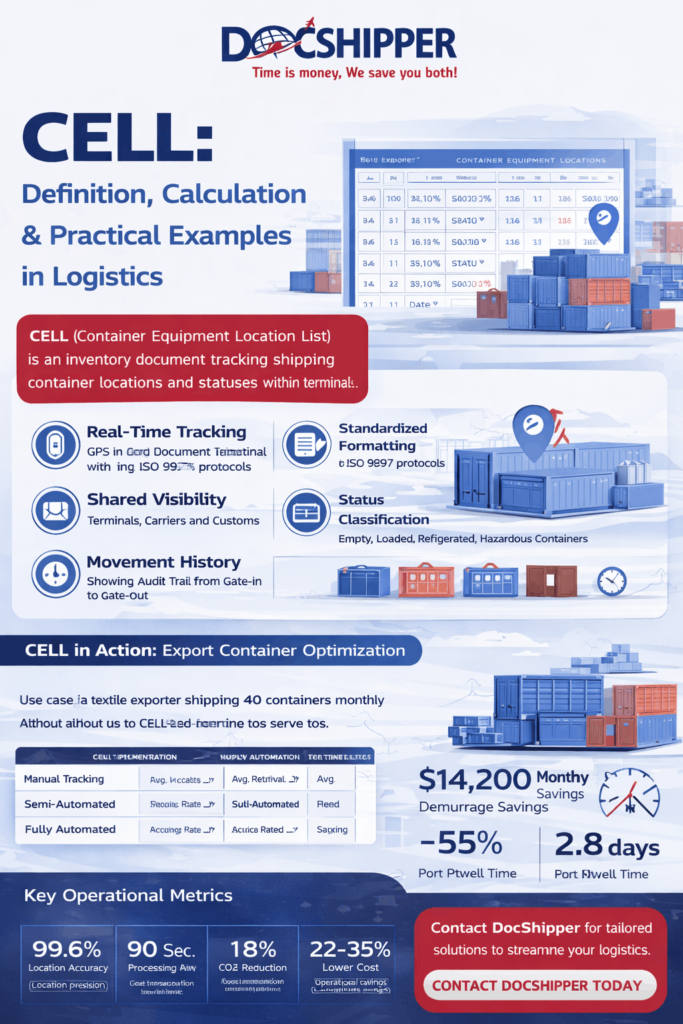
Key characteristics of CELL systems include:
- Real-time positioning: GPS and RFID integration for continuous container tracking
- Standardized formatting: Compliance with ISO 9897 container identification protocols
- Multi-stakeholder access: Shared visibility between carriers, terminals, and customs authorities
- Status classification: Differentiation between empty, loaded, refrigerated, and hazardous containers
- Movement history: Complete audit trail from gate-in to gate-out operations
CELL Mechanisms & Technical Expertise
The CELL framework operates through integrated terminal operating systems (TOS) that capture container data at critical touchpoints. When a container enters a facility, optical character recognition (OCR) scanners automatically record the container number, size, type, and condition. This information populates the CELL database with precise bay-row-tier coordinates.
Location coding systems follow international standards, typically using alphanumeric grids. A position marked as “B12-04-03” indicates Bay 12, Row 04, Tier 03. This granular positioning enables automated crane operations and reduces manual search times from hours to minutes.
The status classification hierarchy within CELL systems categorizes containers by operational state. Categories include “available for loading,” “awaiting customs release,” “scheduled for repair,” or “ready for export.” This stratification allows terminals to prioritize container movements based on vessel departure schedules and customer requirements.
Integration with EDI messaging ensures CELL data synchronizes with COPARN (Container Announcement) and COPRAR (Container Discharge/Loading Report) transmissions. According to UN/CEFACT standards, these automated exchanges eliminate data discrepancies between shipping lines and terminal operators.
Regulatory compliance features embedded in CELL systems flag containers requiring inspections. Hazmat containers (IMO classes 1-9) receive automatic alerts when positioned near incompatible cargo. Customs-hold containers cannot be released without proper clearance codes entered into the CELL system.
At DocShipper, we leverage CELL data to provide clients with predictive arrival windows and proactive exception management, reducing port dwell times by an average of 18% compared to industry benchmarks.
Practical Examples & Operational Data
Understanding CELL applications through real-world scenarios demonstrates its operational impact across different logistics contexts.
Comparative Terminal Performance
| Terminal Type | CELL Implementation | Avg. Container Retrieval Time | Accuracy Rate |
|---|---|---|---|
| Manual Tracking | Paper-based logs | 45-90 minutes | 78% |
| Semi-Automated | Basic CELL + GPS | 12-18 minutes | 94% |
| Fully Automated | Advanced CELL + AI | 3-5 minutes | 99.6% |
Use Case: Export Container Optimization
Scenario: A textile exporter ships 40 containers monthly from Shanghai to Rotterdam. Without CELL integration, their average port dwell time was 6.2 days due to container misplacements and inefficient yard planning.
Implementation: After adopting a CELL-enabled terminal service, the system automatically reserved optimal positions near the vessel berth 48 hours before arrival. Real-time status updates triggered customs pre-clearance procedures.
Results: Dwell time reduced to 2.8 days (55% improvement). Demurrage charges decreased by $14,200 per month. Container repositioning moves dropped from 2.3 to 0.4 per container.
Key Operational Metrics
- Location accuracy: Advanced CELL systems achieve 99.6% precision in container positioning
- Processing speed: Automated gate transactions complete in 90 seconds versus 8 minutes manually
- Cost reduction: CELL adoption reduces operational costs by 22-35% through optimized yard utilization
- Environmental impact: Reduced unnecessary container movements cut terminal CO₂ emissions by 18%
- Scalability: Cloud-based CELL platforms handle 50,000+ container records without performance degradation
Conclusion
The Container Equipment Location List represents critical infrastructure in modern port operations, transforming container management from reactive searching to proactive orchestration. As global trade volumes continue expanding, CELL systems provide the scalability and precision necessary for efficient supply chain execution.
Need expert guidance on optimizing your container tracking processes? Contact DocShipper for tailored logistics solutions that leverage advanced CELL integration.
📚 Quiz
Test Your Knowledge: CELL (Container Equipment Location List)
Q1 — What does CELL stand for in international logistics?
Q2 — A logistics manager assumes that a CELL system works just like a traditional yard management system, simply tracking overall inventory levels at a terminal. Is this correct?
Q3 — A textile exporter shipping 40 containers monthly from Shanghai to Rotterdam wants to reduce port dwell time and demurrage charges. Which approach correctly leverages CELL capabilities?
🎯 Your Result
📞 Free Quote in 24hFAQ | CELL: Definition, Calculation & Practical Examples in Logistics
A CELL system records container number, size/type, current location coordinates, status (empty/loaded), condition, weight, cargo classification, arrival/departure timestamps, and associated booking references. Advanced systems include temperature data for reefers and seal verification records.
Traditional systems track general inventory levels, while CELL provides individual container-level positioning with real-time updates. CELL integrates with automated handling equipment and customs platforms, enabling dynamic slot allocation and predictive planning unavailable in legacy systems.
Yes, modern CELL platforms use role-based access controls allowing shipping lines, terminal operators, customs authorities, and beneficial cargo owners to view relevant data simultaneously. Blockchain-enabled versions provide immutable audit trails while maintaining stakeholder privacy.
Discrepancies trigger automatic alerts for manual verification. Advanced systems use IoT sensors and computer vision to reconcile differences. Persistent conflicts initiate physical audits, with findings used to retrain machine learning algorithms and improve future accuracy.
High-volume terminals update CELL records in real-time with each container movement (every 30-90 seconds during peak operations). Automated systems refresh positioning data continuously via RFID readers and GPS trackers embedded in handling equipment.
While not universally mandated, major port authorities increasingly require CELL-compatible systems for terminal operators. The International Maritime Organization (IMO) recommends CELL adoption as part of supply chain security initiatives, and many countries enforce digital tracking for customs compliance.
CELL platforms connect with Terminal Operating Systems (TOS), Automated Guided Vehicles (AGVs), Optical Character Recognition (OCR) gates, Electronic Data Interchange (EDI) networks, GPS tracking devices, RFID scanners, and customs clearance platforms through standardized APIs.
CELL systems automatically flag containers requiring inspection based on commodity codes, origin countries, or random selection algorithms. Pre-arrival data transmission enables customs authorities to conduct risk assessments before physical arrival, reducing clearance times by 40-60%.
Advanced CELL platforms use predictive analytics to forecast when containers will complete customs clearance, repairs, or cleaning processes. These projections enable vessel planners to optimize stowage plans 48-72 hours before berthing, improving loading efficiency by 25-30%.
Enterprise CELL systems employ AES-256 encryption, multi-factor authentication, intrusion detection systems, and regular penetration testing. Compliance with ISO 27001 standards and GDPR regulations ensures data integrity and privacy protection across international operations.
CELL platforms integrate with reefer monitoring systems to track temperature, humidity, and power status alongside location data. Automated alerts notify operators of deviations from set parameters, enabling immediate intervention to prevent cargo spoilage worth potentially millions in high-value shipments.
Typical returns include 20-35% reduction in operational costs, 50-70% decrease in container search times, and 15-25% improvement in yard capacity utilization. Most mid-sized terminals achieve full ROI within 18-24 months through reduced labor costs and increased throughput efficiency.
Need Help with
Logistics or Sourcing ?
First, we secure the right products from the right suppliers at the right price by managing the sourcing process from start to finish. Then, we simplify your shipping experience - from pickup to final delivery - ensuring any product, anywhere, is delivered at highly competitive prices.


Fill the Form
Prefer email? Send us your inquiry, and we’ll get back to you as soon as possible.
Contact us


:%20Guide%20for%202026)