


In short ⚡
The Certificate of Public Convenience and Necessity (CPCN) is a regulatory authorization issued by governmental agencies permitting carriers to provide transportation services. This certificate confirms that the proposed service meets public demand and operates in the public interest, ensuring regulated market entry for freight and passenger transport operators.
Introduction
Many logistics operators face confusion when entering regulated transportation markets. The question often arises: “Can I legally operate freight services without specific governmental approval?”
The Certificate of Public Convenience and Necessity represents a critical regulatory checkpoint in international and domestic logistics. This authorization determines whether carriers can legally provide transportation services in specific jurisdictions.
Understanding CPCN requirements is essential for:
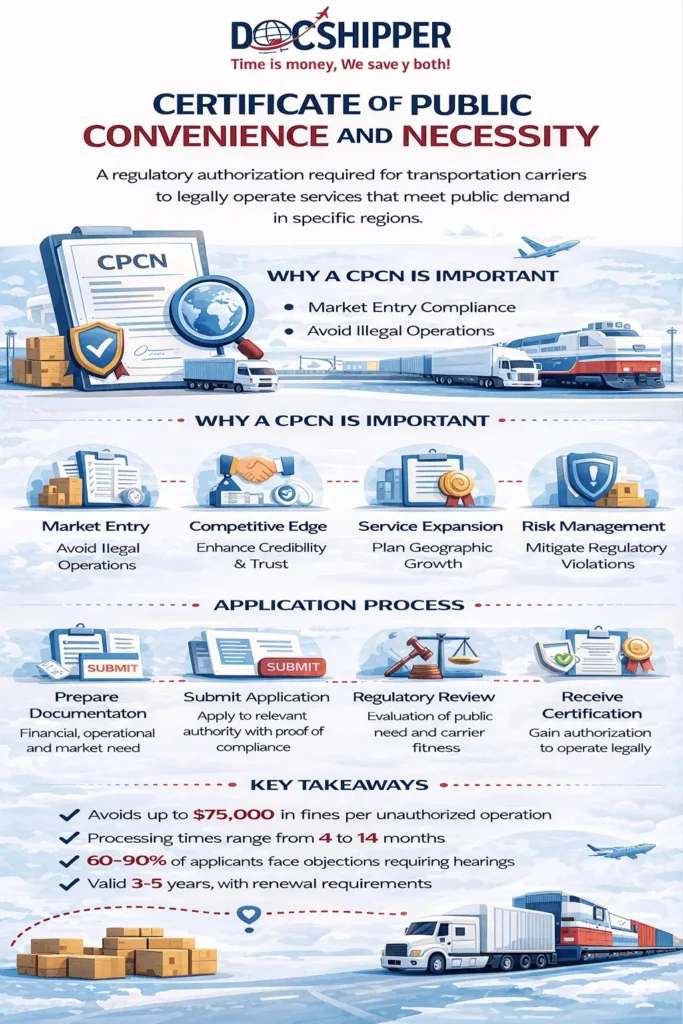
- Market entry compliance – Avoiding illegal operation penalties and service interruptions
- Competitive positioning – Demonstrating regulatory legitimacy to clients and partners
- Service expansion – Planning geographic or modal transportation growth strategically
- Risk management – Preventing costly regulatory violations and license revocations
- Contractual obligations – Meeting shipper requirements for certified carrier status
This regulatory instrument originated in the early 20th century when governments sought to control transportation monopolies and ensure adequate service coverage. Today, CPCN requirements vary significantly across jurisdictions, creating complex compliance landscapes for international operators.
Regulatory Framework & Legal Implications
The CPCN system operates under distinct regulatory philosophies depending on jurisdiction. In the United States, the Surface Transportation Board governs rail carriers, while state-level Public Utility Commissions regulate motor carriers in certain states. The Federal Motor Carrier Safety Administration (FMCSA) requires operating authority registration, though full CPCN requirements have been relaxed since the Motor Carrier Act of 1980.
The application burden of proof rests entirely with the carrier. Applicants must demonstrate that proposed services fulfill unmet public demand without creating harmful competition. Regulatory bodies evaluate factors including service necessity, applicant fitness, and public interest impact. This evaluation process can extend from 60 days to over 12 months depending on jurisdiction complexity and opposition filings.
Key regulatory considerations include:
Jurisdictional scope – Certificates typically specify geographic boundaries, commodity types, and operational modes. A CPCN for refrigerated goods transport in California does not authorize general freight in Nevada. Operators must secure separate authorizations for each regulated territory and service category.
Continuing compliance obligations – Certificate holders face ongoing reporting requirements, service quality standards, and rate regulation in some jurisdictions. Failure to maintain minimum service levels or submit required documentation can trigger suspension or revocation proceedings. At DocShipper, we maintain a compliance calendar for clients holding multiple CPCNs across different regulatory territories to prevent inadvertent violations.
Transfer and modification restrictions – CPCNs are generally non-transferable assets. Corporate mergers, acquisitions, or service expansions require formal regulatory approval. The abandonment process for discontinuing certificated services involves public notice periods and impact assessments, preventing carriers from unilaterally withdrawing from markets.
International implications – Cross-border operations introduce additional complexity. The North American Free Trade Agreement (now USMCA) established frameworks for Mexican and Canadian carriers operating in the U.S., but reciprocal CPCN-equivalent requirements persist. European Union regulations under Regulation 1072/2009 govern road transport licensing, creating parallel authorization systems.
Deregulation trends – Many jurisdictions have eliminated or substantially reduced CPCN requirements since the 1980s. However, specialized sectors including household goods moving, passenger transportation, and hazardous materials transport often retain strict certification mandates. Understanding which services remain regulated requires jurisdiction-specific legal analysis.
Application Process & Practical Examples
The CPCN application process varies by regulatory authority but follows common structural elements. Understanding typical requirements and timelines enables strategic planning for market entry.
Standard Application Components
| Requirement Category | Typical Documentation | Processing Time |
|---|---|---|
| Financial Fitness | Audited statements, capitalization proof, insurance certificates ($750K-$5M minimum) | 30-45 days review |
| Operational Capability | Equipment lists, facility documentation, safety management systems | 45-60 days verification |
| Public Need Demonstration | Market studies, shipper support letters, service gap analysis | 60-90 days evaluation |
| Legal Compliance | Corporate registration, ownership disclosure, criminal background checks | 15-30 days processing |
| Environmental/Safety | Environmental impact assessments, safety ratings, maintenance programs | 30-120 days depending on scope |
Case Study: Interstate Refrigerated Transport Authorization
A logistics company sought CPCN approval to operate refrigerated transport between California and Arizona. The application process illustrates typical challenges:
Initial filing – The applicant submitted comprehensive documentation including three years of financial statements showing $2.3M in liquid assets, proof of $2M cargo insurance, and letters from 12 agricultural shippers requesting the service. Application fees totaled $8,500 across federal and state filings.
Opposition phase – Two existing carriers filed protests claiming adequate service already existed. This triggered a 90-day comment period and required the applicant to provide detailed market analysis demonstrating 23% unmet demand during peak harvest seasons. Legal costs for this phase exceeded $45,000.
Hearing process – The regulatory body scheduled an administrative hearing where the applicant presented temperature-controlled equipment specifications, driver training protocols, and commitment to 98% on-time performance. The hearing consumed 14 business days over three months.
Conditional approval – The authority granted a provisional CPCN valid for 18 months, requiring quarterly service reports and maintaining minimum weekly frequencies on designated routes. Full certification followed after demonstrating compliance during the provisional period.
Total timeline – From initial application to full authorization: 16 months. Total costs including legal fees, application charges, and compliance documentation: approximately $127,000.
At DocShipper, we guide clients through similar authorization processes by preparing documentation packages, coordinating with regulatory counsel, and managing compliance timelines to minimize operational delays.
Key Success Factors
Stakeholder engagement – Proactive communication with existing carriers and shipper communities reduces opposition risks. Pre-filing consultations with regulatory staff identify documentation gaps before formal submission.
Financial transparency – Demonstrating capitalization substantially exceeding minimum requirements signals operational sustainability. Regulators favor applicants showing 150-200% of minimum financial thresholds.
Service differentiation – Applications emphasizing specialized equipment, technology integration, or underserved market segments receive more favorable consideration than general commodity proposals.
Compliance history – Applicants with principals holding clean regulatory records in other jurisdictions accelerate approval processes. Conversely, prior violations trigger enhanced scrutiny regardless of jurisdiction.
Geographic strategy – Requesting authorization for clearly defined, manageable service areas increases approval likelihood compared to overly broad geographic applications that raise feasibility questions.
Conclusion
The Certificate of Public Convenience and Necessity remains a fundamental regulatory instrument governing transportation market access across multiple jurisdictions. Understanding application requirements, compliance obligations, and strategic positioning significantly impacts market entry success and operational sustainability.
Need expert guidance navigating CPCN requirements for your logistics operations? Contact DocShipper for comprehensive regulatory compliance support.
📚 Quiz
Certificate of Public Convenience and Necessity
1. What is the primary purpose of a Certificate of Public Convenience and Necessity (CPCN)?
2. A carrier holding a CPCN for refrigerated goods transport in California wants to expand operations to Nevada. Which statement is correct?
3. A logistics startup is ready to launch interstate freight services and assumes it can begin operations while its CPCN application is under review. Is this correct?
🎯 Your Result
📞 Free Quote in 24hFAQ | Certificate of Public Convenience and Necessity: Definition, Application & Practical Examples
Operating authority represents federal registration with agencies like FMCSA, while a CPCN is a state-level certification demonstrating public necessity. Some jurisdictions require both; others have eliminated CPCN requirements following deregulation. Verify specific state mandates before commencing operations.
Processing times range from 60 days for uncontested applications in streamlined jurisdictions to 18+ months for complex cases involving opposition, environmental reviews, or multi-state coordination. Provisional authorizations may be available during full review processes in certain circumstances.
Generally no. Operating without proper authorization subjects carriers to substantial penalties, service shutdowns, and disqualification from future applications. Some jurisdictions offer temporary operating permits under specific conditions, but these require separate applications and fee payments.
Applicants typically have appeal rights through administrative law processes. Denials often cite insufficient public need demonstration, financial unfitness, or competitive harm concerns. Reapplication is possible after addressing deficiency reasons, though waiting periods may apply depending on jurisdiction.
Requirements vary by country and transport mode. Ocean and air freight forwarding generally face different regulatory frameworks than surface transportation. Cross-border trucking between USMCA countries requires specific operating authorities but not traditional CPCNs in most cases. Consult jurisdiction-specific regulations.
Direct application fees range from $500 to $15,000 depending on jurisdiction and service scope. Total costs including legal representation, documentation preparation, and hearing expenses typically range from $25,000 to $150,000 for contested applications. Uncontested filings may cost $5,000-$20,000 total.
Certificates are generally non-transferable and require regulatory approval for ownership changes. Merger applications must demonstrate continued public service capability and financial fitness under new ownership. Some jurisdictions allow streamlined transfers for qualified buyers; others require complete reapplication processes.
Minimum liability coverage typically ranges from $750,000 for general freight to $5,000,000 for hazardous materials transport. Cargo insurance requirements vary by commodity type. Certificates often mandate continuous coverage with regulatory notification requirements for policy lapses or cancellations.
Requirements depend on service models. Third-party logistics providers arranging transportation without operating vehicles typically don't need CPCNs but may require freight broker authority. Companies operating delivery fleets may need certificates in jurisdictions maintaining intrastate common carrier regulations.
Regulatory burdens disproportionately impact small operators due to application costs and compliance overhead. Some jurisdictions offer simplified processes for carriers below specific revenue or fleet size thresholds. Industry associations often provide resources helping small carriers navigate certification requirements cost-effectively.
Requirements typically include annual financial reporting, service quality metrics, rate filings (in regulated jurisdictions), insurance certificate updates, and operational change notifications. Failure to meet reporting deadlines or service standards can trigger suspension proceedings or certificate revocation.
Common exemptions include private carriage (transporting own goods), agricultural commodities in certain states, and operations below specified size thresholds. Federal preemption eliminates state CPCN authority over interstate motor carriers in most cases, though intrastate operations may still require certification.
Need Help with
Logistics or Sourcing ?
First, we secure the right products from the right suppliers at the right price by managing the sourcing process from start to finish. Then, we simplify your shipping experience - from pickup to final delivery - ensuring any product, anywhere, is delivered at highly competitive prices.


Fill the Form
Prefer email? Send us your inquiry, and we’ll get back to you as soon as possible.
Contact us


