


In short ⚡
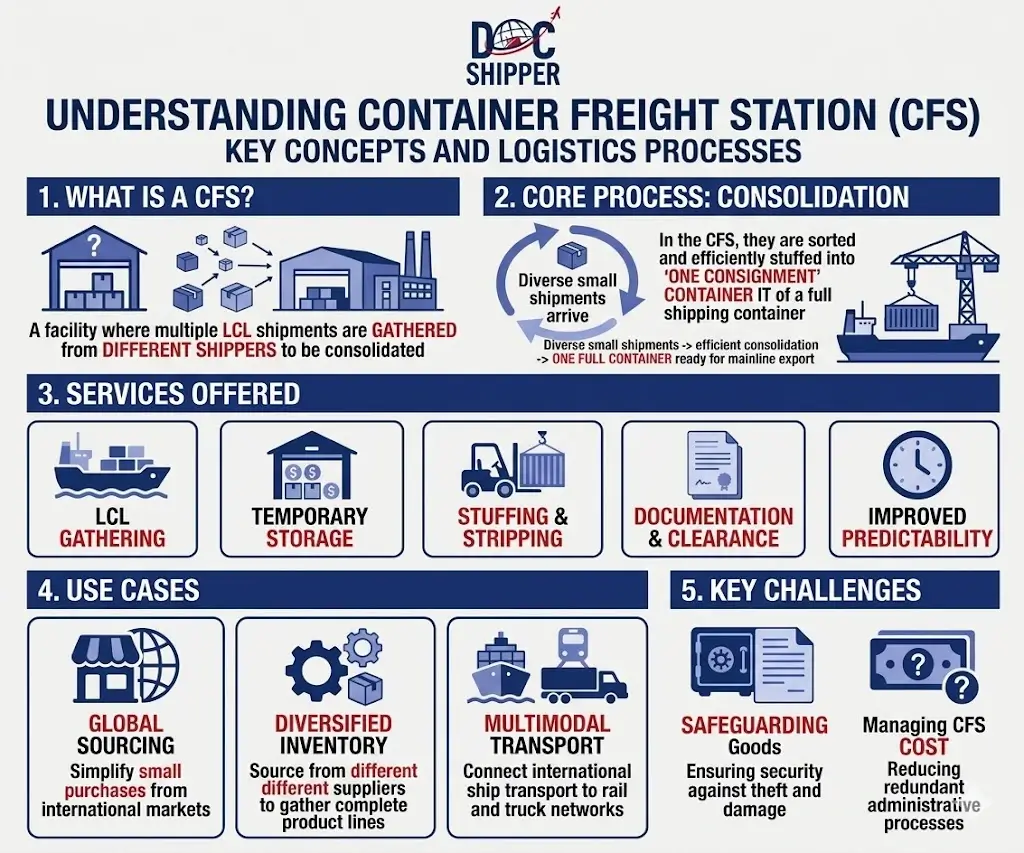
A Container Freight Station (CFS) is a specialized warehouse facility where Less than Container Load (LCL) shipments are consolidated into full containers for export or deconsolidated for distribution upon import. This critical node in the supply chain enables cost-efficient international shipping for businesses without full container volumes.
Introduction
Many importers and exporters face a common dilemma: their cargo doesn’t fill an entire 20ft or 40ft container, yet they need cost-effective international shipping. Paying for a full container when shipping only 5 cubic meters creates massive waste.
The Container Freight Station solves this problem by serving as the consolidation hub where multiple shippers’ goods are combined. This infrastructure is essential for global trade efficiency, particularly for SMEs and e-commerce businesses.
Key characteristics of CFS facilities include:
- Customs bonded status – allowing cargo to remain duty-unpaid until final clearance
- Consolidation and deconsolidation services – grouping or separating LCL shipments
- Cargo handling equipment – forklifts, pallet jacks, and scanning systems
- Documentation processing – managing bills of lading, packing lists, and customs declarations
- Short-term storage capacity – holding cargo before container stuffing or after destuffing
CFS Operations & Regulatory Framework
Container Freight Stations operate under strict customs supervision. In most jurisdictions, CFS facilities must obtain bonded warehouse licenses from customs authorities. This legal status permits cargo to enter the facility without immediate duty payment, streamlining the import process.
The operational workflow follows a precise sequence. For exports, shippers deliver goods to the CFS where workers verify quantities against booking details. Cargo undergoes inspection and measurement to confirm volume and weight. Workers then consolidate compatible shipments into containers based on destination and routing.
Import operations reverse this process. When containers arrive at the port, they’re transported to the CFS for destuffing. Each consignee’s cargo is separated, documented, and held until customs clearance completes. This segregation prevents cargo mixing and ensures accurate delivery.
Regulatory compliance requires meticulous record-keeping. The World Customs Organization establishes international standards for CFS documentation. Operators must maintain detailed cargo manifests, tracking every item’s origin, destination, and customs status.
Technology integration has transformed modern CFS operations. Warehouse Management Systems (WMS) track cargo location in real-time. Barcode scanning reduces manual errors during consolidation. At DocShipper, we partner with certified CFS facilities globally to ensure your LCL shipments receive professional handling with full digital traceability from pickup to final delivery.
Safety protocols are non-negotiable. CFS operators must implement hazardous materials segregation following IMDG Code requirements. Incompatible goods—such as chemicals and foodstuffs—require physical separation and specialized storage conditions.
Practical Examples & Cost Comparisons
Understanding CFS economics requires examining real-world scenarios. Consider a furniture manufacturer in Vietnam shipping to Los Angeles. They produce 12 cubic meters of goods monthly—too small for a dedicated container but too large for air freight.
| Shipping Method | Volume Used | Transit Time | Estimated Cost |
|---|---|---|---|
| Full Container (FCL) | 12/33 CBM (36% utilized) | 18-22 days | $2,400 |
| LCL via CFS | 12 CBM (100% efficiency) | 20-25 days | $960 |
| Air Freight | 12 CBM (2,400 kg) | 5-7 days | $7,200 |
This comparison reveals the CFS advantage: 60% cost savings versus FCL and 87% savings versus air freight. The slight transit time increase (2-3 days) is negligible for most non-perishable goods.
Case Study: Electronics Importer
A UK-based electronics distributor imports smartphone accessories from Shenzhen. Monthly volume fluctuates between 8-15 cubic meters. Using CFS services provides flexibility without committing to full containers during low-demand months.
Key operational data points:
- Consolidation ratio: CFS facilities typically achieve 95-98% container utilization by combining 6-10 different shippers
- Processing time: Export CFS stuffing requires 24-48 hours; import destuffing takes 12-24 hours
- Storage limits: Most CFS facilities offer 5-7 free days before demurrage charges apply
- Documentation turnaround: Digital systems generate bills of lading within 2-4 hours of container departure
- Damage rates: Professional CFS operations maintain cargo damage rates below 0.3%
Regional variations affect CFS pricing. Asian export hubs like Shanghai and Singapore offer highly competitive rates due to volume economies. European CFS facilities in Rotterdam and Hamburg charge premium rates but provide superior infrastructure and faster customs processing.
Conclusion
Container Freight Stations represent the backbone of LCL shipping, transforming fragmented cargo into efficient containerized transport. Understanding CFS operations empowers businesses to optimize shipping costs while maintaining supply chain reliability.
Need expert guidance on CFS selection or LCL shipping strategies? Contact DocShipper for personalized logistics solutions tailored to your business requirements.
📚 Quiz
Test Your Knowledge: Container Freight Station (CFS)
Q1 – What is the primary purpose of a Container Freight Station (CFS)?
Q2 – A common misconception about CFS facilities is that customs duties must be paid immediately when cargo enters the station. Is this correct?
Q3 – A UK electronics distributor ships 10 CBM of smartphone accessories monthly from Shenzhen. Which shipping solution best fits their needs?
🎯 Your Result
📞 Free Quote in 24hFAQ | Container Freight Station (CFS): Definition, Operations & Practical Examples
CFS (Container Freight Station) handles LCL cargo consolidation/deconsolidation, while CY (Container Yard) stores full containers. CFS involves warehouse operations; CY is purely container storage and handling.
Most CFS operators provide 5-7 free storage days. Beyond this period, demurrage charges apply, typically ranging from $5-15 per cubic meter per day depending on location and cargo type.
No. CFS charges are separate line items covering stuffing/destuffing, documentation, and handling. Expect $50-150 per shipment depending on volume, with origin and destination CFS fees both applicable.
Yes, but with restrictions. CFS facilities certified for dangerous goods can handle IMDG-compliant cargo. Segregation requirements apply, and additional documentation (DGD, MSDS) is mandatory.
Essential documents include commercial invoice, packing list, bill of lading instructions, and export declaration. Customs-bonded CFS may also require certificates of origin and product-specific permits.
Standard marine cargo insurance covers CFS operations. However, verify your policy includes warehouse-to-warehouse coverage, as some basic policies exclude CFS handling periods.
Most carriers accept shipments from 1 cubic meter upward. Below this threshold, dimensional weight rules may apply, making courier services more economical than LCL consolidation.
Professional CFS operators use barcode systems, designated storage zones, and strict SOPs. Each shipment receives unique identifiers cross-referenced with digital manifests to ensure accurate segregation.
Inspection appointments are generally permitted with 24-48 hours advance notice. Security protocols require identification and may restrict photography. Some facilities charge inspection fees.
Immediately file a damage report with photographic evidence. CFS operators carry liability insurance, but coverage limits apply. Timely documentation is critical for successful claims processing.
Proximity to ports reduces drayage expenses. Inland CFS facilities may offer lower handling fees but increase trucking costs. Calculate total landed cost including all legs when comparing CFS options.
Major commercial ports universally offer CFS facilities. Smaller regional ports may have limited LCL infrastructure, requiring cargo routing through larger hub ports with established consolidation networks.
Need Help with
Logistics or Sourcing ?
First, we secure the right products from the right suppliers at the right price by managing the sourcing process from start to finish. Then, we simplify your shipping experience - from pickup to final delivery - ensuring any product, anywhere, is delivered at highly competitive prices.


Fill the Form
Prefer email? Send us your inquiry, and we’ll get back to you as soon as possible.
Contact us




:%20Definition,%20Operations%20&%20Practical%20Examples)