


In short ⚡
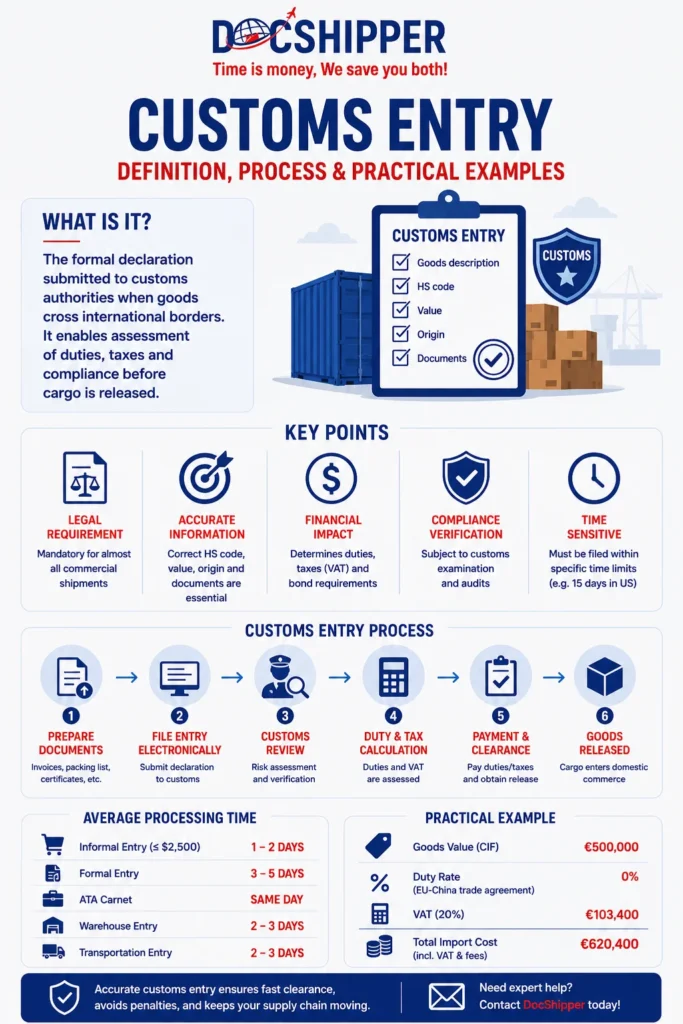
Customs Entry is the formal declaration submitted to customs authorities when goods cross international borders. This document provides essential information about the shipment's nature, value, origin, and classification, enabling authorities to assess duties, taxes, and compliance with import/export regulations before releasing cargo.
Introduction
Many importers underestimate the complexity of customs entry procedures, leading to costly delays, penalties, or cargo seizures. A single error in classification or valuation can result in shipments being held for weeks at the border.
The customs entry serves as the gateway between international trade and domestic markets. Without proper documentation, goods cannot legally enter a country’s commerce stream. This administrative process protects national security, enforces trade agreements, and ensures proper tax collection.
Key characteristics of customs entry include:
- Legal requirement: Mandatory for all commercial imports exceeding de minimis thresholds
- Information density: Requires detailed product descriptions, HS codes, values, and origin certificates
- Time sensitivity: Must be filed within specific timeframes (typically 15 days in the US, variable in EU)
- Financial implications: Determines duty rates, VAT calculations, and potential bonding requirements
- Compliance verification: Subject to audit and examination by customs authorities
In-Depth Understanding & Regulatory Framework
The customs entry process involves multiple components working in coordination. The entry manifest provides preliminary cargo information upon arrival, while the entry summary contains detailed commercial data for duty assessment. These documents must align with supporting paperwork including commercial invoices, packing lists, and certificates of origin.
Classification accuracy represents the cornerstone of proper customs entry. Goods must be assigned the correct Harmonized System (HS) code—a standardized numerical method of classifying traded products. Misclassification can result in incorrect duty rates, triggering retrospective audits and penalties. The World Customs Organization maintains this international nomenclature system used by over 200 countries.
Valuation methods follow strict international guidelines established by the WTO Valuation Agreement. Customs authorities typically accept transaction value—the price actually paid or payable—but may adjust for related-party transactions, assists, royalties, or subsequent proceeds. Alternative valuation methods apply when transaction value cannot be determined.
The concept of Importer of Record (IOR) designates the entity legally responsible for ensuring goods comply with all customs requirements. This party bears liability for accurate declarations, duty payments, and regulatory compliance. At DocShipper, we verify all entry documentation systematically to prevent clearance delays and ensure our clients maintain compliance with evolving customs regulations.
Entry types vary based on shipment characteristics and business needs. Consumption entries permanently import goods into domestic commerce. Warehouse entries allow storage in bonded facilities, deferring duty payment. Transportation entries facilitate transit through a country to a final destination. Temporary importation under bond (TIB) permits conditional entry for specific purposes with duty suspension.
Practical Examples & Key Data
Understanding customs entry through concrete scenarios illuminates the practical implications of regulatory requirements. The following comparative analysis demonstrates how entry complexity varies across shipment types:
| Entry Type | Processing Time | Documentation Required | Typical Use Case |
|---|---|---|---|
| Informal Entry | 1-2 days | Commercial invoice only | Shipments under $2,500 (US threshold) |
| Formal Entry | 3-5 days | Full entry package + bond | Commercial imports over threshold |
| ATA Carnet | Same day | Carnet document | Temporary exhibitions, professional equipment |
| Warehouse Entry | 2-3 days | Entry + warehouse bond | Goods stored before duty payment |
Use Case: Electronics Importer
A European company imports 5,000 smartphones from China valued at €500,000. The customs entry process involves:
- HS Classification: 8517.12.00 (Telephones for cellular networks)
- Duty Calculation: Standard rate 0% (under EU-China trade agreement for this category)
- VAT Assessment: 20% on CIF value (€500,000 + shipping €15,000 + insurance €2,000) = €103,400
- Compliance Requirements: CE marking verification, WEEE registration, battery safety documentation
- Total Import Cost: €620,400 including all taxes and clearance fees
Critical success factors for efficient customs entry:
- Pre-arrival filing: Submitting entry documentation before cargo arrival reduces clearance time by 40-60%
- Broker expertise: Licensed customs brokers reduce error rates from 18% (self-filing) to under 3%
- Continuous bond: Annual bonds cost $500-800 but eliminate per-shipment bonding delays
- Harmonized data: Consistent product descriptions across all documents prevent examination triggers
- Regulatory monitoring: Tariff rates and requirements change frequently—quarterly reviews prevent surprises
Conclusion
Customs entry represents far more than administrative paperwork—it’s the critical control point determining whether international shipments flow smoothly or face costly disruptions. Mastering classification, valuation, and documentation requirements protects businesses from financial penalties while accelerating supply chain velocity.
Need expert guidance navigating customs entry complexities? Contact DocShipper for comprehensive customs brokerage services that ensure compliant, efficient clearance across global markets.
📚 Quiz
Test Your Knowledge: Customs Entry
Q1 — What is a Customs Entry?
Q2 — A common misconception about customs entry is that it is the same as customs clearance. What is the correct distinction?
Q3 — A European company regularly imports electronics from China. Which entry strategy would most effectively reduce clearance time and per-shipment bonding costs?
🎯 Your Result
📞 Free Quote in 24hFAQ | Customs Entry: Definition, Process & Practical Examples
Customs entry is the formal documentation submission process, while customs clearance refers to the authority's approval releasing goods. Entry is the importer's action; clearance is the government's response.
Licensed customs brokers are authorized to file entries professionally. In some jurisdictions, importers may self-file, though this requires significant regulatory knowledge and assumes full liability for accuracy.
Informal entries process within 1-2 days, while formal entries require 3-5 business days. Expedited processing exists for time-sensitive shipments, though examination selections may extend timelines significantly.
Minor errors can be corrected through post-entry amendments. Significant mistakes may trigger audits, duty reassessments, or penalties. Repeated errors can result in increased examination rates for future shipments.
Single transaction bonds cover individual shipments, while continuous bonds provide year-round coverage. Importers with regular shipments benefit financially from continuous bonds, which cost less than multiple single-entry bonds annually.
Yes, many countries encourage pre-arrival filing to expedite clearance. The US allows entry up to 30 days before arrival, while EU systems support advance lodgment through Union Customs Code provisions.
Core documents include commercial invoice, packing list, bill of lading or airway bill, and certificate of origin. Additional requirements vary by product category, potentially including permits, licenses, or compliance certifications.
Duties apply to the customs value (typically CIF: cost, insurance, freight) multiplied by the applicable tariff rate determined by HS classification. Preferential trade agreements may reduce or eliminate duties for qualifying goods.
ISF, also called "10+2," requires ocean importers to submit specific cargo information to US Customs 24 hours before vessel loading. This security measure applies separately from the formal customs entry process.
Post-entry corrections are possible within specific timeframes, typically 15 days for summary amendments. Duty refund claims must be filed within prescribed limitation periods, usually one year from payment date.
Examinations may result from random selection, risk assessment algorithms, inconsistent documentation, first-time importer status, high-risk commodity categories, or trade compliance concerns. Examination rates average 3-5% of total entries.
Yes, late filing incurs penalties ranging from monetary fines to cargo seizure in extreme cases. US regulations impose liquidated damages equal to the entry value for entries not filed within 15 days of arrival.
Need Help with
Logistics or Sourcing ?
First, we secure the right products from the right suppliers at the right price by managing the sourcing process from start to finish. Then, we simplify your shipping experience - from pickup to final delivery - ensuring any product, anywhere, is delivered at highly competitive prices.


Fill the Form
Prefer email? Send us your inquiry, and we’ll get back to you as soon as possible.
Contact us




