
In short ⚡
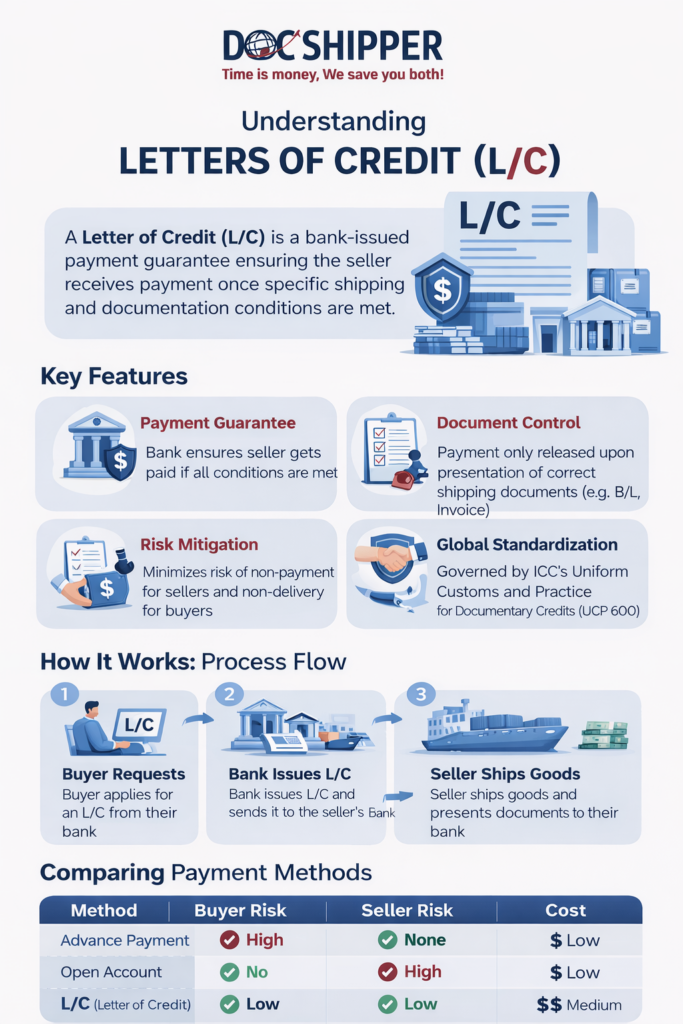
A Letter of Credit (L/C) is a payment guarantee issued by a bank on behalf of a buyer, ensuring the seller receives payment once specified shipping and documentation conditions are met. It mitigates risk in international trade by acting as a trusted intermediary between parties.
Introduction
In cross-border transactions, buyers and sellers face a fundamental dilemma: the seller fears non-payment, while the buyer worries about non-delivery. This trust gap causes delays, disputes, and lost opportunities. The Letter of Credit solves this by introducing bank-backed security.
Letters of Credit are essential instruments in global supply chains, particularly for first-time partnerships or high-value shipments. They balance risk between parties while ensuring compliance with international trade regulations.
- Payment security: The issuing bank guarantees payment if documents comply.
- Documentary control: Payment triggers only upon presentation of correct shipping documents.
- Risk mitigation: Protects both buyer and seller from default or fraud.
- Global standardization: Governed by ICC’s Uniform Customs and Practice (UCP 600).
- Financing option: Sellers can use L/Cs to secure working capital from banks.
Mechanisms & Legal Framework
The Letter of Credit operates through a structured process involving four parties: the applicant (buyer), the beneficiary (seller), the issuing bank, and often an advising or confirming bank in the seller’s country.
The buyer requests the L/C from their bank, which issues the document stipulating exact conditions—shipment dates, document types (Bill of Lading, Commercial Invoice, Certificate of Origin), and compliance standards. The seller ships goods and submits documents to their bank, which verifies them against L/C terms.
If documents match perfectly (a principle called strict compliance), payment is released. Any discrepancy—even a minor typo—can trigger rejection, delaying payment until corrections are made. This rigorous verification protects buyers from receiving incorrect or incomplete shipments.
Letters of Credit are governed internationally by the ICC’s UCP 600 rules, which standardize interpretation and reduce disputes. Types include revocable, irrevocable, confirmed, and standby L/Cs, each offering different security levels.
At DocShipper, we systematically review L/C terms before shipment to ensure document accuracy, preventing costly discrepancies and payment delays for our clients.
Practical Examples & Data
Understanding how Letters of Credit function in real scenarios clarifies their value. Consider a European importer purchasing electronics from a Chinese manufacturer for the first time.
| Payment Method | Buyer Risk | Seller Risk | Cost |
|---|---|---|---|
| Advance Payment | High (no goods guarantee) | None | Low |
| Open Account | None | High (no payment guarantee) | Low |
| Letter of Credit | Low (document control) | Low (bank guarantee) | Medium (1-3% of value) |
Use Case: A U.S. retailer orders $500,000 worth of textiles from India. They establish an irrevocable L/C requiring a clean Bill of Lading, inspection certificate, and insurance documents. The Indian exporter ships goods and presents documents within the 15-day deadline. The advising bank in Mumbai verifies compliance and transfers funds within 5 business days. Total L/C cost: approximately $7,500 (1.5%), providing mutual security worth the investment.
According to ICC data, over $2 trillion in global trade is facilitated annually through Letters of Credit, with rejection rates averaging 50-70% on first presentation due to documentation errors—underscoring the importance of expert document preparation.
Conclusion
The Letter of Credit remains a cornerstone of secure international trade, balancing risk through bank-backed guarantees and strict documentary compliance. Mastering its mechanics prevents costly delays and protects both parties in cross-border transactions.
Need assistance navigating L/C requirements or ensuring document accuracy? Contact DocShipper for expert support throughout your import/export process.
📚 Quiz
Test Your Knowledge: Letter of Credit (L/C)
Q1 — What is the primary purpose of a Letter of Credit (L/C) in international trade?
Q2 — Under an L/C, a bank discovers a minor typo in the seller's Commercial Invoice. What happens next?
Q3 — A buyer and seller have been trading successfully for 5 years with no disputes. Which payment method is most appropriate for their next transaction?
🎯 Your Result
📞 Free Quote in 24hFAQ | Letter of Credit (L/C): Definition, Process & Practical Examples
Revocable L/Cs can be canceled by the buyer or bank without notice, offering minimal seller protection. Irrevocable L/Cs cannot be modified without all parties' consent, making them the standard in international trade.
Banks typically process compliant documents within 5-7 business days. Delays occur if discrepancies are found, requiring document amendments and resubmission.
Yes, if it's a transferable L/C, the beneficiary can transfer rights to a secondary supplier, common when intermediaries are involved in the supply chain.
Banks operate under strict compliance. Even small discrepancies (misspelled names, date inconsistencies) can lead to rejection. The seller must correct and resubmit documents, delaying payment.
Typically, the buyer pays issuance fees, while the seller covers advising and confirmation fees. Costs range from 0.5% to 3% of the transaction value, depending on bank and risk assessment.
No. Established trading partners often use open account terms. L/Cs are recommended for new relationships, high-value orders, or transactions with countries having political or economic instability.
A confirmed L/C adds a second bank's guarantee (usually in the seller's country), providing extra security if the issuing bank defaults—critical when dealing with banks in high-risk regions.
Amendments are possible but require agreement from all parties (buyer, seller, and banks). Changes may incur additional fees and delay the transaction timeline.
Common requirements include Commercial Invoice, Bill of Lading, Packing List, Certificate of Origin, Insurance Certificate, and Inspection Certificate. Exact requirements vary per L/C terms.
Standby L/Cs act as backup guarantees, activated only if the buyer defaults. They function similarly to bank guarantees, whereas commercial L/Cs are primary payment instruments in trade transactions.
Yes, standby L/Cs are commonly used for service contracts, construction projects, or performance bonds, providing payment assurance when service milestones are documented and verified.
UCP 600 (Uniform Customs and Practice) is the ICC's international standard governing L/C operations. It ensures consistent interpretation worldwide, reducing disputes and streamlining cross-border trade processes.
Need Help with Logistics or Sourcing ?
First, we secure the right products from the right suppliers at the right price by managing the sourcing process from start to finish. Then, we simplify your shipping experience - from pickup to final delivery - ensuring any product, anywhere, is delivered at highly competitive prices.
Fill the Form
Prefer email? Send us your inquiry, and we’ll get back to you as soon as possible.
Contact us