


In short ⚡
The Make-or-Buy Decision is a strategic choice companies make to either manufacture a product or component internally (make) or purchase it from external suppliers (buy). This fundamental logistics decision impacts cost structure, production capacity, quality control, and overall supply chain efficiency in international trade operations.
Introduction
Every importer and manufacturer faces a critical dilemma: should we produce this component ourselves or source it externally? This choice determines resource allocation, affects profit margins, and shapes competitive positioning.
In global logistics, the make-or-buy decision extends beyond simple cost comparison. It encompasses quality consistency, intellectual property protection, supply chain resilience, and strategic flexibility.
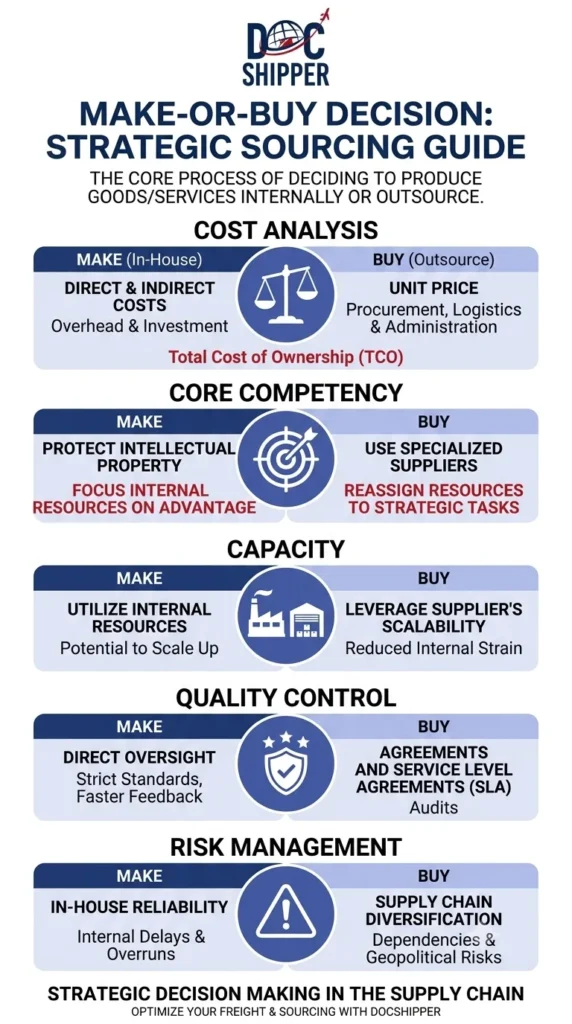
Key factors influencing this decision include:
- Total cost of ownership – Direct costs plus hidden expenses (storage, quality control, overhead)
- Core competency alignment – Whether production fits the company’s strategic focus
- Capacity constraints – Available facilities, workforce, and technological capabilities
- Quality requirements – Control standards and consistency needs
- Supply chain risks – Dependency on external suppliers, geopolitical factors, delivery reliability
Strategic Analysis & Decision Framework
The make-or-buy analysis involves evaluating multiple dimensions beyond immediate cost savings. Companies must conduct a thorough assessment of their strategic capabilities and market positioning.
When considering the “make” option, businesses gain direct quality control over production processes. Manufacturing in-house enables faster iteration, protects proprietary designs, and creates vertical integration benefits. However, this requires significant capital investment, specialized workforce development, and ongoing operational management.
The “buy” alternative offers operational flexibility and reduced capital requirements. Outsourcing allows companies to leverage supplier expertise, scale production rapidly, and focus resources on core activities. The trade-off involves dependency on external partners and potential quality inconsistencies.
Critical evaluation criteria include break-even volume analysis. Low production volumes typically favor buying, as fixed costs of manufacturing become prohibitive. High volumes may justify internal production through economies of scale.
According to World Trade Organization data, global value chains increasingly involve hybrid models where companies make strategic components while buying commodity items. This balanced approach optimizes both control and efficiency.
At DocShipper, we regularly assist clients in evaluating these decisions by providing detailed supplier qualification audits and comparative cost analyses that include all logistics variables—from factory gate to final delivery.
Practical Examples & Cost Comparisons
Real-world applications demonstrate how companies navigate make-or-buy decisions across different scenarios. Understanding concrete numbers clarifies the financial implications of each path.
Case Study: Electronic Component Manufacturing
A European electronics company needs 50,000 circuit boards annually. The comparative analysis reveals:
| Cost Factor | Make (In-House) | Buy (Outsource) |
|---|---|---|
| Initial Investment | $280,000 | $0 |
| Unit Production Cost | $8.50 | $12.00 |
| Annual Fixed Costs | $95,000 | $15,000 |
| Quality Control | $22,000 | $35,000 |
| Total Year 1 Cost | $822,000 | $650,000 |
| Total Year 3 Cost | $1,611,000 | $1,950,000 |
This comparison demonstrates that internal manufacturing becomes more cost-effective after approximately 22 months, assuming consistent volume. The break-even calculation helps determine optimal timing for the investment.
Key decision factors in this scenario:
- Volume stability – Guaranteed demand justifies capital expenditure
- Technology control – Proprietary designs remain protected internally
- Lead time reduction – In-house production cuts delivery cycles by 60%
- Supplier risk – Single external supplier creates vulnerability
- Profit margin impact – Lower unit costs improve long-term profitability
DocShipper frequently encounters clients facing similar decisions. We provide end-to-end support—from supplier sourcing and negotiation to managing the transition if companies choose to outsource their production needs.
Conclusion
The make-or-buy decision remains one of the most critical strategic choices in supply chain management, directly affecting cost structure, operational flexibility, and competitive advantage.
Need expert guidance on your sourcing strategy? Contact DocShipper to discuss your specific requirements and explore optimized solutions.
📚 Quiz
Test Your Knowledge: Make-or-Buy Decision
What is the fundamental definition of a make-or-buy decision?
Which factor is NOT typically considered a hidden cost in make-or-buy analysis?
A company produces 10,000 units annually. Making costs $50,000 in fixed costs + $8/unit variable. Buying costs $5,000 fixed + $12/unit. What is the best decision?
🎯 Your Result
📞 Free Quote in 24hFAQ | Make-or-Buy Decision: Definition, Analysis & Practical Examples
The make decision involves producing goods internally using company resources, facilities, and workforce. The buy decision means purchasing from external suppliers. Make offers control and potential cost savings at scale; buy provides flexibility and lower capital requirements. The optimal choice depends on volume, core competencies, and strategic priorities.
Calculate break-even volume by dividing the difference in fixed costs by the difference in variable costs per unit. Formula: Break-even = (Fixed Cost Make - Fixed Cost Buy) ÷ (Variable Cost Buy - Variable Cost Make). This shows the production quantity where total costs equalize between both options.
Hidden costs include inventory carrying expenses, quality control overhead, equipment maintenance, training requirements, facility depreciation, and opportunity costs of capital. For buying, consider supplier management time, incoming inspection, logistics complexity, and potential supply disruption expenses. Total cost of ownership analysis captures these factors comprehensively.
Companies should prioritize making when products involve proprietary technology requiring protection, when quality control is absolutely critical, when high volumes create significant cost advantages, or when the capability represents a core competitive differentiator. Strategic value often outweighs pure cost considerations in these scenarios.
International sourcing introduces variables like customs duties, longer lead times, currency fluctuations, quality consistency challenges, and geopolitical risks. While offshore buying may offer lower unit prices, total landed costs including freight, duties, and inventory holding often narrow the gap significantly. Companies must evaluate the complete supply chain impact.
Yes, hybrid approaches are increasingly common and often optimal. Companies manufacture strategic or high-value components internally while outsourcing commodity items or overflow capacity. This dual-sourcing strategy balances control with flexibility, reduces dependency risks, and optimizes capital deployment across the product portfolio.
Volume directly impacts per-unit fixed cost allocation. Low volumes make buying more economical because fixed manufacturing costs spread over fewer units create high per-piece expenses. High volumes justify internal production by distributing fixed investments across many units, reducing average costs below external purchase prices.
Stringent quality specifications favor making when suppliers cannot consistently meet standards or when verification costs become prohibitive. Internal production enables direct process control, immediate corrections, and quality integration. However, specialized suppliers with superior capabilities may deliver better quality than in-house alternatives, making buying preferable.
Consider return on investment (ROI) for capital expenditures, working capital requirements, cash flow timing differences, asset utilization rates, and impact on financial ratios. Making ties up capital in equipment and inventory, while buying preserves liquidity. Strategic financial positioning often weighs as heavily as operational cost comparison.
Regular reviews every 18-24 months align with market dynamics, technology evolution, and capacity changes. Trigger events for immediate reassessment include significant volume shifts, supplier performance issues, new technology availability, competitive pressure changes, or major cost structure modifications. Dynamic evaluation maintains optimal sourcing strategies.
Excessive outsourcing creates supplier dependency, erodes internal capabilities, exposes intellectual property, limits innovation control, and reduces operational flexibility. Companies may lose touch with production realities, making product development slower and less market-responsive. Balanced sourcing maintains critical competencies while leveraging external expertise strategically.
Internal manufacturing typically reduces lead times by eliminating supplier communication delays, shipping durations, and customs clearance. Faster response enables better demand matching and lower inventory requirements. However, supplier proximity, established relationships, and just-in-time delivery systems can minimize buying lead times. Time-to-market urgency influences this trade-off significantly.
Need Help with
Logistics or Sourcing ?
First, we secure the right products from the right suppliers at the right price by managing the sourcing process from start to finish. Then, we simplify your shipping experience - from pickup to final delivery - ensuring any product, anywhere, is delivered at highly competitive prices.


Fill the Form
Prefer email? Send us your inquiry, and we’ll get back to you as soon as possible.
Contact us




