In short ⚡
How to Choose a 3PL Provider: Checklist and Key Questions starts with defining your order profile, inbound flows, channels, service needs and peak volumes. Compare providers using consistent cost assumptions, measurable performance data and contract terms that protect your inventory and exit options. Use this checklist:- Document orders, SKUs, product requirements, inbound containers or pallets, sales channels, value-added services and required controls.
- Match the provider type to your dominant flow, such as e-commerce fulfillment, B2B warehousing, freight forwarding with warehousing or marketplace preparation.
- Compare warehouse location, container receiving, WMS integrations, KPIs, scalability, returns and other operational capabilities.
- Send the same data pack and RFQ to three to five providers, asking about receiving procedures, capacity, fees, exclusions, references and subcontractors.
- Define SLAs and contract terms for receiving, accuracy, dispatch, liability, insurance, pricing, inventory reconciliation and termination.
- Plan onboarding with clean master data, test orders, inbound validation, phased stock transfer and weekly KPI reviews for the first three months.
The guidance covers 3PL types, comparison criteria, pricing models, RFQ questions, SLA and contract protection, onboarding steps, and red flags to check before selecting a provider.
We hope you’ll find this article genuinely useful, but remember, if you ever feel lost at any step, whether it’s finding a supplier, validating quality, managing international shipping or customs, DocShipper can handle it all for you!
To choose a 3PL provider, define your order profile and inbound flows first, then compare providers on receiving capacity, technology, service levels, total monthly cost and contract protection. The right partner is not necessarily the one with the lowest pick-and-pack fee. It is the one that can receive your containers accurately, handle your peak and make its promises enforceable.
This method is designed for e-commerce brands and importers moving from 500 to 50,000 orders a month, including businesses receiving stock from Asia into the US, EU or UK. It focuses on selection rather than a ranking of named providers.
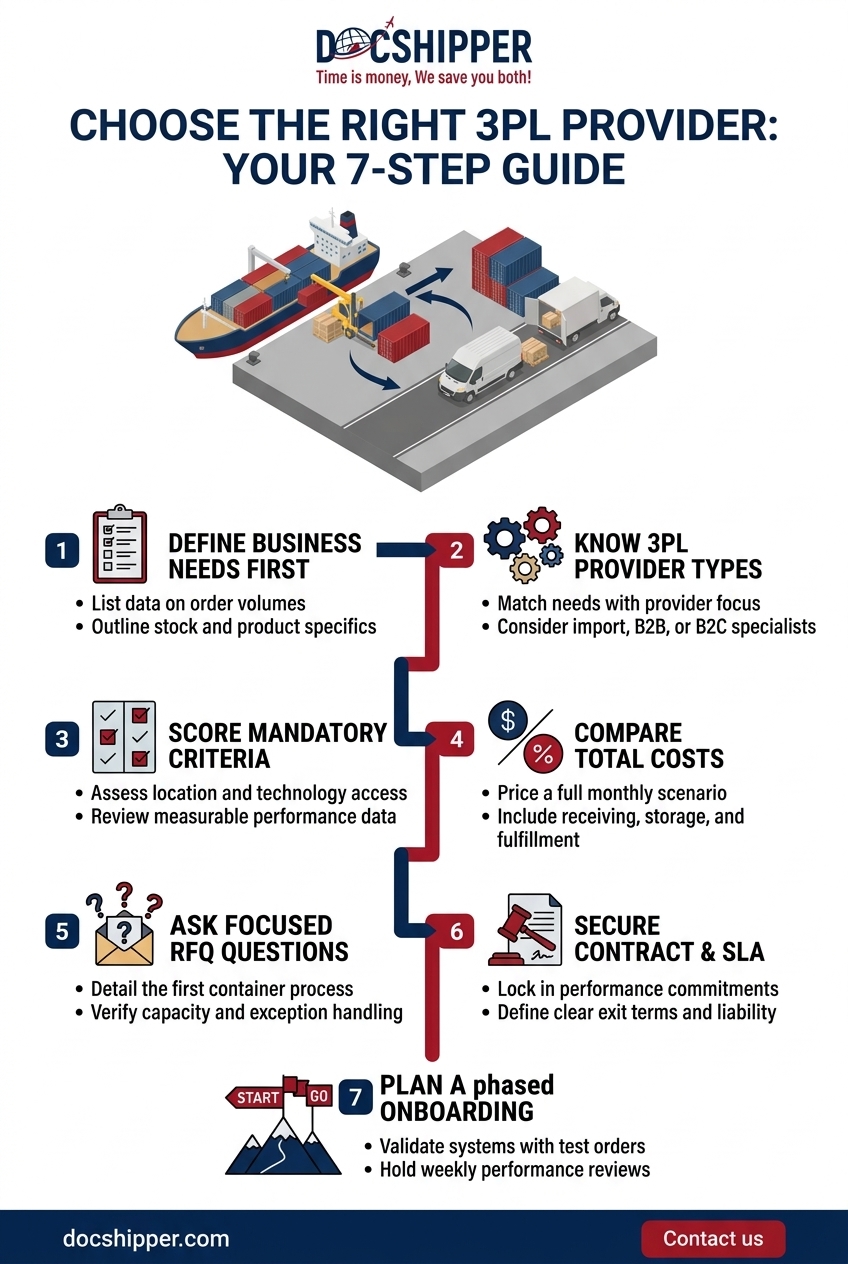
Step 1: Define what you need from a 3PL
Before requesting quotes, document your order volumes and peaks, SKU profile, inbound mode, sales channels, value-added services and required service levels. This needs definition prevents providers from pricing different assumptions and gives you a consistent basis for comparison.
Start with a 12-month data pack. Include monthly orders, average order lines, units per order, returns, peak season dates, SKU count, product dimensions, weights, special handling requirements and inventory value. A SKU, or stock keeping unit, is the unique code used to identify a product or product variation. Include slow-moving and fast-moving items separately because they affect storage and picking effort differently.
Describe how stock reaches the warehouse. A provider receiving parcels has different requirements from one unloading containers, counting cartons, checking purchase orders and reporting shortages. State whether you need devanning, palletization, relabelling, quality checks, customs coordination or delivery from the port to the warehouse.
Map every sales channel: direct-to-consumer website, marketplaces, wholesale customers and retail replenishment. The required integrations, order cut-off times, carton rules and documentation can differ by channel. If you need background on the difference between logistics providers, 3PLs and 4PLs, consult this 3PL versus 4PL guide.
Use this needs template before contacting providers:
- Orders: monthly average, highest month and peak-week expectations
- Products: SKU count, dimensions, weights, lot or serial controls and restricted products
- Inbound: containers, pallets, parcels, ports, estimated receipts and receiving checks
- Outbound: B2C, B2B, marketplace orders, destinations and dispatch cut-offs
- Services: kitting, bundling, labelling, returns inspection and relabelling
- Systems: e-commerce platform, marketplace connections, ERP and reporting requirements
- Controls: inventory accuracy, order accuracy, receiving time and escalation process
Step 2: Know the types of 3PL
E-commerce fulfillment specialists, B2B contract warehouses, freight forwarders with warehousing and marketplace programmes can all be suitable, but they solve different problems. Select the provider type that matches your dominant flow rather than choosing based on a generic fulfillment price.
An e-commerce fulfillment provider usually focuses on fast, repeatable B2C orders, integrations, pick-and-pack operations, parcel shipping and returns. A B2B contract warehouse may be better for pallet movements, wholesale orders, retailer compliance and longer storage cycles. Contract warehousing means space and operational services are provided under an agreed commercial arrangement, rather than treating every shipment as an isolated transaction.
A freight forwarder with warehousing may be useful when the same partner can coordinate international transport, customs clearance, delivery to the warehouse and subsequent fulfillment. This is particularly relevant when your stock arrives by container. A marketplace-oriented provider may add prep, labelling, bundling or routing services, but you should confirm exactly which activities are included.
Do not assume that a provider serving parcels can handle containers well. Ask who books receiving appointments, how unloading is documented, how discrepancies are reported and how quickly stock becomes available for sale. Inbound performance can affect your availability before a single customer order reaches the picking queue.
| Provider type | Best for | Potential limitation |
| E-commerce fulfillment specialist | B2C orders, integrations, parcel dispatch and returns | May have limited container receiving or B2B capability |
| B2B contract warehouse | Pallets, wholesale orders, retailer requirements and bulk storage | May require additional systems or processes for high-volume e-commerce |
| Freight forwarder with warehousing | Import flows, customs coordination, container delivery and storage | Confirm the depth of its pick-and-pack and returns operation |
| Marketplace programme provider | Prep, labelling, bundling and marketplace compliance | Check programme-specific fees, cut-offs and service limits |
Step 3: Compare on the criteria that matter
Score each provider on warehouse location, inbound receiving, technology, measurable KPIs, scalability, value-added services and operational fit. A low-cost warehouse in the wrong position can create higher transport costs and longer replenishment lead times.
Compare locations against your customers, ports, parcel networks and major sales markets. For imported stock, ask whether the proposed warehouse can receive containers from your normal ports and whether the provider coordinates delivery appointments. Confirm whether the quoted location is the actual operating site or a sales office using subcontracted capacity.
Review the warehouse management system, or WMS. A WMS records inventory movements, receiving, storage, picking and dispatch. Ask for a demonstration using your order flow, not a generic presentation. Check integrations with your store, marketplaces, ERP, carrier accounts and returns platform, as well as order status, inventory visibility, batch controls and exportable reports.
Then score operational evidence. Request recent performance data for receiving, inventory accuracy, order accuracy, dispatch before cut-off, returns processing and customer support response. WERC and CSCMP are useful reference points for logistics terminology and KPI design, but your contract should define the measures that apply to your products and channels.
Use a weighted scoring grid. Give each criterion a weight based on business risk, assign each provider a score, multiply the two and record the evidence behind the score. Do not award a high score when the provider only gives a verbal assurance.
| Criterion | Evidence to request | Score |
| Inbound receiving | Container process, appointment rules, count method and discrepancy reports | 1 to 5 |
| Location | Operating address, port access, customer coverage and carrier options | 1 to 5 |
| Technology | WMS demonstration, integrations, reporting and inventory visibility | 1 to 5 |
| Accuracy and speed | Historical KPI reports and proposed measurement method | 1 to 5 |
| Scalability | Peak staffing, space and carrier capacity plan | 1 to 5 |
| Services | Returns, kitting, labelling, inspection and marketplace preparation | 1 to 5 |
Looking for a Reliable Shipping & Sourcing Partner?


Step 4: Understand 3PL pricing models
3PL pricing usually combines receiving, storage, picking, packing, packaging, shipping, returns and additional services. Compare providers through one complete monthly cost scenario using your own data, not through isolated fee-card lines.
Ask each provider to price the same operational event from arrival to final delivery. The scenario should include inbound receiving, container or pallet handling, storage, orders, order lines, packaging materials, shipping, returns, relabelling, account fees and any minimum monthly charges. Ask the provider to identify pass-through costs, fuel or carrier adjustments, peak surcharges and fees triggered by exceptions.
Storage may be charged by pallet, bin, cubic volume or another unit. Pick-and-pack may depend on the number of orders, lines or units. These models cannot be compared without translating them into the same activity profile. Request the assumptions behind every line and ask what happens when volume falls below forecast or rises during peak season.
The US 3PL market recorded USD 323.4 billion in gross revenue in 2025, according to Armstrong & Associates, as reported by Logistics Management on 16 June 2026. Market size does not tell you what your account will cost, so use it as context rather than as a pricing benchmark.
Your comparison sheet should show each line separately:
- Inbound receiving and container or pallet handling
- Storage by the provider’s stated unit
- Pick-and-pack activity
- Packaging and special materials
- Parcel, freight or carrier charges
- Returns receipt and inspection
- Value-added services such as kitting, labelling or bundling
- Technology, account management and minimum charges
- Peak, rush, weekend and exception fees
Step 5: Run an RFQ with the right questions
Send the same data pack and question list to three to five providers. A structured RFQ, or request for quotation, makes responses comparable and exposes assumptions that are often hidden in sales conversations.
Ask how the provider handles your first inbound container from appointment to available inventory. Who unloads it? How are cartons counted? What happens when the physical count differs from the packing list? When will the discrepancy be reported, and when will accepted stock appear in the WMS? These questions test the part of the operation most likely to affect replenishment and stock availability.
Ask about capacity and exceptions. Request the peak plan, staffing model, overflow process, carrier options, cut-off times, returns workflow and business continuity plan. Confirm whether the work is performed by employees, subcontractors or another warehouse. Ask for references from businesses with similar products, order profiles and inbound requirements.
Also ask for the commercial details that determine the real cost: all fee lines, minimums, annual increases, payment terms, pass-through charges, insurance requirements and termination costs. If your products may be sold through Amazon FBA, confirm current preparation responsibilities. Hopstack reported that from 1 January 2026 Amazon no longer provides several US FBA prep and labelling services, including FNSKU and carton labelling, poly bagging, bubble wrap and bundling, regardless of the inbound route.
Include these questions in your RFQ:
- What is your receiving process for containers, pallets and parcels?
- What receiving time and discrepancy-reporting commitment will you offer?
- How do you measure inventory and order accuracy?
- Which WMS, integrations and reports are included?
- What are your order cut-offs and peak-season capacity controls?
- Which services and charges are excluded from the quotation?
- Who carries liability for loss, damage, count discrepancies and picking errors?
- What insurance evidence, references and subcontractor details can you provide?
- How can the agreement be changed or terminated?
Step 6: Check SLAs and the contract
Before signing, define receiving time, inventory accuracy, order accuracy, dispatch cut-off, reporting, escalation, liability, inventory counts and exit rights. A service-level agreement, or SLA, converts operational expectations into measurable commitments.
Write each KPI with a definition, measurement period, data source, target, exclusions and remedy. “Fast receiving” is not enforceable. A usable clause states what event starts the clock, what event ends it, how exceptions are treated and how the result is reported.
Cover inbound controls specifically. The contract should address appointment booking, unloading, carton and pallet counts, visible damage, shortage reports, quarantine stock and the point at which inventory becomes available. It should also explain who pays for rework when the issue results from the warehouse, supplier documentation or transport damage.
Review liability and exit terms with care. Check liability limits, insurance obligations, claims deadlines, inventory reconciliation, data access, confidentiality, price changes, subcontracting, business continuity, notice periods, stock removal assistance and fees for transferring inventory. A low price is not attractive if leaving the contract is operationally impossible.
Use this contract checklist:
| Area | Point to define |
| Receiving SLA | Appointment, unload, count, discrepancy notice and inventory availability |
| Outbound SLA | Order cut-off, dispatch timing, accuracy and exception handling |
| Inventory control | Cycle counts, annual counts, reconciliation and adjustment approval |
| Liability | Loss, damage, errors, insurance, claim process and limits |
| Commercial terms | Fee schedule, minimums, increases, pass-through charges and payment terms |
| Exit | Notice, stock transfer, data export, final charges and transition support |
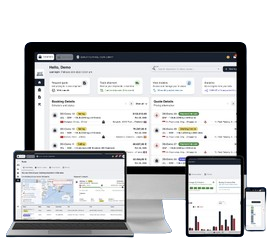
DocShipper Platform
One platform. Your entire supply chain
Sourcing, freight, customs & documents — all centralised, all visible, 24/7.
Step 7: Plan onboarding
Plan onboarding as a controlled operational project, not as a single stock transfer. The sequence should cover data integration, product setup, test orders, inbound validation, inventory transfer, go-live controls and weekly KPI reviews for the first three months.
Begin with master data. Clean SKU codes, dimensions, weights, barcodes, carton configurations, bundles, lot rules, return reasons and shipping restrictions before sending inventory. Confirm how the WMS handles duplicate SKUs, backorders, damaged units, quarantine stock and channel-specific labelling.
Run tests before moving all stock. Send test orders through each channel, validate inventory updates, check carrier labels, confirm packing rules and process a return. For the first inbound containers, agree the delivery appointment, documents, count method, discrepancy escalation and release process in writing.
Use a phased transfer where operationally possible. Keep a clear cutover date, stock reconciliation report, open-order list and customer communication plan. Review receiving, inventory, order accuracy, dispatch performance, returns and unresolved tickets weekly for the first three months, then adjust the operating plan based on evidence.
- Week 1: confirm scope, master data, integrations and responsibilities
- Week 2: test orders, labels, inventory updates and returns
- Go-live preparation: approve inbound appointment, transfer plan and escalation contacts
- First receipts: reconcile quantities, damage and available inventory
- First three months: hold weekly KPI reviews and document corrective actions
Red flags when choosing a 3PL
Warning signs include no clear receiving SLA, vague fee lists, weak references, untested integrations and a long lock-in period without practical exit terms. These issues matter more than a polished warehouse tour or a low headline handling fee.
Be cautious when a provider cannot explain how it handles a container discrepancy, refuses to separate included and excluded services, or gives a price without stating assumptions. A provider that avoids operational questions during the sales process may create larger problems after inventory arrives.
Question claims that are not supported by reports, contract language or references. If a provider promises unlimited peak capacity, perfect accuracy or instant onboarding, ask what evidence supports the promise and what remedy applies when performance falls short.
Before selecting a 3PL, confirm that you can identify the operating site, responsible contacts, receiving workflow, data source for KPIs, total cost assumptions and exit process. If any of these remain unclear, the comparison is not complete.
Conclusion
Choosing a 3PL provider is a flow-matching exercise, not a search for the cheapest fulfillment fee. Your decision should reflect how stock arrives, how products are stored and picked, how orders move through each channel and how the provider will be held accountable.
- Define your needs before asking for quotes.
- Score providers on inbound container handling as well as picking and packing.
- Compare a full monthly cost scenario using identical assumptions.
- Ask the same RFQ questions to three to five providers.
- Write measurable SLAs covering receiving, accuracy, dispatch and reporting.
- Protect your inventory with clear liability, insurance and reconciliation terms.
- Negotiate practical exit clauses and onboard through testing and KPI reviews.
Importing stock for your 3PL or your own warehouse? We ship your containers from Asia, clear customs and deliver to the warehouse on schedule.
FAQ | How to Choose a 3PL Provider: A Practical 7-Step Method
Yes, but you must confirm that its WMS supports the controls your products require. Ask whether it can record batch or serial numbers, apply FIFO or FEFO rules, block quarantined stock and provide traceability from receipt to shipment. Request a live demonstration using a realistic order, return and recall scenario rather than relying on a general software overview.
Confirm how quickly the provider can identify affected units, freeze inventory and produce a list of customers or orders involved. The agreement should define who authorises the recall, who pays for inspection and rework, how customer returns are handled and how inventory records are updated. A recall test before go-live can reveal gaps that ordinary test orders will not show.
Multiple sites may make sense when delivery distance, customs requirements or service-level commitments vary significantly between your main markets. However, splitting inventory also increases safety-stock requirements, transfer costs, integration complexity and the risk of stock imbalances. Start with a single site unless the expected transport savings or service improvement clearly justify the additional control burden.
Not automatically. A warehouse may receive your goods without accepting responsibility for customs declarations, duties, import VAT or regulatory compliance. Clarify who acts as importer of record, who supplies commercial documents, who pays duties and taxes, and who is responsible when customs information is incorrect. Have your customs broker or legal adviser review the arrangement before shipping.
Compare the minimum charge with the cost and operational risk of managing fulfillment yourself. A smaller provider, shared warehouse or pay-as-you-go arrangement may be more suitable while volume is developing. In negotiations, ask whether the minimum can be reduced during a defined launch period and whether unused storage or handling capacity can be carried forward, rather than accepting an open-ended commitment.
A controlled pilot is useful when the products, integrations or inbound process are complex. Start with a limited SKU range, sales channel or shipment batch and define success thresholds for inventory accuracy, order processing, receiving and returns. Keep the pilot period, data access, fees and exit conditions in writing so that a failed test does not leave your inventory or customer orders trapped in the operation.
Need Help with
Logistics or Sourcing ?
First, we secure the right products from the right suppliers at the right price by managing the sourcing process from start to finish. Then, we simplify your shipping experience - from pickup to final delivery - ensuring any product, anywhere, is delivered at highly competitive prices.


Fill the Form
Prefer email? Send us your inquiry, and we’ll get back to you as soon as possible.
Contact us