In short ⚡
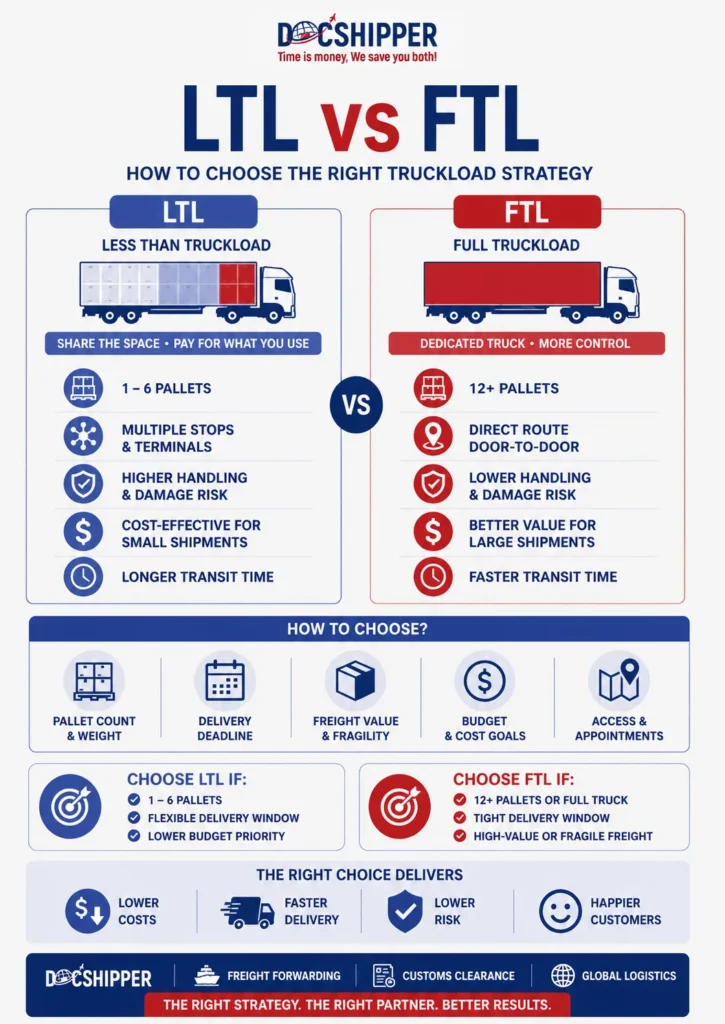
LTL vs FTL compares sharing trailer space with other shippers to reserving an entire truck for your own freight.
LTL suits 1–6 pallets, flexible transit, and smaller loads, while FTL suits higher pallet counts, heavier or high-value freight, and strict delivery windows, with faster, more direct transit and lower damage risk.
We hope you’ll find this article genuinely useful, but remember, if you ever feel lost at any step, whether it’s finding a supplier, validating quality, managing international shipping or customs, DocShipper can handle it all for you!
LTL vs FTL in a nutshell: what they mean and when each fits best
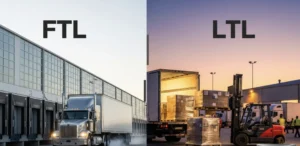
If you’re comparing ltl vs ftl, you’re really choosing between sharing trailer space with other shippers or buying the whole trailer for yourself.
Here’s the thing, the “right” option isn’t about what sounds more premium, it’s about how your freight behaves in the real world: size, handling, time pressure, and how much risk you can tolerate.
We’ve seen importers get this wrong after negotiating hard with a supplier, then losing the savings to reclassification, accessorials, or a late delivery window that triggers chargebacks.
- LTL, you pay for the space you use, your shipment rides with others.
- FTL, you pay for the entire truck, your freight rides alone.
| Criteria | LTL (Less Than Truckload) | FTL (Full Truckload) |
| Best for | 1 to 6 pallets, smaller freight, flexible transit | High volume, heavy freight, tighter delivery windows |
| Handling | Multiple terminals, more touchpoints | Minimal touchpoints, typically door-to-door |
| Pricing logic | Freight class, density, lanes, accessorials | Lane rate, equipment type, seasonality, capacity |
| Risk profile | Higher risk of damage, delays, reweigh or reclass | Lower damage risk, fewer delays from transfers |
Simple workflow to choose fast (ltl vs ftl):
Estimate pallets and total weight, check delivery deadline, assess fragility and value, then compare an LTL quote vs an FTL rate with the same pickup and appointment requirements.
Quick checklist (ltl vs ftl fit):
- Do you need a strict delivery appointment or retailer window?
- Will your freight tolerate extra handling at hubs and cross-docks?
- Are you shipping high-density goods or bulky, low-density cartons?
- Do you expect accessorials like liftgate, limited access, inside delivery?
DocShipper Alert
Let our team validate your LTL vs FTL setup before you book, we model accessorials, reclass risk, and delivery windows to protect your margin.
What is less than truckload (LTL) and how it works in practice
In the ltl vs ftl debate, LTL shipping means your pallets share a trailer with other shipments, and a carrier consolidates everything through terminals.
You’ll notice fast that LTL isn’t “one truck from A to B”, it’s often pickup, terminal sort, linehaul, another terminal, then final delivery.
From experience, the most common LTL pain shows up after pickup: a surprise reweigh or reclass because the pallet footprint or density didn’t match the bill of lading.
We once handled a shipment of boxed fittings that the supplier stacked too wide on the pallet, it pushed the dimensions into a higher cost bracket, and the “cheap” LTL quote stopped being cheap.
- Pros: cost-efficient for small loads, flexible frequency, easier to ship 1 to 3 pallets regularly.
- Cons: more handling, more checkpoints, higher chance of damage or missed appointments.
- Watch-outs: freight class, density, packaging strength, and accessorial charges.
Operationally, LTL rules tend to follow standardized classification practices, and you’ll see references aligned with frameworks used across the industry by bodies like the NMFTA.
What is full truckload (FTL) and how it differs from LTL on the road
On the ltl vs ftl side, FTL shipping means you reserve the entire trailer, so the truck typically runs more directly, with fewer stops that aren’t yours.
If your freight is time-sensitive or fragile, that reduced handling is the real value, not the “bigger shipment” image.
Here’s a scenario we see a lot: you negotiate FOB with a supplier, plan a tight production-to-launch timeline, then the load sits because LTL linehaul schedules don’t align with your cutoff.
Switching to FTL can remove two terminal touches and buy you predictable transit, especially on long lanes.
- Pros: faster point-to-point transit, lower damage risk, easier appointment planning.
- Cons: you pay for unused space if you’re not close to filling the trailer, capacity can tighten in peak seasons.
- Best-fit freight: higher pallet count, heavier loads, high-value goods, or strict delivery windows.
When you book FTL, you’ll also bump into compliance and safety requirements that professional carriers follow under guidance commonly associated with agencies like the FMCSA, which influences driver hours and scheduling realism.
Looking for a Reliable Shipping & Sourcing Partner?
Key decision factors: how to decide between LTL and FTL for your shipment
Choosing in ltl vs ftl isn’t a theory exercise, it’s a cost, risk, and service-level decision you can model before you book.
And yes, you’ve probably already dealt with suppliers who confirm “ready cargo” on Friday, then your pickup fails, and suddenly the whole plan collapses.
We build the decision around your shipment profile first, then we stress-test it against deadlines and risk.
Step-by-step workflow (ltl vs ftl decision):
1) Confirm packed dimensions and pallet count, 2) validate total weight and packaging type, 3) map pickup and delivery constraints, 4) estimate LTL class and accessorials, 5) compare to an FTL all-in rate, 6) choose the option that protects your service level.
Decision checklist you can use before requesting quotes:
- Do you have accurate packed dimensions, not just product dimensions?
- Are pallets stackable, or will the carrier treat them as non-stackable?
- Do you need liftgate, residential delivery, or limited access pickup?
- Is your deadline firm, or can you accept a wider delivery window?
DocShipper Info
We compare LTL and FTL side by side, including real pickup constraints and accessorial exposure, so your service level stays intact.
Shipment profile: weight, pallet count, dimensions, and freight class
In ltl vs ftl, your shipment profile is the first filter, pallets, weight, and dimensions tell you whether LTL pricing will stay stable or get hit with adjustments.
If your load starts creeping toward a partial truck, LTL can suddenly price like a premium service, while FTL becomes the simpler play.
A quick real-life example: we’ve seen a buyer plan for “4 pallets”, then the supplier ships 6 because they didn’t want to double-stack cartons.
The result, the LTL carrier billed dimensional changes and the cost landed close to an FTL rate, with more risk and longer transit.
- Pallet count: as you move past mid-single digits, you should benchmark FTL.
- Density: low-density freight often gets a higher LTL class, higher cost.
- Dimensions: overhang or oversized pallets trigger reclass and fees.
- Freight class: misclassifications are one of the biggest LTL budget killers.
If you want this to run smoothly, we’ll typically ask you for photos of the loaded pallets and the final packing list before we lock the booking.
DocShipper Advice
Send us pallet photos and final packing lists, we flag density, class, and overhang risks before carriers do.
Speed, risk, and budget: finding the best trade‑off for your business
The real ltl vs ftl decision often comes down to what you’re optimizing for: the lowest line-item cost, or the lowest total landed cost once delays and damage risk enter the picture.
You can save $200 on LTL and lose $2,000 if a missed delivery window triggers storage, re-delivery, or retailer penalties.
We’ve had customers shipping cosmetics to a 3PL with strict receiving appointments, the LTL carrier missed by a day after a terminal delay.
They paid detention and rescheduling fees, then switched to FTL for the next run because predictability mattered more than the initial quote.
- Speed: FTL usually wins on direct transit and schedule control.
- Risk: LTL has more touchpoints, so packaging and labeling matter more.
- Budget: LTL wins for smaller loads, but watch accessorials and post-audit charges.
- Service level: appointments and tight windows often justify FTL.
When you’re unsure, we can quote both options and walk you through the “all-in” comparison, pickup constraints, accessorials, and the risk profile, so you don’t choose blind.
DocShipper Alert
We calculate the true landed impact, including delay penalties and damage exposure, so you choose with full visibility.
Core differences between LTL and FTL you must understand before booking
When you compare LTL vs FTL, you are not just choosing a price. You are choosing a transport model that affects cost structure, risk exposure, transit time, and operational complexity.
Before you book any truck, you need to understand how each model behaves on the road and inside the carrier network. These differences directly impact your margins and customer satisfaction.
| Criteria | LTL | FTL |
| Truck space | Shared with multiple shippers | Dedicated to one shipper |
| Pricing model | Based on freight class, weight, pallet count | Flat rate per truck, regardless of fill rate |
| Transit time | Longer, multiple terminals and stops | Direct route, fewer handling points |
| Handling frequency | High, cross-docking and transfers | Minimal, usually loaded once and unloaded once |
| Damage risk | Higher due to multiple touches | Lower due to limited handling |
| Best for | Small to mid-sized shipments | Large volume or high-value freight |
With LTL, your pallets move through hub-and-spoke networks. That means more scans, more docks, and more chances for delays or claims.
With FTL, you control the entire trailer capacity. You gain predictability, tighter scheduling, and lower per-unit cost when volume justifies it.
- Choose LTL if your shipment is under 10 to 12 pallets or below roughly 10,000 to 15,000 lbs
- Choose FTL if you approach 24 to 26 pallets or need the full trailer space
- Switch to FTL if damage risk or delivery penalties cost you more than the freight difference
- Evaluate density, because lightweight bulky freight can make LTL expensive
At DocShipper, we often audit your shipment profile before advising on ltl vs ftl. A wrong decision at this stage can erode your logistics margin for the entire quarter.
DocShipper Info
Our freight audit reviews class, density, and lane economics to confirm whether LTL or FTL protects your cost structure long term.
Practical use cases: examples of when LTL wins and when FTL makes more sense

Theory is helpful, but your daily operations are what really matter. Let’s look at situations where each model clearly outperforms the other.
When LTL wins, you optimize flexibility and cash flow. You only pay for the space you use.
- Shipping 4 pallets of spare parts to a regional distributor
- Replenishing retail stores with limited backroom capacity
- Testing a new product in small batches before scaling
- Managing seasonal overflow without committing to full trailers
When FTL makes more sense, control and speed become strategic priorities. You reduce handling and shorten lead time.
- Moving 20 plus pallets from a factory to a central warehouse
- Transporting fragile or high-value goods
- Meeting strict delivery appointments with financial penalties
- Executing time-sensitive production replenishment
In cross-border trade, especially between Mexico, Canada, and the US, FTL often simplifies customs coordination. One truck, one shipment, one set of documents.
For ecommerce brands scaling fast, we frequently see a shift from LTL to FTL once order consolidation improves. That transition is a key growth milestone in your supply chain maturity.

DocShipper Advice
We help you plan the shift from LTL to FTL, aligning consolidation, customs, and capacity with your expansion roadmap.
Conclusion
You now understand that choosing between LTL and FTL is a strategic logistics decision. It directly affects cost efficiency, risk exposure, and service reliability.
- LTL is ideal for smaller shipments and cost flexibility
- FTL provides speed, control, and lower risk for large volumes
- Handling frequency is a major factor in damage and delay risk
- Shipment density and pallet count should guide your cost analysis
- Your long-term growth strategy may shift you from LTL to FTL
- Working with a freight partner like us ensures you choose the optimal model every time
If you want to optimize your ltl vs ftl strategy, we analyze your shipment data, negotiate carrier contracts, and manage the entire transport flow. You focus on selling, we secure the right truck at the right cost.
FAQ | ltl vs ftl: how to choose the right truckload strategy for your freight
Think LTL when your shipment is “small but frequent” rather than “big and consolidated”:
- You’re shipping about 1–6 pallets or well below a full trailer.
- You don’t have a rigid delivery appointment or retailer penalty window.
- Your cash flow prefers paying only for the space you use.
- Your freight is reasonably durable and can tolerate extra handling at terminals.
- You’re testing a new lane, new product, or sporadic orders where volume isn’t stable yet.
The tipping point usually shows up in your numbers and your pain:
- **Volume triggers**
- You’re regularly shipping 8–12+ pallets on a lane.
- Your total weight approaches 10,000–15,000 lbs or more.
- **Cost triggers**
- LTL quotes (plus accessorials and reclass fees) are close to or higher than an FTL rate.
- Your “partial” loads occupy most of a trailer footprint.
- **Risk & service triggers**
- Missed LTL appointments are causing storage, re-delivery, or chargebacks.
- Damage and claims are rising due to repeated handling and cross-docking.
When 2–3 of these bullets apply on the same lane, it’s time to benchmark FTL every time.
With LTL, packaging and labeling do most of the work for you:
- **Packaging basics**
- Use new or strong pallets, no broken boards or missing deck boards.
- Shrink-wrap tightly, including at the pallet base, and use corner boards.
- Keep freight inside the pallet footprint—no overhang.
- **Stacking & stability**
- Avoid top-heavy pallets; put heavier cartons at the bottom.
- If pallets are non‑stackable, mark them clearly and design them to resist side impact.
- **Labeling & documents**
- Apply labels on at least two sides, not just the top.
- Match BOL details to the actual weight, class, and dimensions.
- **Operational habits**
- Take photos of packed pallets before pickup.
- Use carriers with solid LTL claims performance, not just the cheapest rate.
Both models have traps, but LTL is where “cheap” can turn expensive fast:
- **LTL hidden costs**
- Reweigh / reclass fees when dimensions or class don’t match the BOL.
- Accessorials: liftgate, residential or limited access, inside delivery, appointment fees.
- Storage and re-delivery if appointments are missed.
- Damage and claims, plus the cost of re-shipping replacements.
- **FTL hidden costs**
- Detention and layover if loading/unloading takes too long.
- Truck ordered not used (TONU) if you cancel late.
- Fuel surcharges and peak-season capacity surcharges.
The fix: request quotes with **all** constraints disclosed (dock type, appointments, equipment needs) and compare the “all‑in” cost, not just line-haul.
In most cases, FTL is the safer play, but you can make either work with the right setup:
- Choose **FTL** when:
- The cargo is fragile, high-value, or sensitive to vibration and stacking.
- A single damage incident would cost more than the FTL price difference.
- You need minimal handling and a direct route.
- If you must use **LTL**:
- Over-invest in packaging (crating, foam, corner protection, double‑wall cartons).
- Clearly mark “Do Not Stack” and secure loads to pallets with straps and wrap.
- Select premium LTL carriers with strong damage ratios, not generic economy options.
Ask yourself: “If this shipment breaks or is delayed, what’s my real loss?” That answer usually points you to FTL for higher‑risk freight.
Use a quick, repeatable decision workflow instead of gut feeling:
- Step 1 – Confirm the **packed** dimensions, weight, and pallet count.
- Step 2 – Check **delivery requirements**: deadline, appointment, penalties.
- Step 3 – Assess **fragility and value**: how much damage or delay can you tolerate?
- Step 4 – List expected **accessorials** (liftgate, residential, limited access, etc.).
- Step 5 – Get a realistic **LTL quote** (with freight class and accessorials) and an **FTL rate** for the same lane.
- Step 6 – Compare:
- All‑in freight cost (including risk of claims and penalties).
- Transit reliability and appointment control.
- Impact on your customer promises and margins.
Document this in a simple matrix per lane and product type—after a few cycles, patterns emerge and the choice becomes almost automatic.
Your truckload strategy directly impacts how “reliable” you look as a supplier:
- With **LTL**:
- More risk of missed appointments due to terminal delays.
- Higher chance of partial deliveries or split shipments.
- Receiving teams may face mixed-quality pallets and more handling work.
- With **FTL**:
- Easier to hit strict delivery windows and vendor compliance rules.
- Cleaner inbound flows: one truck, one shipment, one set of documents.
- Lower chance of chargebacks, detention, and frustration with your brand.
If key customers or 3PLs run tight schedules and use penalty structures, leaning toward FTL on those lanes often protects both your relationship and your margin.
Need Help with
Logistics or Sourcing ?
First, we secure the right products from the right suppliers at the right price by managing the sourcing process from start to finish. Then, we simplify your shipping experience - from pickup to final delivery - ensuring any product, anywhere, is delivered at highly competitive prices.
Fill the Form
Prefer email? Send us your inquiry, and we’ll get back to you as soon as possible.
Contact us