In short ⚡
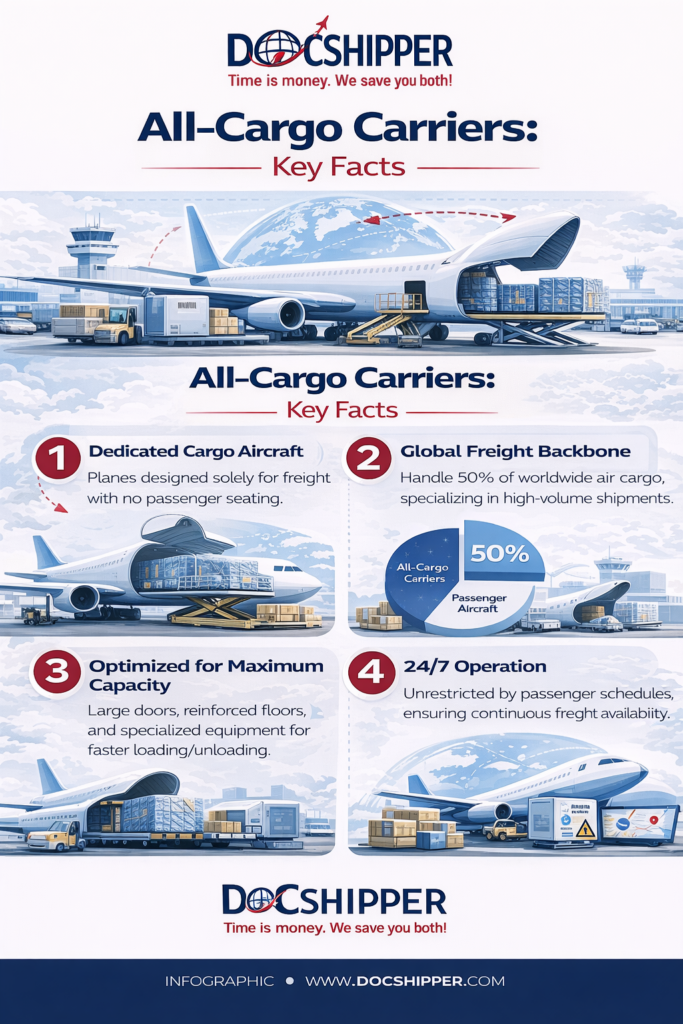
An All-Cargo Carrier is an airline that exclusively transports freight and mail, operating no scheduled passenger services. These specialized carriers utilize dedicated cargo aircraft with reinforced floors, large loading doors, and optimized configurations for maximum payload capacity, serving global supply chains with time-sensitive and high-volume shipments.Introduction
Many businesses struggle to differentiate between passenger airlines offering cargo services and dedicated freight operators. This distinction matters significantly when shipping time-critical goods or managing large-scale international logistics.
All-cargo carriers form the backbone of global air freight infrastructure, handling approximately 50% of worldwide air cargo volume. Their specialized operations enable faster customs clearance, flexible scheduling, and capacity guarantees that mixed-service airlines cannot match.
Key characteristics of all-cargo carriers include:
- Dedicated fleet configuration: Aircraft designed exclusively for freight with no passenger seats
- 24/7 operational capability: Unrestricted by passenger flight schedules or airport slot limitations
- Specialized handling infrastructure: Direct ramp access, temperature-controlled facilities, and hazmat capabilities
- Payload optimization: Maximum weight and volume utilization without passenger baggage constraints
- Express integration: Direct connectivity with ground courier networks for door-to-door service
Operational Framework & Industry Expertise
All-cargo carriers operate under distinct regulatory frameworks compared to passenger airlines. The Federal Aviation Administration (FAA) and International Civil Aviation Organization (ICAO) classify these operators under Part 121 or equivalent international regulations, requiring specific certifications for freight-only operations.
The business model differs fundamentally from passenger carriers. All-cargo airlines generate revenue exclusively through freight rates, typically charging by chargeable weight (greater of actual or volumetric weight). They maintain profitability through high utilization rates, often exceeding 12 flight hours daily per aircraft.
Fleet composition represents a critical operational advantage. Dedicated freighters feature main deck cargo loading through nose doors or side cargo doors, enabling palletized shipments up to 20 feet long. Lower deck capacity accommodates containerized freight in standardized ULD (Unit Load Device) configurations.
The network structure typically follows hub-and-spoke models with major sorting facilities located at strategic global points. These hubs operate with military precision, sorting thousands of shipments nightly through automated conveyor systems and barcode tracking.
Customs integration provides significant competitive advantages. According to U.S. Customs and Border Protection, all-cargo carriers maintain bonded warehouse facilities and direct electronic data interchange with customs authorities, accelerating clearance processes.
At DocShipper, we leverage partnerships with major all-cargo carriers to guarantee capacity during peak seasons, ensuring our clients’ shipments move without delay regardless of market conditions.
Practical Examples & Market Data
The all-cargo carrier market demonstrates distinct operational patterns and economic metrics that differentiate it from passenger airline cargo services.
Market Leaders Comparison
| Carrier | Fleet Size | Annual Tonnage | Primary Markets |
|---|---|---|---|
| FedEx Express | 380+ aircraft | 6.8 million tons | Express parcels, e-commerce |
| UPS Airlines | 290+ aircraft | 5.2 million tons | Integrated logistics, healthcare |
| Cargolux | 30+ aircraft | 1.1 million tons | Heavy cargo, oversized freight |
| Kalitta Air | 25+ aircraft | 850,000 tons | Charter, ACMI operations |
Use Case: Electronics Manufacturing Supply Chain
A semiconductor manufacturer needs to ship 8,000 kg of precision components from Taiwan to Germany within 48 hours. The shipment requires temperature control between 15-25°C and vibration-sensitive handling.
All-cargo carrier solution:
- Direct routing: Taipei (TPE) → Frankfurt (FRA) with single aircraft, no transshipment
- Transit time: 36 hours door-to-door including customs clearance
- Cost structure: $18.50/kg = $148,000 total (includes fuel surcharge, security fees, handling)
- Capacity guarantee: Reserved main deck space with priority loading
- Risk mitigation: $500,000 cargo insurance, real-time GPS tracking, dedicated customer service
DocShipper Platform
Cut logistics costs. Not corners.
See exactly where your logistics costs are bleeding — and how to fix it. Book your expert demo.

Industry Performance Metrics
Recent data reveals critical operational differences:
- Load factor: All-cargo carriers average 68% versus 48% for passenger airline belly cargo
- On-time performance: 94% for dedicated freighters versus 87% for mixed operations
- Damage rate: 0.3% for all-cargo versus 0.7% for passenger airline cargo holds
- Revenue per available ton-kilometer: $0.42 for pure freighters versus $0.31 for passenger conversions
- Peak season surcharges: 15-25% premium during Q4 e-commerce rush, significantly lower than passenger airline premiums
Conclusion
All-cargo carriers provide unmatched reliability and capacity for businesses requiring dedicated freight solutions. Their specialized infrastructure and operational focus deliver measurable advantages in transit time, handling quality, and supply chain predictability.
Need expert guidance on selecting the right all-cargo carrier for your shipments? Contact DocShipper for customized freight solutions tailored to your industry requirements.
📚 Quiz
Test Your Knowledge: All-Cargo Carrier
Q1 — What best defines an all-cargo carrier?
Q2 — A common misconception is that all-cargo carriers are always more expensive than passenger airlines for freight. According to the article, when do all-cargo carriers actually offer better value?
Q3 — A semiconductor manufacturer needs to ship 8,000 kg of temperature-sensitive components from Taiwan to Germany within 48 hours. Which solution best fits this scenario?
🎯 Your Result
📞 Free Quote in 24hFAQ | All-Cargo Carrier: Definition, Operations & Practical Examples
All-cargo carriers operate exclusively freight aircraft with no passenger seats, providing dedicated capacity, flexible scheduling, and specialized handling infrastructure. Passenger airlines allocate limited belly hold space, subject to passenger priority and weight restrictions.
Rates vary by route and volume. All-cargo carriers often provide better value for large shipments (500+ kg) due to volume discounts and guaranteed capacity. For small parcels under 100 kg, passenger airline cargo may offer competitive pricing.
Yes, most all-cargo carriers maintain IATA Dangerous Goods certifications and can transport hazmat shipments following ICAO Technical Instructions. Passenger airlines face stricter restrictions on hazardous cargo in belly holds.
Common freighter aircraft include Boeing 747-400F, 777F, 767-300F, and 737-800BCF, plus Airbus A330-200F. Many carriers also operate converted passenger aircraft (passenger-to-freighter conversions) for cost-effective capacity expansion.
Dedicated freighters typically arrive at cargo-specific terminals with direct customs facilities, enabling faster clearance. Many all-cargo carriers maintain customs bonded warehouses and pre-clearance programs, reducing ground time by 6-12 hours compared to passenger terminals.
Most major all-cargo carriers provide active and passive temperature control solutions, including refrigerated containers, thermal blankets, and climate-controlled warehousing. This capability is essential for pharmaceuticals, perishables, and electronics requiring specific temperature ranges.
Capacity varies by aircraft type: Boeing 747-8F carries up to 140 tons, 777F handles 103 tons, while narrow-body 737-800BCF manages 23 tons. All-cargo carriers optimize payload through weight distribution and fuel management strategies.
Pricing follows chargeable weight calculations (greater of actual or volumetric weight at 167 kg/m³ or 366 lbs/cubic foot). Rates include base freight charge plus fuel surcharges, security fees, handling charges, and destination fees. Volume commitments typically secure 15-30% discounts.
Major all-cargo carriers provide online tracking systems with milestone updates (booking, departure, arrival, customs clearance, delivery). Premium services include GPS tracking, temperature monitoring, and proactive exception alerts via email or SMS.
Standard liability coverage ranges from $20-$50 per kilogram under Warsaw/Montreal Convention limits. Shippers should purchase additional cargo insurance for high-value goods, as carrier liability rarely covers full replacement value for electronics, jewelry, or specialized equipment.
Major carriers maintain published flight schedules on primary routes, operating 3-7 weekly frequencies. Secondary routes may operate on demand or charter basis. Express carriers like FedEx and UPS run daily overnight networks with precise cutoff times.
Specialized all-cargo carriers operate nose-loading freighters capable of accommodating cargo up to 40 feet long and weighing 100+ tons. These carriers provide engineering analysis, custom loading plans, and specialized ground handling equipment for industrial machinery, aerospace components, and project cargo.
Need Help with
Logistics or Sourcing ?
First, we secure the right products from the right suppliers at the right price by managing the sourcing process from start to finish. Then, we simplify your shipping experience - from pickup to final delivery - ensuring any product, anywhere, is delivered at highly competitive prices.


Fill the Form
Prefer email? Send us your inquiry, and we’ll get back to you as soon as possible.
Contact us