In short ⚡
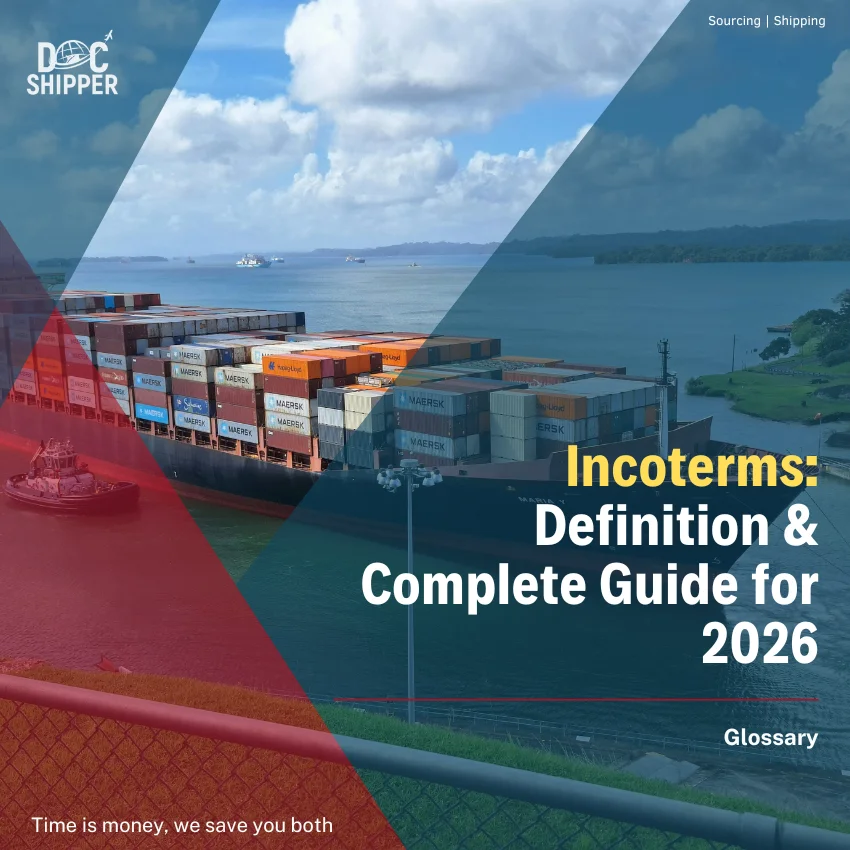
Incoterms (International Commercial Terms) are standardized trade terms published by the International Chamber of Commerce (ICC) that define the responsibilities, costs, and risks between buyers and sellers in international transactions. These rules clarify who pays for shipping, insurance, customs, and when the risk transfers from seller to buyer.
Introduction
One of the most common mistakes in international trade? Assuming that “shipping costs included” means the same thing to everyone. Without standardized commercial terms, disputes over who pays customs duties, freight charges, or insurance premiums are inevitable. This ambiguity can lead to costly delays, legal conflicts, and damaged business relationships.
Incoterms exist precisely to eliminate this confusion. Used in over 140 countries, they provide a universal language for international commerce. Whether you’re shipping electronics from Shenzhen or coffee from Colombia, these rules ensure both parties understand their obligations from the moment goods leave the factory until they reach the final destination.
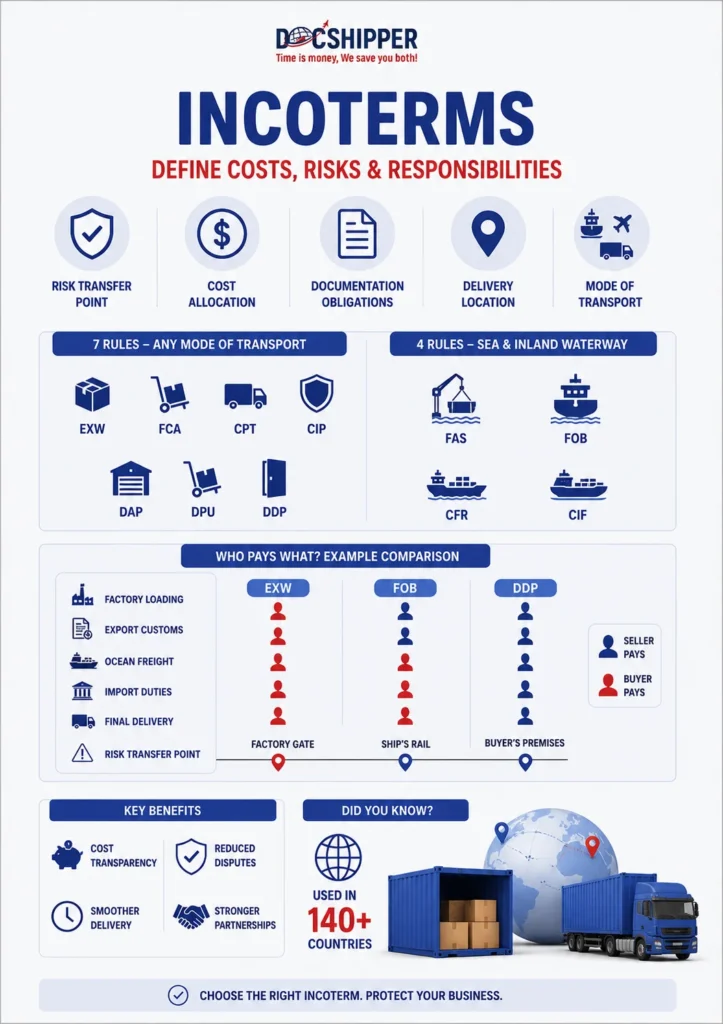
Key characteristics of Incoterms include:
- Risk transfer point: Defines exactly when responsibility shifts from seller to buyer
- Cost allocation: Specifies who pays for transport, insurance, and customs clearance
- Documentation obligations: Clarifies which party handles export/import paperwork
- Delivery locations: Establishes precise handover points (factory, port, warehouse)
- Mode of transport: Certain terms apply only to sea freight, others to any transport method
Understanding Incoterms: Deep Dive & Expertise
The current version, Incoterms 2020, comprises 11 distinct rules divided into two categories. Rules for any mode of transport (EXW, FCA, CPT, CIP, DAP, DPU, DDP) and rules exclusively for sea and inland waterway transport (FAS, FOB, CFR, CIF). This distinction matters because using a maritime-only term for air freight creates legal ambiguity.
The risk transfer mechanism operates independently from cost allocation. For instance, under CFR (Cost and Freight), the seller pays for ocean freight to the destination port, but risk transfers to the buyer once goods cross the ship’s rail at the loading port. This separation often confuses newcomers who assume whoever pays freight also bears the risk during transit.
From a legal perspective, Incoterms are not laws but contractual terms incorporated by reference. According to the World Trade Organization, they complement but don’t replace the need for a comprehensive sales contract. Courts worldwide recognize them, though interpretation can vary slightly by jurisdiction.
The insurance dimension deserves special attention. Only CIF and CIP require the seller to arrange insurance. CIP 2020 mandates Institute Cargo Clauses (A) coverage, while CIF requires only minimum coverage under Clauses (C). This difference reflects the fact that CIF applies exclusively to sea transport, where lower coverage historically sufficed.
At DocShipper, we systematically verify Incoterms alignment during contract review. We’ve encountered countless disputes arising from mismatched terms—for example, a Chinese exporter quoting FOB Shanghai while the European buyer expected DDP Hamburg. Such misalignments create unexpected costs and delays that proper verification prevents.
Practical Examples & Data Comparison
Consider a practical scenario: importing machinery from Germany to the United States. The cost breakdown varies dramatically depending on the chosen Incoterm. Here’s a comparative analysis showing how responsibility and expenses shift across three common terms:
| Cost Element | EXW (Ex Works) | FOB (Free On Board) | DDP (Delivered Duty Paid) |
|---|---|---|---|
| Factory Loading | Buyer | Seller | Seller |
| Export Customs | Buyer | Seller | Seller |
| Ocean Freight | Buyer | Buyer | Seller |
| Import Duties | Buyer | Buyer | Seller |
| Final Delivery | Buyer | Buyer | Seller |
| Risk Transfer Point | Factory gate | Ship’s rail | Buyer’s premises |
Use Case: A textile importer in Los Angeles orders $50,000 worth of fabric from Vietnam. Under FOB Ho Chi Minh, the supplier arranges export and loading (approximately $800). The buyer pays ocean freight ($2,200), U.S. customs duties at 8% ($4,000), and inland delivery ($350). Total landed cost: $57,350.
Had the same transaction used DDP Los Angeles, the Vietnamese supplier would quote approximately $58,500 all-inclusive. While this appears $1,150 more expensive, it eliminates the buyer’s logistical burden, customs brokerage fees, and import compliance risk—valuable for companies without import expertise.
Industry data reveals telling patterns. According to ICC surveys, FOB and CIF dominate sea freight (68% combined usage), while FCA increasingly replaces FOB for containerized cargo due to clearer liability. For air and multimodal shipments, DAP accounts for 41% of transactions, as buyers prefer controlling customs clearance.
Regional preferences also vary significantly. European importers favor DDP for Asian sourcing (52% adoption rate), reflecting confidence in supplier logistics capabilities. Conversely, North American buyers typically use FOB or FCA (63% combined), preferring to control ocean freight negotiations and leverage volume discounts with their forwarders.
The choice carries financial implications beyond obvious costs. Under EXW, buyers assume all risks immediately, potentially complicating insurance claims if damage occurs during loading. DDP transfers maximum responsibility to sellers but requires they understand foreign import regulations—a capability not all exporters possess, creating compliance risks.
Conclusion
Incoterms form the backbone of international trade clarity, transforming vague agreements into precise contractual obligations. Selecting the appropriate term requires analyzing not just costs but also risk tolerance, logistical capabilities, and regulatory expertise. The wrong choice creates disputes, unexpected expenses, and supply chain disruptions that far exceed any perceived savings.
Need guidance selecting the optimal Incoterm for your shipments? Contact DocShipper for expert advice tailored to your specific trade routes and business requirements.
📚 Quiz
Test Your Knowledge: Incoterms
What is the primary purpose of Incoterms in international trade?
Under CFR (Cost and Freight) terms, who bears the risk during ocean transit?
A company wants to ship electronics by air from China to the USA. Which Incoterm should they use?
🎯 Your Result
📞 Free Quote in 24hFAQ | Incoterms: Definition, Calculation & Concrete Examples
Incoterms 2020 replaced DAT with DPU (Delivered at Place Unloaded), allowing delivery at any location, not just terminals. CIP insurance requirements increased from Institute Cargo Clauses (C) to (A), providing broader coverage. FCA now permits buyers to instruct carriers to issue on-board bills of lading to sellers. The explanatory notes were enhanced for clarity, and the rules align better with modern security requirements and containerized transport practices.
No. FOB (Free On Board) applies exclusively to sea and inland waterway transport. For air freight, use FCA (Free Carrier) instead. FOB's risk transfer point—"when goods pass the ship's rail"—makes no sense for air cargo. Using FOB incorrectly creates legal ambiguity about when risk transfers. FCA works for all transport modes and clearly defines the handover point, typically the airport cargo terminal or carrier's warehouse.
The buyer pays import customs duties under CIF (Cost, Insurance, and Freight). While the seller covers ocean freight and minimum insurance to the destination port, responsibility transfers once goods cross the ship's rail at the origin port. Import duties, taxes, customs clearance fees, and onward delivery from the destination port all fall to the buyer. This cost split often confuses newcomers who assume comprehensive seller responsibility.
No. Only CIF and CIP require the seller to arrange cargo insurance. Under all other terms, insurance is optional but highly recommended. Even when not contractually obligated, prudent traders secure coverage because Incoterms allocate risk transfer points but don't mandate insurance. The party bearing risk during transport should arrange appropriate coverage. Many experienced importers maintain open cargo policies regardless of the Incoterm used.
The risk transfer point defines exactly when responsibility for loss or damage shifts from seller to buyer. If goods are destroyed after this point, the buyer still must pay the seller. For example, under FOB, once cargo crosses the ship's rail, any subsequent damage (storm, accident, theft) becomes the buyer's problem. This operates independently from who pays freight—under CFR, the seller pays shipping but risk transferred earlier at loading.
While technically possible to modify Incoterms through contract amendments, doing so defeats their purpose as standardized terms and creates confusion. If standard rules don't fit, choose a different Incoterm rather than altering one. Courts and insurers interpret Incoterms as published by ICC. Modifications introduce ambiguity and potential disputes. Better to use precise contract language alongside an unmodified Incoterm to address unique requirements.
EXW (Ex Works) gives buyers maximum control, as they handle everything from factory loading through final delivery. However, this also means maximum responsibility and complexity. Buyers must arrange export customs clearance in the seller's country, which can be legally complicated. FCA offers a practical alternative—buyers control main transport while sellers handle export formalities. For importers with strong logistics capabilities, EXW or FCA enables better cost management and carrier selection.
Always specify the Incoterm in writing within the sales contract, purchase order, or commercial invoice. Include the specific version (e.g., "FOB Shanghai Incoterms 2020") and the precise location. Verbal agreements or assumptions create disputes. The commercial invoice should prominently display the term. This documentation becomes critical for customs declarations, insurance claims, and resolving disagreements. Email confirmations explicitly stating the term also provide evidence.
No. Incoterms address only delivery obligations, cost allocation, and risk transfer—not payment conditions or when legal ownership changes. You can use FOB terms but pay via letter of credit, wire transfer, or open account. Ownership transfer depends on your sales contract and applicable law, not the Incoterm. For example, goods might be delivered under DDP, but ownership could transfer upon payment or at shipment depending on contract terms.
FOB remains the most widely used term for ocean freight, particularly in Asia-Pacific trade, accounting for approximately 35-40% of maritime transactions. FCA is gaining popularity for containerized shipments due to clearer liability provisions. For air freight and multimodal transport, DAP dominates. Regional preferences vary—European trade favors DDP and CIP, while North American importers prefer FOB and FCA. The "most common" depends heavily on industry, transport mode, and geographic route.
Yes, especially when lacking import expertise. DDP (Delivered Duty Paid) shifts all logistics complexity to the seller, allowing small importers to receive goods ready for sale without navigating customs regulations, freight booking, or duty calculations. However, sellers typically add a premium for this convenience. Small businesses should compare DDP quotes against FOB plus third-party logistics services. For occasional imports or unfamiliar markets, DDP's simplicity often justifies slightly higher costs.
Under FCA, risk transfers when goods are handed to the carrier nominated by the buyer. If damage occurs after this handover, the buyer bears the loss. This makes cargo insurance essential when using FCA. The buyer should arrange coverage from the carrier's warehouse or the moment the carrier takes possession. If damage occurs before handover (while still at seller's premises), the seller remains responsible. Clear documentation of handover timing and condition proves critical for claims.
Need Help with
Logistics or Sourcing ?
First, we secure the right products from the right suppliers at the right price by managing the sourcing process from start to finish. Then, we simplify your shipping experience - from pickup to final delivery - ensuring any product, anywhere, is delivered at highly competitive prices.


Fill the Form
Prefer email? Send us your inquiry, and we’ll get back to you as soon as possible.
Contact us