


In short ⚡
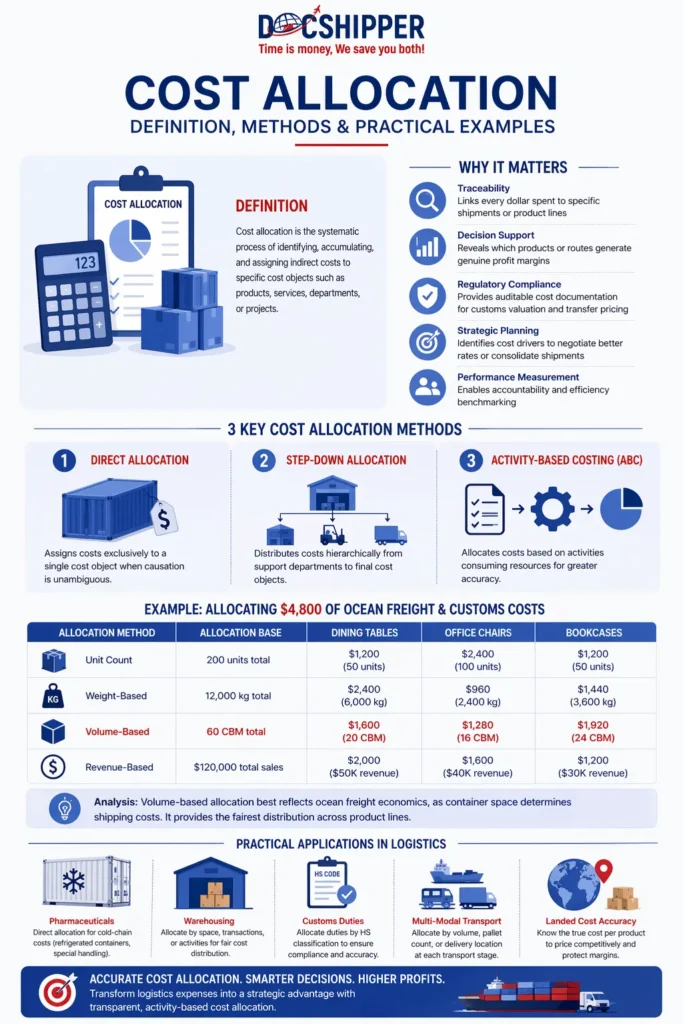
Cost allocation is the systematic process of identifying, accumulating, and assigning indirect costs to specific cost objects such as products, services, departments, or projects. This accounting methodology enables businesses to accurately determine true operational expenses, establish competitive pricing strategies, and optimize resource distribution across international supply chains.Introduction
Many importers struggle to determine the actual landed cost of their goods. Shipping charges, warehouse fees, customs brokerage, and administrative overhead often remain buried in general expense accounts, distorting profitability calculations and pricing decisions.
In international logistics, cost allocation transforms opaque expense pools into transparent, product-specific costs. This precision becomes critical when managing multi-SKU shipments, evaluating supplier performance, or justifying pricing to clients.
- Traceability: Links every dollar spent to specific shipments or product lines
- Decision Support: Reveals which products or routes generate genuine profit margins
- Regulatory Compliance: Provides auditable cost documentation for customs valuation and transfer pricing
- Strategic Planning: Identifies cost drivers to negotiate better carrier rates or consolidate shipments
- Performance Measurement: Enables departmental accountability and efficiency benchmarking
Cost Allocation Fundamentals & Methodology
Cost allocation operates through allocation bases—quantifiable metrics that distribute shared expenses proportionally. Common bases include weight, volume, revenue, labor hours, or transaction count. The chosen base must demonstrate a logical cause-and-effect relationship with the cost incurred.
International freight logistics typically employs three primary allocation methods:
Direct allocation assigns costs exclusively to a single cost object when causation is unambiguous. For example, container detention fees apply only to the specific shipment that exceeded free time. This method provides maximum accuracy but applies only to traceable expenses.
Step-down allocation sequences cost distribution hierarchically. Warehouse operating costs might first allocate to storage zones, then subdivide to individual SKUs based on cubic footage occupied. This method balances precision with administrative feasibility for mid-sized operations.
Activity-based costing (ABC) identifies discrete activities consuming resources, then allocates costs based on activity consumption. Customs clearance might allocate based on HS code complexity, while quality inspection allocates per unit inspected. ABC delivers superior accuracy for complex, multi-service logistics operations.
According to the International Accounting Standards (IAS 2), inventory valuation must include all costs of purchase, conversion, and other costs incurred in bringing inventories to their present location and condition. This standard mandates proper allocation of freight, insurance, and handling costs to landed inventory values.
At DocShipper, we implement activity-based cost allocation across our door-to-door services, ensuring clients receive itemized breakdowns of warehousing, customs brokerage, and last-mile delivery charges per product category. This transparency enables precise margin analysis and informed sourcing decisions.
Practical Applications & Comparative Data
Consider a furniture importer receiving a 40-foot container with three product lines: dining tables, office chairs, and bookcases. Total ocean freight and customs clearance cost $4,800. Without allocation, the company cannot determine which product category justifies continued importation.
| Allocation Method | Allocation Base | Dining Tables Cost | Office Chairs Cost | Bookcases Cost |
|---|---|---|---|---|
| Unit Count | 200 units total | $1,200 (50 units) | $2,400 (100 units) | $1,200 (50 units) |
| Weight-Based | 12,000 kg total | $2,400 (6,000 kg) | $960 (2,400 kg) | $1,440 (3,600 kg) |
| Volume-Based | 60 CBM total | $1,600 (20 CBM) | $1,280 (16 CBM) | $1,920 (24 CBM) |
| Revenue-Based | $120,000 total sales | $2,000 ($50K revenue) | $1,600 ($40K revenue) | $1,200 ($30K revenue) |
Analysis: Volume-based allocation best reflects ocean freight economics, as container space determines shipping costs. Weight-based allocation would unfairly burden dining tables, while unit-based allocation ignores size disparities. Revenue-based allocation penalizes high-margin products, distorting strategic decisions.
Use Case – Pharmaceutical Distribution: A medical supply importer ships temperature-controlled vaccines alongside standard bandages. Refrigerated container rental ($3,200) and specialized handling ($800) must allocate exclusively to vaccines through direct allocation, while general customs brokerage ($600) allocates proportionally by declared value. This precision ensures vaccine pricing covers cold-chain infrastructure without inflating bandage costs.
Warehousing Allocation Example: A 3PL facility incurs $50,000 monthly operating costs serving five clients. Client A occupies 40% of warehouse space but generates 60% of picking transactions. Allocating solely by square footage charges Client A $20,000, while activity-based allocation (50% space, 50% transactions) charges $25,000—more accurately reflecting resource consumption.
Customs Duty Allocation: When importing mixed commodity shipments, customs duties vary by HS classification. A shipment containing textiles (12% duty) and electronics (0% duty) requires separate duty allocation. Blending duties across all products would overcharge electronics and undercharge textiles, violating customs regulations and distorting inventory valuation.
Multi-Modal Transport Allocation: A shipment combining ocean freight ($2,000), rail transport ($800), and final-mile trucking ($400) requires phased allocation. Ocean freight allocates by container volume, rail by pallet count, and trucking by delivery location. This granular approach reveals that rural deliveries cost 35% more than urban drops, informing minimum order value policies.
Conclusion
Effective cost allocation transforms logistics from a black-box expense into a strategic advantage. Accurate product-level costing enables data-driven sourcing decisions, competitive pricing strategies, and compliance with international accounting standards.
Need expert guidance on implementing cost allocation systems for your international shipments? Contact DocShipper for customized logistics solutions with transparent, activity-based cost breakdowns.
📚 Quiz
Test Your Knowledge: Cost Allocation
1. What is the primary purpose of cost allocation in international logistics?
2. A furniture importer ships dining tables, office chairs, and bookcases in the same container. Which allocation base most accurately reflects ocean freight costs?
3. A medical importer ships temperature-controlled vaccines alongside standard bandages. How should the refrigerated container rental cost ($3,200) be allocated?
🎯 Your Result
📞 Free Quote in 24hFAQ | Cost Allocation: Definition, Methods & Practical Examples
Cost allocation assigns indirect costs to cost objects using systematic bases, while cost apportionment distributes costs across multiple departments or periods. Allocation focuses on products/services; apportionment addresses organizational units or timeframes.
Customs authorities require accurate allocation of freight, insurance, and handling costs to determine dutiable value. Improper allocation can trigger valuation disputes, penalties, or duty underpayment assessments during audits.
Cubic meter (CBM) or container space percentage provides the most accurate allocation for ocean freight, as carriers charge based on volume or weight (whichever yields higher revenue). Weight-only allocation ignores space utilization economics.
While consistency aids comparability, allocation methods should adapt to shipment characteristics. Homogeneous cargo suits simple allocation; mixed commodities require activity-based approaches. Document methodology changes for audit trails.
Multinational companies must allocate costs at arm's-length prices between related entities. Tax authorities scrutinize allocation methods to prevent profit shifting, requiring detailed documentation of allocation bases and supporting rationale.
Enterprise resource planning (ERP) systems like SAP and Oracle include cost allocation modules. Specialized transportation management systems (TMS) such as BluJay or MercuryGate offer shipment-level cost distribution with customizable allocation rules.
Accurate landed cost allocation enables precise reorder point calculations, safety stock optimization, and ABC inventory classification. Products with high allocated logistics costs may justify larger order quantities to reduce per-unit freight expenses.
Warehousing typically allocates by volume (cubic meters or pallet positions) since storage space is the constraining resource. Weight-based allocation only applies when floor loading capacity limits storage density.
Consolidations require two-tier allocation: first distribute shared container costs by volume/weight, then allocate destination-specific costs (deconsolidation, local delivery) to respective consignees. This preserves cost traceability while capturing consolidation savings.
Frequent mistakes include using revenue-based allocation for freight (penalizes high-margin goods), ignoring demurrage/detention in landed costs, failing to allocate customs brokerage fees, and applying uniform rates to heterogeneous cargo.
Allocating carbon emissions and environmental costs to specific products enables lifecycle assessments and ESG reporting. Companies can identify high-emission SKUs and optimize routing, packaging, or modal choices to reduce environmental impact.
Yes. Detailed allocation often exposes hidden costs like excessive handling for fragile goods, premium freight for poor demand forecasting, or duplicative inspections. This visibility drives process improvements and supplier negotiations.
Need Help with
Logistics or Sourcing ?
First, we secure the right products from the right suppliers at the right price by managing the sourcing process from start to finish. Then, we simplify your shipping experience - from pickup to final delivery - ensuring any product, anywhere, is delivered at highly competitive prices.


Fill the Form
Prefer email? Send us your inquiry, and we’ll get back to you as soon as possible.
Contact us




