


In short ⚡
Division in logistics refers to the strategic segmentation of operations, cargo, or organizational functions into distinct units for optimized management, accountability, and efficiency. This compartmentalization enables precise cost allocation, risk distribution, and streamlined coordination across complex supply chains.Introduction
Many logistics professionals struggle with inefficiencies stemming from poorly structured operations. When shipments, teams, or processes lack clear boundaries, accountability disappears and costs spiral. Division solves this by creating defined segments within the supply chain.
In international trade, division manifests across multiple dimensions. It’s not merely splitting tasks—it’s a fundamental organizational principle that determines how goods move, how responsibilities cascade, and how profits crystallize.
Key characteristics include:
- Operational segregation: Separating warehousing, transport, and customs clearance functions
- Geographic partitioning: Region-based management (Asia-Pacific division, European division)
- Cargo compartmentalization: Breaking consolidated shipments into smaller units
- Financial allocation: Distributing costs across product lines or service categories
- Risk isolation: Preventing failures in one segment from cascading system-wide
Operational Mechanisms & Strategic Implementation
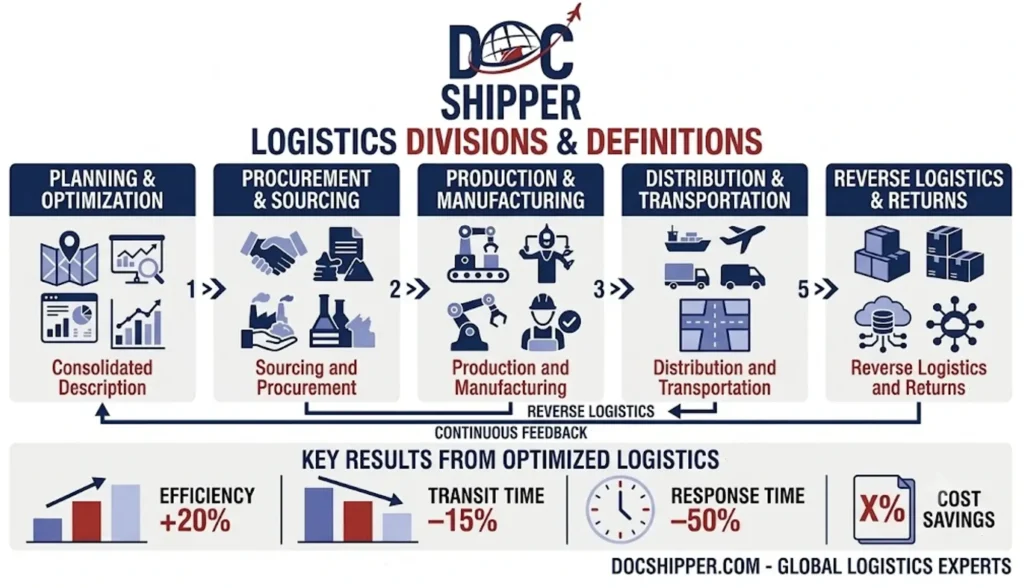
Division operates through several core mechanisms. Functional division separates logistics activities into specialized departments—procurement, freight forwarding, warehousing, and distribution. Each unit develops deep expertise while maintaining interfaces with adjacent functions.
Cargo division addresses the physical breakup of shipments. A full container load (FCL) arriving at port may undergo division into less-than-container-load (LCL) units for final delivery. This requires precise documentation, relabeling, and separate customs entries for each divided portion.
From a regulatory perspective, jurisdictional division matters significantly. The European Union Customs Code mandates separate declarations when goods cross internal borders under specific regimes. Improper division can trigger compliance violations.
Cost division methodologies vary by operation scale. Activity-based costing (ABC) assigns expenses proportionally across divisions based on resource consumption. Direct division allocates costs to specific shipments or clients without intermediate pooling.
Organizational structure division creates business units with profit-and-loss accountability. At DocShipper, we structure our regional divisions to ensure local expertise while maintaining global coordination standards. This prevents the common pitfall of siloed operations that duplicate efforts or miss cross-regional optimization opportunities.
Practical Applications & Quantified Data
Consider a textile importer receiving 500 cartons from Bangladesh. The original shipment divides into three distinct flows:
| Division Segment | Carton Quantity | Destination | Transit Time | Cost per Unit |
|---|---|---|---|---|
| Retail Division | 300 | Distribution Center A | 5 days | $8.40 |
| Wholesale Division | 150 | Regional Hub B | 3 days | $6.20 |
| E-commerce Division | 50 | Fulfillment Center C | 7 days | $11.30 |
The cost variance per unit reflects 34% higher expenses for the e-commerce division due to smaller handling volumes and specialized packaging requirements. This quantified division enables precise margin analysis per channel.
Geographic division efficiency: A multinational electronics company operating across Asia reduced operational redundancies by 22% after restructuring into country-specific divisions. Each division maintained local supplier relationships while leveraging centralized procurement for common components.
Risk mitigation through division: When one automotive parts supplier experienced a factory fire, only their North American division faced disruption. The European and Asian divisions continued operations, limiting total revenue impact to 18% instead of a potential company-wide shutdown.
Cargo division scenario: A 40-foot container consolidating goods from five Chinese exporters undergoes division at the destination port. Each consignee receives separate commercial invoices, packing lists, and customs entries. Processing time increases from 2 hours (full container) to 8 hours (divided units), but enables faster final-mile delivery since each recipient receives only their portion.
Financial division precision: Companies using divisional accounting report 41% faster identification of underperforming service lines compared to aggregated reporting. This granularity supports data-driven decisions about resource allocation or service discontinuation.
Conclusion
Division transforms logistics from a monolithic operation into a flexible, analyzable system where performance metrics, costs, and responsibilities align with specific segments. This structural clarity drives both operational efficiency and strategic agility.
Need expert guidance on structuring your logistics divisions for maximum efficiency? Contact DocShipper for tailored consultation on organizational optimization and cargo management strategies.
📚 Quiz
Test Your Knowledge: Division in Logistics
1. What is the primary purpose of division in logistics operations?
2. When cargo division occurs at a destination port, what is the primary trade-off?
3. A textile company receives 500 cartons and divides them into three distribution channels. The e-commerce division shows 34% higher per-unit costs than wholesale. What does this scenario demonstrate?
🎯 Your Result
📞 Free Quote in 24hFAQ | Division in Logistics: Definition, Calculation & Practical Examples
Division involves physically or organizationally separating operations, cargo, or teams into distinct units with clear boundaries. Segmentation is a classification approach that groups similar elements (customers, products) for analysis without necessarily creating operational separation. Division changes structure; segmentation changes perspective.
When a consolidated shipment undergoes division, each separated portion requires individual customs documentation. This includes separate commercial invoices, bills of lading, and duty calculations. Processing time increases proportionally, but compliance risk decreases since each consignee's goods receive dedicated scrutiny rather than aggregate assessment.
Division creates transparency that enables cost reduction through targeted optimization. While administrative overhead may increase slightly (more invoices, separate tracking), the ability to identify inefficiencies per division typically yields net savings of 12-18% according to supply chain studies. The key is balancing granularity with operational complexity.
Over-division leads to coordination failures, duplicated resources, and communication silos. When divisions become too numerous or autonomous, economies of scale disappear. A manufacturer with 47 regional divisions reported 23% higher procurement costs than competitors with 8-12 consolidated divisions due to fragmented purchasing power.
Advanced TMS (Transportation Management Systems) and WMS (Warehouse Management Systems) use hierarchical data structures where parent records link to divided child records. Each division maintains separate inventory counts, cost centers, and performance dashboards while rolling up to consolidated reporting. API integrations ensure real-time synchronization across divisions.
Transfer pricing regulations require divisions within the same corporate entity to transact at arm's-length prices when crossing borders. The OECD Transfer Pricing Guidelines mandate documentation proving inter-divisional charges reflect market rates. Improper division accounting can trigger tax audits and penalties in multiple jurisdictions simultaneously.
Insurance policies often define coverage boundaries by divisional structure. A claim arising from one division's operations may not extend protection to others unless explicitly stated. Marine cargo insurance typically requires separate policies per shipment division, with premiums calculated based on each segment's risk profile rather than aggregated exposure.
Key indicators include transaction volume (divisions should handle minimum 500+ annual shipments for efficiency), geographic concentration (80%+ of a region's volume justifies dedicated division), product specialization requirements, and management span of control (typically 5-9 direct reports per division leader for effective oversight).
Yes, matrix organizational structures allow temporary divisional overlays. Retailers commonly create seasonal divisions for peak periods (holiday logistics divisions) that dissolve after the rush. Project-based divisions handle one-time initiatives like facility relocations or product launches, then reintegrate into permanent structures upon completion.
Shared service centers or internal logistics divisions manage inter-division transfers using shadow billing or transfer pricing mechanisms. Tracking systems assign dual reference numbers—one for the sending division's records and one for receiving. Costs typically charge to the initiating division unless agreements specify proportional allocation based on benefit received.
Divisional structures enable precise carbon footprint allocation. Companies report Scope 3 emissions by division, allowing clients to assess environmental impact of specific service lines. This granularity supports targeted reduction initiatives—a European logistics firm reduced emissions by 31% in its air freight division while road division emissions decreased only 12%.
Best practice suggests annual reviews with comprehensive restructuring every 3-5 years or when operational volume shifts by 25%+ in any division. Mergers, market entries, or technology implementations (like automation) often necessitate immediate divisional realignment to prevent organizational inefficiency during transition periods.
Need Help with
Logistics or Sourcing ?
First, we secure the right products from the right suppliers at the right price by managing the sourcing process from start to finish. Then, we simplify your shipping experience - from pickup to final delivery - ensuring any product, anywhere, is delivered at highly competitive prices.


Fill the Form
Prefer email? Send us your inquiry, and we’ll get back to you as soon as possible.
Contact us




