


In short ⚡
Documents Against Payment (D/P) is a collection method in international trade where the exporter instructs their bank to release shipping documents to the importer only upon immediate payment. This mechanism provides security for sellers while enabling buyers to verify goods before taking possession, creating a balanced risk framework in cross-border transactions.Introduction
In international trade, one of the most common challenges is balancing payment security with operational flexibility. How can exporters ensure they receive payment before relinquishing control of their goods? How do importers guarantee they’re paying for legitimate shipments?
Documents Against Payment (D/P) addresses this dilemma through a structured banking process. Unlike advance payment or open account terms, D/P creates a conditional release mechanism that protects both parties during the critical handover phase.
This payment method is particularly relevant for:
- New trading relationships where trust hasn’t been fully established
- Mid-value transactions where Letters of Credit seem disproportionately expensive
- Buyers requiring physical verification before payment commitment
- Exporters seeking more security than open account terms provide
- Countries with currency controls where documentary collections facilitate compliance
How D/P Works: Mechanism & Banking Expertise
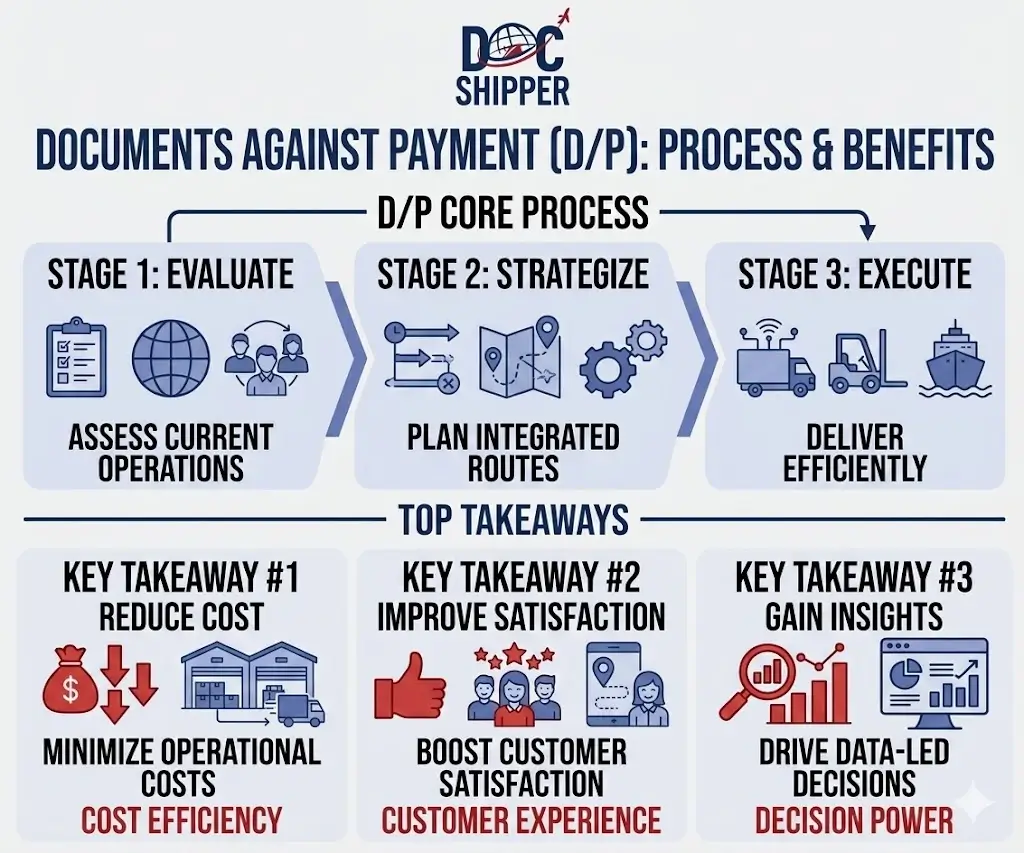
The D/P process operates through a documentary collection governed by the ICC Uniform Rules for Collections (URC 522). Understanding each step is critical for logistics professionals managing international shipments.
Step 1: Shipment and Document Preparation
After shipping goods, the exporter compiles the required commercial documents: commercial invoice, packing list, bill of lading (or air waybill), certificate of origin, and any inspection certificates. These documents prove ownership and enable customs clearance.
Step 2: Bank Submission (Remitting Bank)
The exporter submits documents to their bank (remitting bank) with explicit instructions: “Release documents only against payment.” The bank acts as an intermediary, not a guarantor. This distinction is crucial—unlike Letters of Credit, banks verify documents but don’t guarantee payment.
Step 3: International Transfer (Collecting Bank)
The remitting bank forwards documents to a correspondent bank in the importer’s country (collecting bank). This collection order includes clear payment instructions and any special conditions.
Step 4: Buyer Notification
The collecting bank notifies the importer that documents have arrived and are available against immediate payment. The buyer cannot access the bill of lading—and therefore cannot claim the goods—without settling the invoice.
Step 5: Payment and Document Release
Upon payment (typically via wire transfer or bank draft), the collecting bank releases the documents. The importer can now clear customs and take possession of goods. Payment is transferred back through the banking chain to the exporter.
At DocShipper, we coordinate with banks to ensure document accuracy before submission, reducing rejection risks that can delay payment and create demurrage charges at destination ports.
Practical Examples & Comparative Data
Understanding D/P becomes clearer through real-world scenarios and comparative analysis with alternative payment methods. These examples illustrate when D/P provides optimal balance between security and cost.
Use Case: Textile Machinery Export from Germany to India
A German manufacturer ships €85,000 worth of textile equipment to a new Indian buyer. The parties agree on D/P terms because:
- The buyer lacks credit history for a Letter of Credit
- The seller wants more security than 30-day payment terms
- L/C costs would add €800-1,200 in bank fees
Result: Documents are released upon payment confirmation. Total banking fees: approximately €300-450, representing significant savings compared to documentary credits while maintaining seller protection.
Comparative Payment Method Analysis
| Payment Method | Seller Security | Buyer Security | Cost Level | Processing Time |
|---|---|---|---|---|
| Advance Payment | Highest | Lowest | Minimal | 1-3 days |
| Letter of Credit | Very High | Very High | High ($500-2,000) | 7-14 days |
| D/P (Documents Against Payment) | Moderate-High | Moderate | Low ($200-500) | 5-10 days |
| D/A (Documents Against Acceptance) | Moderate | High | Low ($200-500) | 5-10 days + credit period |
| Open Account | Low | Highest | Minimal | Immediate + 30-90 days |
Key Statistics on D/P Usage
According to SWIFT trade finance data, documentary collections (D/P and D/A combined) account for approximately 15-20% of international trade payment methods, with higher concentration in:
- Asian trade corridors where documentary practices remain standard
- Commodity transactions with established quality standards
- Repeat business relationships transitioning from L/C terms
- Mid-market companies seeking cost-effective risk mitigation
The rejection rate for D/P collections typically ranges from 5-8% when documents are professionally prepared, compared to 50-70% discrepancy rates in Letters of Credit due to stricter compliance requirements.
Conclusion
Documents Against Payment represents a pragmatic middle ground in international trade finance—offering exporters meaningful protection while keeping transaction costs manageable. Its effectiveness depends on proper documentation and clear banking instructions.
Need expert guidance on selecting the right payment terms for your international shipments? Contact DocShipper for comprehensive support throughout your import/export operations.
📚 Quiz
Test Your Knowledge: Documents Against Payment (D/P)
1. What is the core principle of Documents Against Payment (D/P)?
2. A common misconception about D/P is that banks guarantee payment. What is the accurate interpretation?
3. A German exporter ships €85,000 textile machinery to a new Indian buyer. Which scenario best demonstrates correct D/P application?
🎯 Your Result
📞 Free Quote in 24hFAQ | Documents Against Payment (D/P): Definition, Process & Practical Examples
D/P (Documents Against Payment) requires immediate payment before document release, while D/A (Documents Against Acceptance) releases documents when the buyer accepts a time draft, allowing deferred payment (typically 30-180 days). D/P offers stronger protection for exporters but less flexibility for importers.
No, not physically. The importer cannot access the bill of lading without payment, preventing physical inspection before settlement. However, buyers can request pre-shipment inspection certificates as part of the document package. This limitation is why D/P works best with established product specifications or trusted suppliers.
If the importer refuses payment, the exporter retains ownership through the bill of lading. The seller can redirect goods to another buyer, return them (incurring reverse freight charges), or store them at destination. Unlike Letters of Credit, banks don't guarantee payment—they only facilitate document exchange.
Documentary collection fees generally range from $200-500 total (combining remitting and collecting bank charges), significantly less than Letters of Credit which cost $500-2,000+. Costs vary based on transaction value, banking relationships, and country-specific charges.
D/P can work for first transactions if the importer has verifiable business credentials and the product has resale value. However, for very large orders or high-risk markets, Letters of Credit provide stronger protection. Many exporters start with D/P for sample orders before extending open account terms.
Standard D/P document sets include: commercial invoice, packing list, bill of lading (or air waybill), certificate of origin, and insurance certificate. Additional documents may include inspection certificates, health certificates (for food/pharma), or beneficiary certificates depending on product type and destination country requirements.
Typical timeline ranges from 5-10 business days after goods arrive at destination port. This includes document courier time (2-4 days), buyer notification (1-2 days), and payment processing (2-4 days). Delays can occur if documents contain discrepancies or if the importer negotiates payment extensions.
Yes, parties can negotiate split arrangements—for example, 30% advance payment with 70% D/P at shipment. This hybrid approach reduces exporter risk while demonstrating buyer commitment. Clear contract language and separate document sets for each payment tranche are essential for smooth execution.
Primary risks include: buyer refusal to pay (requiring goods redistribution), destination country payment restrictions, political instability affecting fund transfers, and buyer insolvency before document release. Unlike L/Cs, exporters carry greater non-payment risk, making buyer creditworthiness assessment critical.
Banks check that the document package is complete according to collection instructions but do not verify content authenticity or accuracy. They confirm document types are present (invoice, B/L, certificates) but don't validate commercial details like quantities, prices, or product descriptions—unlike the detailed scrutiny in Letter of Credit transactions.
Yes. Banks must comply with anti-money laundering (AML) regulations, sanctions screening, and know-your-customer (KYC) requirements. Transactions involving sanctioned countries, entities, or individuals will be blocked regardless of payment method. D/P offers no exemption from compliance obligations that apply to all international payments.
D/P primarily applies to tangible goods shipments where a bill of lading creates title transfer. For services, alternative mechanisms like escrow arrangements or milestone-based payments are more appropriate. However, D/P can apply to service-related documentation (engineering drawings, software licenses) if a transferable ownership document exists.
Need Help with
Logistics or Sourcing ?
First, we secure the right products from the right suppliers at the right price by managing the sourcing process from start to finish. Then, we simplify your shipping experience - from pickup to final delivery - ensuring any product, anywhere, is delivered at highly competitive prices.


Fill the Form
Prefer email? Send us your inquiry, and we’ll get back to you as soon as possible.
Contact us




:%20Definition,%20Process%20&%20Practical%20Examples)