


In short ⚡
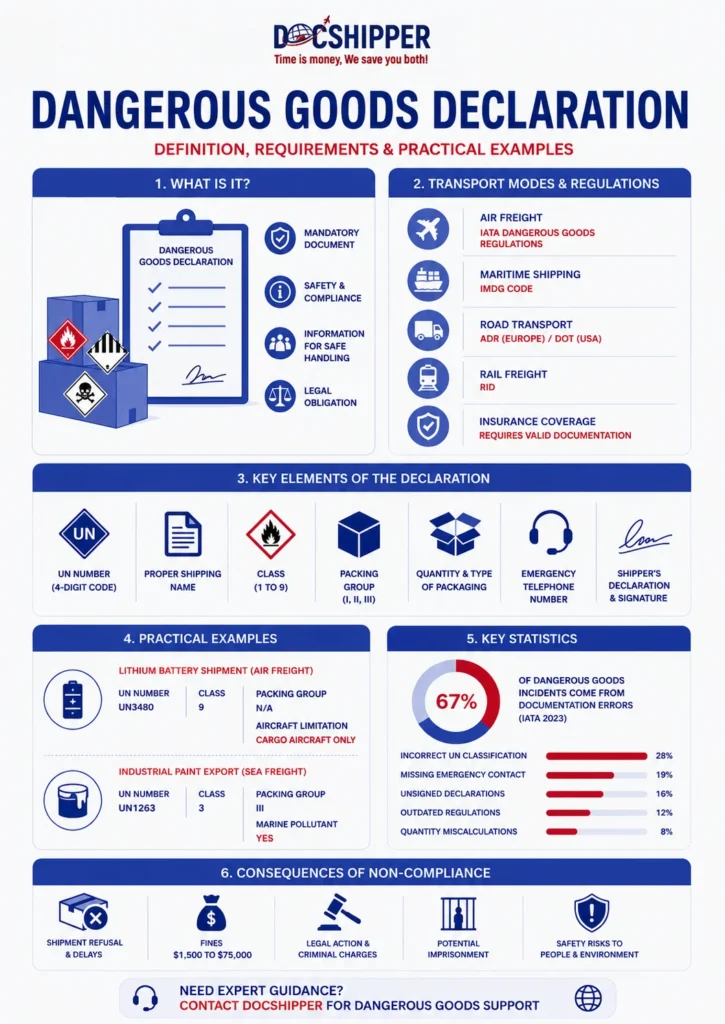
The Dangerous Goods Declaration is a mandatory transport document certifying that hazardous materials comply with international safety regulations. It provides critical information about the nature, classification, packaging, and emergency procedures for dangerous goods, ensuring safe handling throughout the logistics chain.
Introduction
Many importers underestimate the complexity of shipping products containing batteries, chemicals, or flammable substances. A missing or incomplete Dangerous Goods Declaration can result in shipment refusal, severe fines, or even legal prosecution.
This document serves as the cornerstone of hazardous material transportation. It bridges the gap between shipper responsibility and carrier liability, ensuring every party in the supply chain understands the risks involved.
The declaration’s importance spans all transport modes:
- Air freight: Governed by IATA Dangerous Goods Regulations, the strictest standards worldwide
- Maritime shipping: Regulated by the IMDG Code under IMO conventions
- Road transport: Subject to ADR agreements in Europe and DOT regulations in the United States
- Rail freight: Follows RID directives with specific classification requirements
- Insurance coverage: Invalid without proper dangerous goods documentation
Understanding this declaration is not optional. It’s a legal obligation that protects human lives, infrastructure, and the environment.
Regulatory Framework & Compliance Requirements
The Dangerous Goods Declaration follows a standardized format established by international bodies. The UN Model Regulations provide the foundation, adapted by each transport mode into specific rulebooks.
The document must be issued by a certified dangerous goods shipper. This certification requires specialized training renewed every two years. Untrained personnel cannot legally sign this declaration, regardless of their position within the company.
Key elements that must appear on every declaration include:
- UN Number: Four-digit identifier assigned to each hazardous substance (e.g., UN1950 for aerosols)
- Proper Shipping Name: Official designation from UN dangerous goods lists, not brand names
- Class and Division: Classification from 1 (explosives) to 9 (miscellaneous dangerous goods)
- Packing Group: Level of danger (I = high, II = medium, III = low)
- Quantity and Type of Packaging: Exact number of packages and their UN certification codes
The shipper’s declaration statement is perhaps the most critical section. By signing, the shipper certifies under penalty of law that the goods are properly classified, packaged, marked, and labeled. This signature carries legal liability that can extend to criminal prosecution in case of incidents.
Additional technical information includes the Emergency Response Telephone Number, operational 24/7, and the technical name in parentheses for generic entries. For air transport, the aircraft type limitation (CAO = Cargo Aircraft Only, or PAX = passenger aircraft permitted) determines routing options.
At DocShipper, we systematically verify every Dangerous Goods Declaration against the latest regulatory updates before shipment authorization. Our compliance team cross-references UN numbers with Material Safety Data Sheets to ensure consistency and prevent costly rejections. Visit our contact page for specialized dangerous goods support.
Regulatory bodies maintain strict oversight. The IATA Dangerous Goods Regulations are updated annually with hundreds of changes affecting classifications, packaging specifications, and documentation requirements.
Practical Examples & Industry Data
Understanding theoretical requirements is insufficient. Real-world applications reveal the complexities exporters face daily. The following scenarios illustrate common situations requiring a Dangerous Goods Declaration.
Case Study 1: Lithium Battery Shipment
A Chinese manufacturer exports 5,000 laptop batteries to Germany via air freight. Each battery contains 150 Wh capacity. The declaration must specify:
- UN Number: UN3480 (lithium ion batteries)
- Proper Shipping Name: “Lithium ion batteries”
- Class: 9 (miscellaneous dangerous goods)
- Packing Group: Not applicable for lithium batteries
- Aircraft Limitation: Cargo Aircraft Only (exceeds 100 Wh threshold)
Additional requirement: Section II lithium battery marking and handling label. Total regulatory compliance cost: $450-$650 including documentation, specialized packaging, and handling fees.
Case Study 2: Industrial Paint Export
A European paint manufacturer ships 800 liters of oil-based paint to the Middle East by sea. The declaration details:
- UN Number: UN1263
- Proper Shipping Name: “Paint (including paint, lacquer, enamel, stain, shellac solutions, varnish, polish, liquid filler, and liquid lacquer base)”
- Class: 3 (flammable liquids)
- Packing Group: III
- Marine Pollutant: Yes (special marking required)
This shipment requires IMO-certified drums with proper ventilation. Non-compliance resulted in one documented case where $23,000 worth of paint was destroyed at port due to improper documentation.
Comparative Table: Documentation Requirements by Transport Mode
| Transport Mode | Primary Regulation | Document Format | Renewal Frequency |
|---|---|---|---|
| Air Freight | IATA DGR | Shipper’s Declaration (7-part form) | Per shipment |
| Sea Freight | IMDG Code | Container Packing Certificate + DG Declaration | Per container |
| Road Transport | ADR/DOT | Transport Document (simplified format) | Per journey |
| Rail Transport | RID | Consignment Note Section | Per wagon |
Industry Statistics
According to IATA’s 2023 Dangerous Goods Safety Report, 67% of dangerous goods incidents stem from documentation errors rather than packaging failures. The most common mistakes include:
- Incorrect UN classification: 28% of total errors Missing emergency contact: 19% of violations
- Unsigned declarations: 16% of rejected shipments
- Outdated regulatory references: 12% of compliance issues
- Quantity miscalculations: 8% of documentation problems
The financial impact is substantial. A single documentation error can result in fines ranging from $1,500 to $75,000 depending on jurisdiction and severity. In extreme cases involving bodily harm, criminal charges may apply with potential imprisonment.
Conclusion
The Dangerous Goods Declaration represents far more than bureaucratic paperwork. It’s a safety protocol that protects lives and ensures regulatory compliance across international borders. Mastering its requirements is non-negotiable for businesses handling hazardous materials.
Need expert guidance on dangerous goods documentation? Our specialists handle classification, packaging verification, and regulatory compliance daily. Contact DocShipper for comprehensive support with your hazardous cargo shipments.
📚 Quiz
Test Your Knowledge: Dangerous Goods Declaration
What is the primary purpose of a Dangerous Goods Declaration?
According to IATA's 2023 report, what percentage of dangerous goods incidents stem from documentation errors rather than packaging failures?
A company executive wants to sign a Dangerous Goods Declaration for an urgent lithium battery shipment. The executive has full signing authority but has never taken dangerous goods training. Can they legally sign the declaration?
🎯 Your Result
📞 Free Quote in 24hFAQ | Dangerous Goods Declaration: Definition, Requirements & Practical Examples
Only individuals who have completed certified dangerous goods training specific to their transport mode can sign the declaration. This training must be renewed every 24 months. Company executives without proper certification cannot legally sign, regardless of their authority level. The signatory assumes full legal liability for the accuracy of all information provided.
No. Each shipment requires a unique Dangerous Goods Declaration. Even if shipping identical products to the same destination, separate documents are mandatory. The declaration must reference specific transport details including flight numbers, vessel names, or vehicle identifications. Pre-signed blank declarations are strictly prohibited under international law.
Consequences vary by severity. Minor errors may result in shipment delays and correction fees ($150-$500). Material misrepresentations can lead to cargo seizure, fines up to $75,000, and potential criminal prosecution. If an error causes an incident, liability extends to personal injury claims and environmental cleanup costs potentially reaching millions.
Not all, but most rechargeable batteries require dangerous goods documentation. Lithium metal batteries exceeding 1g lithium content and lithium ion batteries exceeding 2.7Wh capacity are classified as dangerous. Small consumer electronics with installed batteries under 100Wh may qualify for exceptions under Section II regulations, requiring simplified marking but not full declarations.
Retention periods vary by jurisdiction. The United States DOT requires 3 years minimum. European ADR regulations mandate 5 years. IATA recommends retaining air freight declarations for 6 years. Best practice suggests keeping records for 7 years to cover potential litigation statute of limitations in most countries.
Yes, but with restrictions. Electronic dangerous goods declarations (e-DGD) are accepted for air freight when using IATA-approved systems. Maritime and road transport increasingly accept digital formats. However, a physical copy with original signature must still accompany the shipment. Purely digital documentation without hardcopy backup is not universally accepted.
Packing Groups indicate danger levels within a class. Group I represents high danger requiring the strictest packaging specifications. Group II indicates medium danger with moderate packaging requirements. Group III represents low danger with basic packaging standards. Not all dangerous goods classes use this system; explosives (Class 1) and radioactive materials (Class 7) have different classification methods.
Limited quantity exceptions exist when specific criteria are met. Packages must not exceed maximum net quantity per inner packaging (varies by substance), display the LQ marking, and meet specific packaging requirements. Even when qualifying for limited quantity exceptions, the commercial invoice must clearly state "Dangerous Goods in Limited Quantities" with the applicable UN number.
The number must reach a person or service with comprehensive knowledge of the shipped dangerous goods, available 24/7 throughout the shipment duration. This cannot be a general company switchboard or voicemail system. Many companies contract specialized emergency response services like CHEMTREC (North America) or NCEC (Europe) to fulfill this requirement professionally.
Start with the Safety Data Sheet (SDS) Section 14, which typically lists the UN number. If absent or unclear, consult the dangerous goods lists in IATA DGR (air), IMDG Code (sea), or ADR (road). When multiple UN numbers seem applicable, choose the most specific entry. Generic "N.O.S." (Not Otherwise Specified) entries require technical names in parentheses and should be avoided when a specific entry exists.
Forwarders can assist with preparation, but the legal signatory must be from the shipper's organization and must hold valid dangerous goods certification. Brokers cannot sign declarations as they don't have physical custody or classification responsibility. The shipper retains full legal liability regardless of who prepares the document, making verification of all information essential.
The top rejection reasons include missing emergency contact information, unsigned declarations, quantity discrepancies between declaration and actual shipment, incorrect UN numbers that don't match the product, and outdated regulatory references. Additionally, lack of proper packaging certification marks and missing supplementary documents like Material Safety Data Sheets frequently cause clearance issues.
Need Help with
Logistics or Sourcing ?
First, we secure the right products from the right suppliers at the right price by managing the sourcing process from start to finish. Then, we simplify your shipping experience - from pickup to final delivery - ensuring any product, anywhere, is delivered at highly competitive prices.


Fill the Form
Prefer email? Send us your inquiry, and we’ll get back to you as soon as possible.
Contact us




