


In short ⚡
A bank draft is a guaranteed payment instrument issued by a financial institution, where funds are withdrawn from the payer's account and held by the bank until the payee presents the draft for payment. Unlike personal checks, bank drafts offer near-absolute security as they are pre-funded and backed by the issuing bank, making them essential for high-value international trade transactions.
Introduction
In international commerce, payment security remains a primary concern for both exporters and importers. Traditional payment methods like personal checks carry inherent risks of insufficient funds or fraud. This uncertainty can paralyze cross-border transactions, especially when dealing with unknown business partners or high-value shipments.
The bank draft addresses this challenge by providing an irrevocable payment commitment. When a freight forwarder requires payment for customs clearance or an overseas supplier demands advance payment, bank drafts offer a middle ground between wire transfers and letters of credit.
Key characteristics of bank drafts include:
- Pre-funded guarantee: Funds are secured before issuance
- Bank liability: The issuing institution assumes payment responsibility
- Fraud resistance: Security features and bank verification reduce counterfeiting risks
- International acceptance: Recognized by financial institutions globally
- Traceability: Clear audit trail for accounting and compliance purposes
Mechanisms & Legal Framework
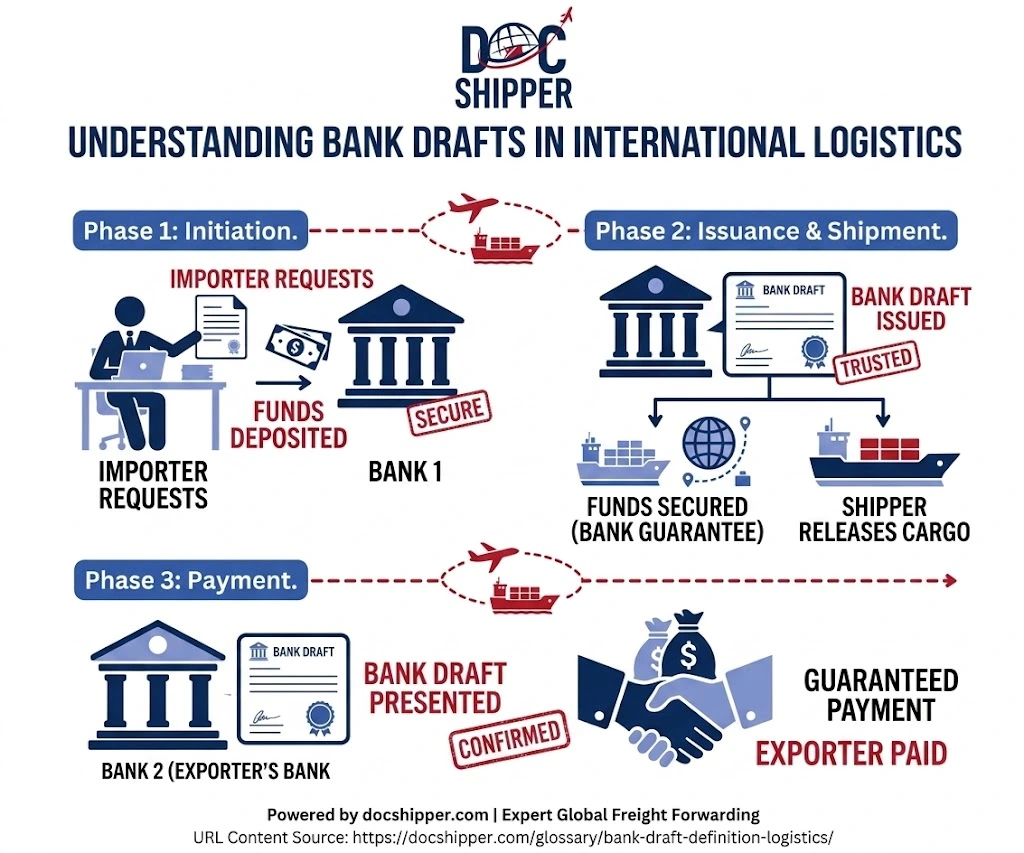
The bank draft issuance process follows a standardized protocol across most jurisdictions. When a client requests a draft, the issuing bank immediately debits the specified amount from their account and transfers it to the bank’s own reserve account. This pre-funding mechanism guarantees availability of funds when the payee presents the instrument for collection.
The draft document itself contains several security elements: watermarked paper, magnetic ink character recognition (MICR) encoding, unique serial numbers, and often holographic seals. These features make authentication straightforward for receiving banks and significantly reduce fraudulent activity compared to personal checks.
From a legal perspective, bank drafts are governed by the Uniform Commercial Code (UCC) in the United States, particularly Article 3 covering negotiable instruments, and the Bills of Exchange Act in Commonwealth countries. According to the United Nations Commission on International Trade Law (UNCITRAL), bank drafts represent unconditional orders to pay a determinate sum, creating legal obligations enforceable across jurisdictions.
The processing timeline for international bank drafts typically spans 3 to 10 business days, depending on correspondent banking relationships. When the payee deposits the draft, their bank initiates verification with the issuing institution through the SWIFT network or other interbank messaging systems. Upon confirmation, funds are released to the payee’s account.
At DocShipper, we regularly guide clients through bank draft requirements for customs duties and freight charges. Our experience shows that understanding the clearing process prevents shipment delays. For instance, we verify draft authenticity before releasing goods from our warehouses, ensuring our clients avoid payment disputes that could result in demurrage fees or storage charges.
One critical distinction involves demand drafts versus time drafts. Demand drafts are payable immediately upon presentation, making them ideal for spot transactions. Time drafts, conversely, specify a future payment date, functioning similarly to post-dated checks but with bank guarantee backing. In international trade finance, time drafts often accompany letters of credit for deferred payment arrangements.
Practical Examples & Data
To illustrate the practical application of bank drafts in logistics, consider this comparative scenario between three payment methods for a $50,000 machinery shipment from Germany to the United States:
| Payment Method | Processing Time | Cost | Security Level | Typical Use Case |
|---|---|---|---|---|
| Wire Transfer | 1-2 days | $35-$50 | High (irreversible) | Established relationships |
| Bank Draft | 5-7 days | $10-$20 | Very High (pre-funded) | New trading partners |
| Letter of Credit | 7-14 days | $250-$500 | Maximum (documentary control) | Complex transactions |
According to 2023 data from the International Chamber of Commerce, bank drafts account for approximately 18% of international B2B payment volumes below $100,000, positioned between wire transfers (52%) and letters of credit (12%). The remaining 18% comprises various alternative payment methods including escrow services and digital payment platforms.
Use Case: Customs Duty Payment
A DocShipper client importing textile machinery from Italy to Canada faced a $28,400 customs duty obligation. The Canadian Border Services Agency accepted three payment methods: certified check, wire transfer, or bank draft. The importer chose a bank draft for these reasons:
- Cost efficiency: Draft issuance cost $15 versus $45 for international wire transfer
- Physical documentation: Required for their accounting department’s audit trail
- Timing flexibility: Could be obtained locally and mailed with customs documents
- Security assurance: Eliminated risk of wire transfer errors or fraud
- Acceptance certainty: Pre-approved by customs broker as valid payment instrument
The entire process took six business days from draft issuance to customs clearance. DocShipper coordinated with the customs broker to ensure the draft arrived concurrently with shipment documentation, preventing demurrage charges that would have accrued at $150 per day for container storage.
Industry statistics reveal: Payment-related delays account for 23% of all shipment hold-ups at borders. Bank drafts reduce this risk significantly compared to personal or corporate checks, which require 7-10 additional days for clearing verification before customs authorities release goods.
Conclusion
Bank drafts represent a balanced solution for international trade payments, offering security comparable to wire transfers at lower costs and with tangible documentation advantages. Their pre-funded nature eliminates payment uncertainty while maintaining flexibility for various transaction scenarios.
Need assistance with payment instruments for your international shipments? Contact DocShipper for expert guidance on selecting the optimal payment method for your specific logistics requirements.
📚 Quiz
Test Your Knowledge: Bank Draft
What fundamentally distinguishes a bank draft from a personal check?
A client claims they can easily cancel a bank draft the same way they would stop payment on a personal check. Is this correct?
Your supplier in Germany requires $50,000 payment for machinery. You need physical documentation for auditing and want to minimize costs. Which payment method is most appropriate?
🎯 Your Result
📞 Free Personalized QuoteFAQ | Bank Draft: Definition, Process & Practical Examples
While both are bank-guaranteed instruments, a bank draft is typically drawn on the issuing bank's funds held at another institution (often internationally), whereas a cashier's check is drawn on the bank's own internal accounts. Bank drafts are primarily used for international transactions, while cashier's checks are more common for domestic high-value payments. Both offer superior security compared to personal checks.
Cancelling a bank draft is significantly more difficult than stopping a personal check. Since funds are already withdrawn from the payer's account, cancellation requires proving the draft was lost, stolen, or never delivered. The bank typically imposes a 90-day waiting period and may require an indemnity bond. If the payee has already deposited the draft, cancellation becomes impossible. This irreversibility is precisely what makes drafts secure for payees.
Unlike personal checks that typically expire after six months, bank drafts generally remain valid indefinitely in most jurisdictions. However, banks may charge revalidation fees if a draft remains uncashed beyond a certain period (commonly 1-3 years). For international trade, it's advisable to present drafts within 12 months of issuance to avoid complications with outdated exchange rates or account changes.
While bank drafts are significantly more secure than personal checks due to their security features and pre-funding, sophisticated counterfeits do exist. Recipients should verify authenticity by contacting the issuing bank directly using contact information obtained independently (not from the draft itself). Banks can confirm whether a draft number was genuinely issued and remains outstanding. DocShipper always verifies large-value drafts before releasing shipments to clients.
Bank draft fees typically range from $5 to $20 for domestic drafts and $10 to $50 for international drafts, depending on the issuing institution and currency conversion requirements. Some premium accounts include free drafts as a benefit. Additional costs may include courier fees if expedited delivery is needed, and beneficiary banks might charge collection fees ranging from $10 to $30 when depositing foreign-issued drafts.
Yes, but the process is lengthy. You must file a declaration of loss with your bank and typically wait 90-180 days (the "waiting period" varies by institution). The bank may require you to purchase an indemnity bond, which can cost 1-3% of the draft value, to protect against fraudulent duplicate claims. Once the waiting period expires and the draft has not been presented for payment, the bank will refund your original amount minus any administrative fees.
Most countries accept bank drafts for customs duty payments, but specific requirements vary. Some nations require drafts drawn on domestic banks only, while others accept international instruments. Countries with strict foreign exchange controls (such as China and India) may mandate wire transfers instead. Always verify acceptable payment methods with your customs broker or freight forwarder before arranging payment. DocShipper's country-specific expertise ensures compliance with local payment regulations.
When a bank draft is issued in a foreign currency, the exchange rate is typically locked at the time of issuance. However, if there's a significant delay between issuance and deposit, currency fluctuations could affect the payer's accounting. Some banks offer "dual currency drafts" that specify amounts in both the payer's and payee's currencies. For large transactions, consider requesting a forward exchange rate contract to hedge against volatility during the clearing period.
Yes, bank drafts are negotiable instruments that can be endorsed to third parties, similar to checks. The original payee endorses the back of the draft and specifies the new payee. However, some banks issue "non-negotiable" drafts (marked as "account payee only") that can only be deposited into the named beneficiary's account. This restriction enhances security but reduces flexibility. For logistics payments, non-negotiable drafts are often preferred to prevent diversion of funds.
If a bank draft is lost in transit, immediately notify the issuing bank to place a stop-payment alert. You'll need to complete a lost instrument affidavit and potentially purchase an indemnity bond. The bank will monitor the draft number for attempted deposit while processing your refund request. This typically takes 90 days minimum. To avoid this situation, consider using tracked courier services for high-value drafts or opt for electronic payment methods when time-sensitive transactions are involved.
While traditional bank drafts are physical instruments, many financial institutions now offer "electronic drafts" or "e-drafts" that function similarly through secure banking portals. These digital equivalents provide the same bank guarantee but with faster processing (1-3 days versus 5-10 days). However, not all organizations accept electronic formats, particularly government agencies handling customs duties. Some hybrid solutions involve issuing traditional drafts with electronic tracking and verification capabilities for enhanced security and transparency.
The optimal choice depends on your specific circumstances. Wire transfers offer speed (1-2 days) but cost more ($35-$50) and leave no physical documentation. Bank drafts are more economical ($10-$20), provide tangible proof of payment, but take longer (5-7 days). For urgent customs clearances, wire transfers are preferable. For planned payments where cost efficiency matters and physical records are required for auditing, bank drafts excel. DocShipper can advise on the most suitable payment method based on your shipment timeline, budget, and documentation requirements.
Need Help with
Logistics or Sourcing ?
First, we secure the right products from the right suppliers at the right price by managing the sourcing process from start to finish. Then, we simplify your shipping experience - from pickup to final delivery - ensuring any product, anywhere, is delivered at highly competitive prices.


Fill the Form
Prefer email? Send us your inquiry, and we’ll get back to you as soon as possible.
Contact us




