


In short ⚡
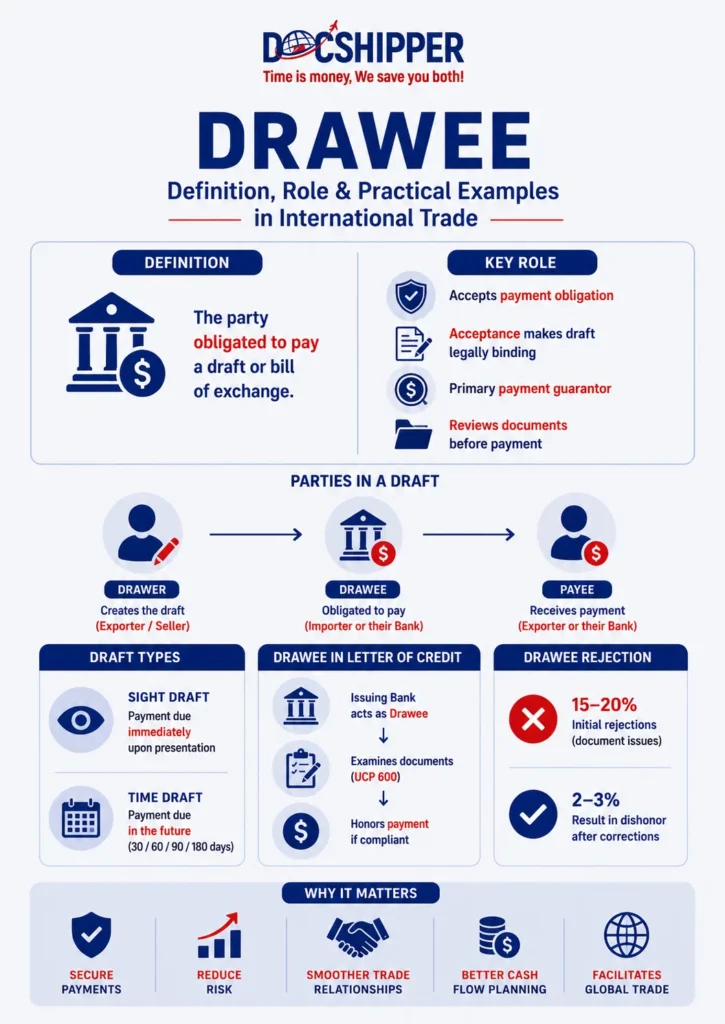
The drawee is the party obligated to pay a specified sum under a bill of exchange or draft in international trade. Typically a buyer or their bank, the drawee accepts financial responsibility upon receiving the commercial instrument, making them the payment guarantor in cross-border transactions. This role is fundamental in documentary credit operations and trade finance mechanisms.
Introduction
In international commerce, confusion often arises between the drawee, drawer, and payee in payment instruments. Misidentifying the drawee can lead to payment delays, rejected drafts, or financial disputes worth thousands of dollars. Understanding this role is critical for importers, exporters, and freight forwarders managing letter of credit transactions.
The drawee concept originated in medieval banking and remains essential in modern documentary collections and letters of credit. Their acceptance transforms a simple draft into a binding payment obligation, providing security for sellers while offering buyers deferred payment terms.
Key characteristics of the drawee:
- Primary obligor: Legally bound to honor the draft amount upon presentation
- Acceptance authority: Their signature validates the bill of exchange
- Credit risk bearer: Assumes financial responsibility in the transaction chain
- Payment facilitator: Typically the buyer’s bank in documentary credit operations
- Document reviewer: Examines shipping documents before payment release
Legal Framework & Operational Mechanics
Under the Uniform Commercial Code (UCC) Article 3 and ICC Uniform Rules for Collections (URC 522), the drawee’s obligations activate when they “accept” a time draft or receive a sight draft. Acceptance occurs through signature placement across the bill’s face, creating an irrevocable payment commitment.
The distinction between sight drafts and time drafts fundamentally alters the drawee’s timeline. Sight drafts require immediate payment upon document presentation, while time drafts allow 30, 60, or 90 days. This deferred payment structure enables importers to sell goods before settling with suppliers.
In letter of credit scenarios, the issuing bank typically acts as drawee. They examine documents against credit terms, ensuring compliance with UCP 600 standards. Banks operating as drawees must verify documents within five banking days, per international banking practice. At DocShipper, we systematically verify bill of exchange details to prevent discrepancies that could delay drawee acceptance.
The honor obligation distinguishes drawees from other parties. Once accepted, a time draft becomes equivalent to a promissory note. The drawee cannot later refuse payment based on underlying commercial disputes—their commitment is independent of the goods’ condition or contract fulfillment.
Dishonor consequences carry significant legal weight. If a drawee refuses to pay without legitimate documentary discrepancies, they may face breach of contract claims, damage to banking relationships, and potential liability for consequential damages. International conventions provide recourse through protested bills and legal action in the drawee’s jurisdiction.
Practical Scenarios & Data
Understanding drawee mechanics becomes clearer through real-world applications. Consider these typical international trade scenarios where drawee identification proves critical:
| Payment Method | Drawee Identity | Payment Timeline | Risk Level |
|---|---|---|---|
| Documentary Collection (D/P) | Buyer (Importer) | Upon document presentation | High for exporter |
| Documentary Collection (D/A) | Buyer (Importer) | 30-90 days after acceptance | Very high for exporter |
| Letter of Credit (Sight) | Issuing Bank | 5-7 banking days | Low for both parties |
| Letter of Credit (Usance) | Issuing/Confirming Bank | 60-180 days post-shipment | Low with bank guarantee |
| Open Account | N/A (No draft involved) | Per commercial agreement | Maximum for exporter |
Case Study: A German machinery exporter ships €250,000 worth of equipment to a Brazilian importer using a 90-day time draft. The Brazilian buyer’s bank (Banco do Brasil) acts as drawee, accepting the draft upon document verification. This acceptance allows the exporter to discount the draft with their bank at 3.5% annual rate, receiving immediate payment of approximately €247,813 while the drawee pays full amount in 90 days.
Statistical data reveals drawee behavior patterns. According to ICC Banking Commission reports, approximately 15-20% of drafts experience initial rejection due to documentary discrepancies. However, only 2-3% result in complete dishonor after correction opportunities. Banks serving as drawees maintain stricter compliance, with rejection rates around 8-12% compared to direct buyer drawees at 22-28%.
Key operational insights for working with drawees:
- Document precision: 70% of drawee rejections stem from Bill of Lading inconsistencies
- Timeline awareness: Bank drawees typically respond within 3-5 business days versus 7-14 for corporate drawees
- Communication channels: Direct bank relationships reduce payment delays by 40% in documentary operations
- Currency considerations: Multi-currency drafts increase drawee scrutiny time by 2-3 days
- Jurisdictional factors: Drawee obligations vary under UCC, UCP 600, and national commercial codes
Conclusion
The drawee’s role as the payment obligor makes them the cornerstone of secure international trade finance. Properly identifying and engaging the drawee ensures smooth payment flows and minimizes financial risk in cross-border transactions.
Need expert guidance on documentary credits and payment instruments? Contact DocShipper for comprehensive trade finance support.
📚 Quiz
Test Your Knowledge: Drawee
Who is the drawee in a letter of credit transaction?
Can a drawee refuse payment after accepting a time draft due to disputes about goods quality?
A German exporter ships machinery worth €250,000 with a 90-day time draft drawn on Banco do Brasil. What is the drawee's primary obligation?
🎯 Your Result
📞 Free Quote in 24hFAQ | Drawee: Definition, Role & Practical Examples in International Trade
The drawer is the party issuing the bill of exchange (typically the exporter/seller), while the drawee is the party ordered to pay (usually the importer/buyer or their bank). The drawer creates the payment instruction; the drawee executes it. In a letter of credit transaction, the beneficiary acts as drawer, and the issuing bank serves as drawee.
A drawee can refuse payment only if documentary discrepancies exist or the bill doesn't comply with the underlying credit terms. Once a drawee accepts a time draft by signing it, they create an unconditional obligation to pay at maturity regardless of goods quality or contract disputes. Wrongful dishonor exposes the drawee to legal liability and damages.
The issuing bank (buyer's bank) typically serves as drawee in letter of credit operations. In confirmed letters of credit, the confirming bank may also act as drawee. This bank obligation provides significantly greater payment security compared to having the buyer directly as drawee, since banks must honor compliant presentations per UCP 600 rules.
If the drawee is a bank, regulatory protections and deposit insurance may apply. For corporate drawees, the drawer (beneficiary) becomes an unsecured creditor in bankruptcy proceedings. This risk explains why exporters prefer bank drawees in high-value transactions. Documentary credit insurance can mitigate drawee insolvency risk, covering 90-95% of invoice value.
Drawee acceptance transforms a draft into a negotiable instrument with enhanced marketability. Accepted drafts can be discounted with banks or sold in secondary markets at rates reflecting the drawee's creditworthiness. An accepted draft from a major international bank trades at lower discount rates (2-4% annually) compared to unaccepted drafts (6-12%).
Under UCP 600 Article 14, bank drawees have maximum five banking days to examine documents and determine compliance. This period begins the banking day following document presentation. Corporate drawees in collections typically receive documents "against acceptance" or "against payment" without strict timeline mandates, though commercial practice suggests 7-10 business days.
Generally no. Bills of exchange require a single, clearly identified drawee to maintain negotiability and enforceability. However, joint account holders or co-signing entities may collectively serve as drawee. In complex transactions, separate drafts should be issued for each paying party to preserve legal clarity and facilitate collection.
Document requirements depend on the payment method. For documentary collections, drawees typically review commercial invoices, bills of lading, packing lists, insurance certificates, and certificates of origin. Letter of credit drawees examine documents specified in the credit terms, which may include inspection certificates, beneficiary certificates, and other trade documents per UCP 600 requirements.
The drawee's domicile generally determines the governing law and jurisdiction for enforcement actions. Bills drawn on US drawees fall under UCC Article 3, while European drawees may be governed by national implementations of the Geneva Convention. International drafts often include choice-of-law clauses, but drawee location remains primary for enforcement proceedings.
The drawee is the paying party obligated under the bill of exchange, while an endorsee is a subsequent holder who receives the instrument through endorsement. A bill may pass through multiple endorsees before presentation to the drawee. Endorsees gain rights to payment but don't assume the drawee's payment obligation unless they specifically accept the bill themselves.
Bank drawees in letter of credit transactions typically charge handling fees ranging from $75-$300 depending on document complexity. These charges are separate from acceptance commissions (0.125-0.5% per month) on time drafts. Corporate drawees in documentary collections rarely charge examination fees, though payment processing costs may be passed to the drawer per collection instructions.
Upon dishonor, the drawer can formally protest the bill through a notary public, creating legal evidence for court proceedings. The drawer may sue the drawee for breach of acceptance obligation, claiming the draft amount plus interest and costs. In letter of credit cases, dishonor by the issuing bank (drawee) constitutes wrongful refusal, entitling the beneficiary to damages including consequential losses.
Need Help with
Logistics or Sourcing ?
First, we secure the right products from the right suppliers at the right price by managing the sourcing process from start to finish. Then, we simplify your shipping experience - from pickup to final delivery - ensuring any product, anywhere, is delivered at highly competitive prices.


Fill the Form
Prefer email? Send us your inquiry, and we’ll get back to you as soon as possible.
Contact us




