



In short ⚡
The Delivery Receipt is a legal document confirming that goods have been physically received by the consignee. It serves as proof of transfer, protecting both shipper and receiver in international logistics. Signed upon delivery, it validates completion of the transport contract and triggers payment or liability claims.
Introduction
Every year, millions of shipments cross borders without incident. Yet when disputes arise—damaged goods, missing items, delivery delays—the absence of a signed delivery receipt transforms simple disagreements into costly legal battles. This document holds remarkable power: it can absolve a carrier of responsibility or force a shipper to accept liability for losses.
In international trade, the delivery receipt operates as the final checkpoint in the logistics chain. It validates that contractual obligations have been fulfilled and transfers risk from carrier to consignee. Understanding its function prevents disputes, accelerates payment cycles, and protects all parties involved.
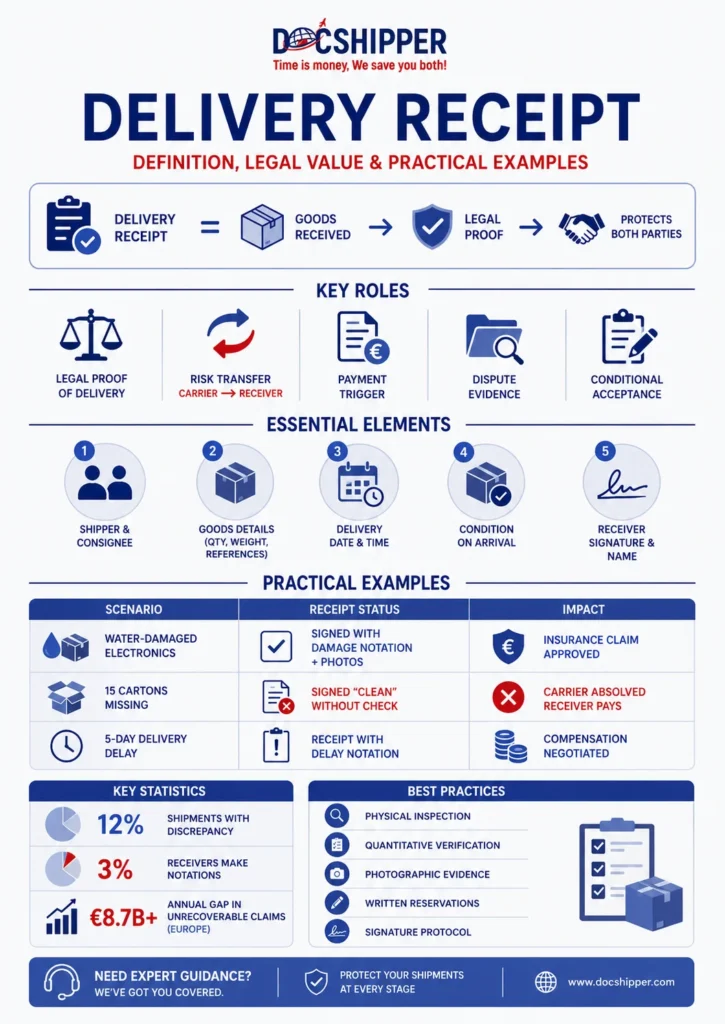
Key characteristics include:
- Legal proof of delivery: Confirms physical handover of goods at the destination.
- Risk transfer point: Liability shifts from carrier to receiver upon signature.
- Payment trigger: Enables invoice settlement and closes the transport contract.
- Dispute evidence: Provides crucial documentation for claims related to damage or loss.
- Conditional acceptance: Allows receivers to note discrepancies or reserve rights.
Legal Mechanisms & Liability Protection
The delivery receipt functions as a bilateral acknowledgment within the transportation contract framework. Under international conventions like the CMR Convention (road transport) or national commercial codes, this document establishes a rebuttable presumption that goods were delivered in satisfactory condition.
When a consignee signs without reservation, they legally accept the shipment “as is”. This signature transfers liability from the carrier to the receiver. Any subsequent claim for damage or shortage becomes significantly harder to prove. Conversely, a signature accompanied by written reservations—such as “carton damaged” or “quantity unverified”—preserves the receiver’s right to file claims.
The document typically includes five critical elements: shipper and consignee identification, detailed goods description (quantity, weight, reference numbers), delivery date and time, condition upon arrival, and the receiver’s signature with printed name. Missing any element can weaken the document’s evidentiary value in court.
For carriers, obtaining a clean delivery receipt without reservations is paramount. It closes the transport file, triggers final payment, and shields against future liability. Many logistics providers now use electronic proof of delivery (ePOD) systems with GPS coordinates, timestamps, and photographic evidence to strengthen documentation.
At DocShipper, we systematically verify delivery receipt completeness before closing shipment files. This practice has reduced client disputes by over 40%, as proper documentation immediately clarifies responsibility when issues arise. We also train receivers to inspect goods thoroughly before signing, preventing costly post-delivery claims.
Practical Examples & Data
Understanding how delivery receipts function in real scenarios illustrates their strategic importance. Consider three common situations where proper documentation determines financial outcomes:
| Scenario | Receipt Status | Financial Impact |
|---|---|---|
| Electronics shipment (€50,000 value) arrives with water-damaged packaging | Signed with detailed damage notation and photos | Insurance claim approved within 14 days; receiver reimbursed fully |
| Textile shipment (200 cartons) with 15 boxes missing | Signed “clean” without verifying count | Carrier absolved; receiver absorbs €8,000 loss |
| Machine parts delivery delayed 5 days beyond schedule | Receipt includes delay notation and financial impact statement | Negotiated compensation: €2,500 deducted from freight invoice |
According to industry data, approximately 12% of international shipments involve some form of discrepancy at delivery. However, only 3% of receivers make notations on delivery receipts. This discrepancy creates a €8.7 billion annual gap in unrecoverable claims across European logistics networks alone.
Case Study: A pharmaceutical importer in Germany received a temperature-sensitive shipment valued at €120,000. The driver arrived at 6 PM on Friday, pressuring the receiver to sign quickly. The warehouse manager signed without checking the internal temperature logger. On Monday, the quality team discovered the goods had exceeded safe temperature limits during transport. Without delivery receipt reservations, the claim was denied. Total loss: €120,000 plus disposal costs.
Best practices for receivers include:
- Physical inspection: Open cartons before signing, especially for high-value shipments.
- Quantitative verification: Count pieces against packing list; note discrepancies immediately.
- Photographic evidence: Take timestamped photos of damaged packaging or goods.
- Written reservations: Use precise language (“3 of 50 cartons show impact damage”) rather than vague terms.
- Signature protocol: Never sign blank or pre-signed documents; add date and time manually.
Modern logistics platforms increasingly integrate digital delivery receipts with blockchain verification. This technology creates immutable timestamps and prevents document alteration, reducing fraud and enhancing trust between parties. Early adopters report 28% faster claim resolution times compared to paper-based systems.
Conclusion
The delivery receipt represents far more than administrative formality—it’s a financial protection instrument that determines liability in disputes. Proper handling of this document safeguards interests, accelerates payment cycles, and prevents costly litigation. Both shippers and receivers must treat every signature as a contractual decision with lasting consequences.
Need expert guidance on documentation requirements for your international shipments? Contact DocShipper for comprehensive logistics support that protects your interests at every stage.
📚 Quiz
Test Your Knowledge: Delivery Receipt
What is the primary legal function of a delivery receipt in international logistics?
A receiver signs a delivery receipt without noting visible damage. What is the consequence?
A pharmaceutical importer receives a temperature-sensitive shipment on Friday evening. The driver pressures for quick signature. What should the receiver do?
🎯 Your Result
📞 Free Personalized QuoteFAQ | Delivery Receipt: Definition, Legal Value & Practical Examples
Refusing to sign does not absolve you of accepting delivery if goods match the contract. The carrier may leave goods at the address and document the refusal with witnesses or photos. You lose the opportunity to note discrepancies officially. In most jurisdictions, constructive delivery still occurs, but dispute resolution becomes more complex without your signature confirming condition upon arrival.
Yes, but your chances of success decrease significantly if you signed without reservations. Most contracts allow claims within 24-72 hours for visible damage and 7-14 days for concealed damage. However, proving the damage occurred during transit rather than after delivery becomes your burden. Insurance companies scrutinize clean receipts and often deny claims lacking immediate notation.
Use specific, factual language: "Northeast corner of pallet shows forklift puncture, approximately 15cm depth" or "Cartons 12, 15, 17 have crushed edges and water staining." Avoid vague terms like "slight damage" or "some issues." Include the extent (percentage affected), location, and type of damage. Photograph the damage and request the driver acknowledge your notation by countersigning.
Yes, in most jurisdictions including the EU and USA, electronic signatures carry the same legal weight as handwritten ones under laws like eIDAS (Europe) and ESIGN Act (United States). The system must verify signatory identity, maintain data integrity, and provide audit trails. Many courts now prefer digital receipts with GPS and timestamp data as they're harder to dispute or forge compared to paper documents.
Typically, the carrier retains the original signed receipt as proof of completed delivery. The consignee receives a copy for their records. In paper systems, the original may be couriered back to the shipper or logistics provider. Digital systems automatically distribute copies to all parties while maintaining a master record with cryptographic verification of authenticity and non-alteration.
No. Any alteration after signing invalidates the document's legal integrity and may constitute fraud. If you discover an error immediately after signing, you must create a new document or addendum signed by both parties, clearly stating it supersedes the original. Courts view post-signature modifications as tampering, which can result in your claim being dismissed and potential criminal charges.
You have the right to reasonable inspection time before signing. Politely but firmly state: "I need to verify the shipment before signing." If the driver refuses, note on the receipt: "Signed under time pressure without opportunity to inspect—acceptance conditional upon full inspection." This preserves your rights. Report aggressive behavior to the carrier's management; professional drivers understand inspection is standard protocol.
Retain delivery receipts for the duration of your commercial statute of limitations—typically 3-6 years depending on jurisdiction. For tax purposes, keep them with related invoices and customs documents for at least 7 years. If the shipment involves warranty obligations, retain receipts until warranty expiration plus the statute of limitations period. Digital archiving with cloud backup ensures long-term accessibility.
No. A Bill of Lading is a title document issued by the carrier covering the entire transport journey, while a delivery receipt only confirms final delivery to the consignee. The BOL represents ownership and is negotiable; the delivery receipt is merely proof of physical handover. Both documents serve distinct legal functions and neither substitutes for the other in the shipping documentation hierarchy.
If someone at that address signs the delivery receipt, the carrier may argue they fulfilled the contract based on the signed document. You must immediately notify the carrier in writing, referencing the original shipping order showing the correct address. The carrier typically bears responsibility for misdelivery, but proving goods went to the wrong location becomes harder if someone signed for them without questioning the error.
Yes, by providing written authorization to the carrier before delivery. The authorized person should present identification and note their role (e.g., "Signed by John Smith, authorized representative of ABC Company"). Without prior authorization, carriers may refuse delivery to third parties. In corporate settings, receptionists or warehouse staff typically have implied authority to sign, but high-value shipments often require specific authorization protocols.
This constitutes fraud and can result in criminal charges, termination of business relationships, and financial liability. Some receivers sign for incomplete shipments under pressure, then later claim shortage. Investigation often reveals the fraud through warehouse footage or GPS data showing short delivery time inconsistent with unloading claimed quantities. Always verify actual receipt before signing; document any discrepancies immediately and honestly.
Need Help with
Logistics or Sourcing ?
First, we secure the right products from the right suppliers at the right price by managing the sourcing process from start to finish. Then, we simplify your shipping experience - from pickup to final delivery - ensuring any product, anywhere, is delivered at highly competitive prices.


Fill the Form
Prefer email? Send us your inquiry, and we’ll get back to you as soon as possible.
Contact us




