


In short ⚡
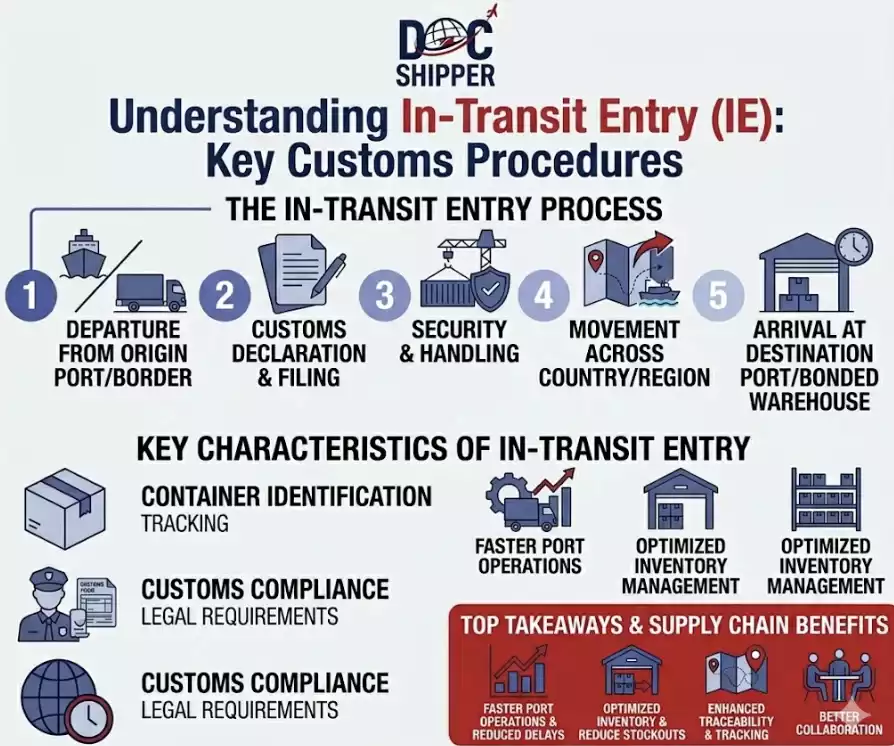
In-Transit Entry (I.T.) is a customs procedure allowing goods to transit through a country's territory without formal importation, destined for another final destination. This mechanism enables merchandise to pass through intermediate ports or borders while suspended from duties and taxes until reaching their ultimate country of import.
Introduction
Many importers struggle with shipments requiring transit through multiple countries before reaching their final destination. The confusion often stems from misunderstanding customs procedures for goods that don’t remain in the transit country.
In international logistics, the In-Transit Entry represents a critical facilitation tool. It streamlines cross-border movements by allowing merchandise to traverse territories without triggering full customs clearance procedures at each stop.
Key characteristics of I.T. procedures include:
- Duty suspension: No payment of import duties or taxes in the transit country
- Bonded movement: Goods remain under customs control throughout the journey
- Documentation requirements: Specific transit documents and guarantees must be provided
- Time limitations: Transit must be completed within prescribed timeframes
- Route restrictions: Predetermined paths and exit points must be followed
In-Depth Analysis & Legal Framework
The In-Transit Entry mechanism operates under international conventions and national regulations. Most countries follow guidelines established by the World Customs Organization’s Revised Kyoto Convention, which standardizes transit procedures globally.
The bonded transit status ensures goods remain sealed and monitored from entry to exit points. Customs authorities place electronic or physical seals on containers, preventing unauthorized access during passage through their territory.
A customs guarantee or bond is mandatory for I.T. movements. This financial security covers potential duties and penalties if goods don’t exit the transit country as declared. The guarantee amount typically equals the full duty value of the merchandise.
The Carnet TIR system (Transports Internationaux Routiers) represents the most recognized I.T. framework for road transport. Under this convention, trucks with TIR seals can cross multiple borders with minimal inspections, significantly reducing transit times.
At DocShipper, we systematically verify transit documentation and guarantee requirements before shipment departure. This proactive approach prevents costly delays at intermediate checkpoints and ensures compliance with all transit country regulations.
The Automated Commercial Environment (ACE) in the United States and similar electronic systems worldwide have digitalized I.T. processes. Real-time tracking and automated notifications now provide unprecedented transparency throughout the transit journey.
Practical Examples & Data
Understanding In-Transit Entry through concrete scenarios demonstrates its practical value in supply chain operations. Consider these common situations:
Comparative Analysis: Direct vs. Transit Shipment
| Criterion | Direct Shipment | In-Transit Entry |
|---|---|---|
| Transit time | 14-18 days | 22-28 days |
| Customs clearances | 1 (final destination) | 2+ (simplified at transit points) |
| Freight cost | $2,500-$3,000/container | $1,800-$2,200/container |
| Documentation complexity | Low | Medium-High |
| Cost savings potential | Baseline | 15-25% reduction |
Use Case: Electronics from China to Mexico via USA
A Mexican importer purchases $150,000 worth of electronics from Shenzhen. Instead of direct shipping to Veracruz, the goods transit through Los Angeles for consolidation with other shipments.
I.T. Process breakdown:
- Container arrives at Long Beach port with In-Transit Entry documentation
- U.S. Customs conducts simplified inspection (no duty assessment)
- Goods remain in bonded warehouse for 48 hours during consolidation
- Truck transport under TIR Carnet to Laredo border crossing
- Exit confirmed electronically; I.T. bond released within 24 hours
Financial impact: The importer saves approximately $18,000 in freight costs compared to direct ocean shipping, despite additional documentation fees of $800 for I.T. processing.
Key Data Points
- Average processing time: I.T. entries at major U.S. ports are processed within 2-6 hours using ACE automation
- Violation rate: Only 0.3% of I.T. shipments result in bond forfeitures due to procedural errors
- Cost of guarantees: Typical I.T. bond fees range from $350-$600 per entry
- Time limitations: Most countries allow 30-90 days for transit completion before penalties apply
- Container tracking: Modern I.T. systems provide real-time GPS monitoring with 15-minute update intervals
Conclusion
The In-Transit Entry mechanism represents an indispensable tool for optimizing international supply chain efficiency. Mastering its requirements enables significant cost reductions while maintaining customs compliance across multiple jurisdictions.
Need assistance navigating complex transit procedures? Contact DocShipper for expert guidance on your international shipments.
📚 Quiz
Test Your Knowledge: In-Transit Entry (I.T.)
What is the primary purpose of an In-Transit Entry (I.T.) procedure?
Which statement correctly describes the customs guarantee requirement for I.T. movements?
A company ships electronics from China to Mexico via the United States. What happens if the I.T. shipment doesn't exit U.S. territory within the allowed timeframe?
🎯 Your Result
📞 Free Quote in 24hFAQ | In-Transit Entry (I.T.): Definition, Process & Practical Examples
In-Transit Entry (I.T.) allows goods to pass through a country without formal importation, while Immediate Exportation (I.E.) involves goods that technically enter a country's customs territory but are immediately re-exported. I.T. is used for shipments continuing to another country; I.E. applies when merchandise is rejected or returned after arrival. Both avoid duty payments but require different documentation procedures.
I.T. bonds typically remain active for the duration specified in the transit permit, usually 30 to 90 days depending on the transit country. In the United States, continuous transit bonds are valid for one year and can cover multiple shipments. The bond releases automatically once customs confirms the goods have exited the territory, which usually occurs within 24-48 hours of departure verification.
Yes, customs authorities reserve the right to inspect I.T. cargo at any point during passage through their territory. However, inspections are typically less comprehensive than full import examinations. Modern risk-assessment systems select only high-risk shipments for detailed inspection, while low-risk I.T. cargo usually passes with document verification only. Seals must remain intact unless broken by authorized customs officers.
Failure to complete transit within the prescribed period triggers penalties and potential bond forfeiture. The transit country may assess import duties retroactively, plus interest and fines ranging from 5% to 25% of the duty value. Extensions are possible if requested before expiration with valid justification (equipment breakdown, force majeure). Repeated violations can result in suspension of I.T. privileges for the importer or carrier.
Most commercial goods qualify for I.T. treatment, but restrictions apply to sensitive categories. Prohibited items include weapons, hazardous materials without special permits, perishable goods requiring temperature control, and products subject to sanitary or phytosanitary regulations. Each transit country maintains specific exclusion lists. Agricultural products, pharmaceuticals, and high-value electronics often require additional documentation even under I.T. procedures.
While not legally mandatory in all jurisdictions, using a licensed customs broker is highly recommended for I.T. procedures. Brokers ensure accurate documentation, proper bond posting, and compliance with complex transit regulations. The cost of broker services ($150-$400 per entry) is minimal compared to potential penalties from filing errors. Large freight forwarders often include I.T. documentation in their service packages.
Yes, consolidation is permitted in bonded warehouses or Free Trade Zones within transit countries. This common practice allows combining smaller shipments into full containers for more economical onward transport. However, all consolidated goods must maintain their I.T. status, and individual I.T. entries must reference the consolidation facility. Deconsolidation or repackaging may trigger additional customs scrutiny and documentation requirements.
Core documents include the original Bill of Lading marked "In-Transit," commercial invoice showing final destination, I.T. bond or guarantee certificate, and customs transit declaration (form varies by country). Additional requirements may include cargo manifest, packing list, and entry summary. Electronic submissions through systems like ACE, CHIEF, or AES are mandatory in most developed economies. Missing or inaccurate paperwork is the primary cause of I.T. delays.
Standard marine cargo insurance typically covers I.T. movements, but policy terms should explicitly include transit territory coverage. Some insurers impose additional premiums for shipments passing through high-risk regions or multiple borders. Gaps in coverage can occur during handoffs between carriers at transit points. Comprehensive door-to-door policies that include all intermediate stops provide the best protection for I.T. cargo.
Absolutely. Air freight benefits significantly from I.T. procedures, especially for hub-and-spoke routing through major airports. The process is streamlined compared to ocean freight, with most air I.T. entries processed within hours. Airlines and air freight forwarders handle documentation electronically through IATA systems. The key difference is shorter transit timeframes—typically 5-15 days maximum compared to 30-90 days for ocean shipments.
Amendments to I.T. entries are possible but must be submitted before the shipment exits the transit country. The process requires filing a formal amendment with customs authorities, potentially posting an additional bond, and updating carrier routing instructions. Some jurisdictions charge amendment fees ($50-$200). Frequent destination changes may trigger increased scrutiny on future I.T. filings. Planning accuracy is crucial to avoid complications and delays.
Digital transformation has revolutionized I.T. processing through GPS tracking, blockchain-based documentation, and AI-powered risk assessment. Real-time visibility platforms allow shippers to monitor cargo location and customs status continuously. Automated border crossings using RFID seals and electronic pre-clearance reduce physical inspection needs. These technologies have decreased average transit processing times by 40-60% over the past decade while improving security and compliance.
Need Help with
Logistics or Sourcing ?
First, we secure the right products from the right suppliers at the right price by managing the sourcing process from start to finish. Then, we simplify your shipping experience - from pickup to final delivery - ensuring any product, anywhere, is delivered at highly competitive prices.


Fill the Form
Prefer email? Send us your inquiry, and we’ll get back to you as soon as possible.
Contact us




:%20Definition,%20Process%20&%20Practical%20Examples)