


In short ⚡
An Indemnity Bond is a legally binding guarantee issued by an importer or their bank to compensate a carrier, customs authority, or logistics provider for potential losses arising from missing or irregular shipping documents. This financial instrument ensures cargo release without original paperwork while protecting stakeholders against fraud, misdeclaration, or legal claims.
Introduction
Every year, thousands of shipments face delays due to lost or delayed original documents. A missing Bill of Lading can immobilize cargo for weeks, generating storage fees and contractual penalties. The Indemnity Bond solves this critical issue.
In international trade, carriers and customs authorities require original documents to release goods. When these documents are unavailable, an Indemnity Bond acts as a substitute guarantee. This mechanism is essential for:
- Emergency cargo release when original Bills of Lading are lost or delayed in transit
- Time-sensitive shipments where demurrage costs exceed bonding expenses
- Document discrepancies requiring immediate correction without halting operations
- Multi-modal transport involving multiple carriers and jurisdictions
- Risk mitigation for shipping lines against fraudulent claims or delivery disputes
Understanding how to properly issue and utilize an Indemnity Bond can save importers significant costs and operational disruptions. The bond’s legal validity varies by jurisdiction, making expert guidance crucial.
Legal Framework & Operational Mechanisms
An Indemnity Bond operates under common law principles and international maritime conventions. Its enforceability depends on three core elements: consideration, legal capacity, and absence of fraud or misrepresentation.
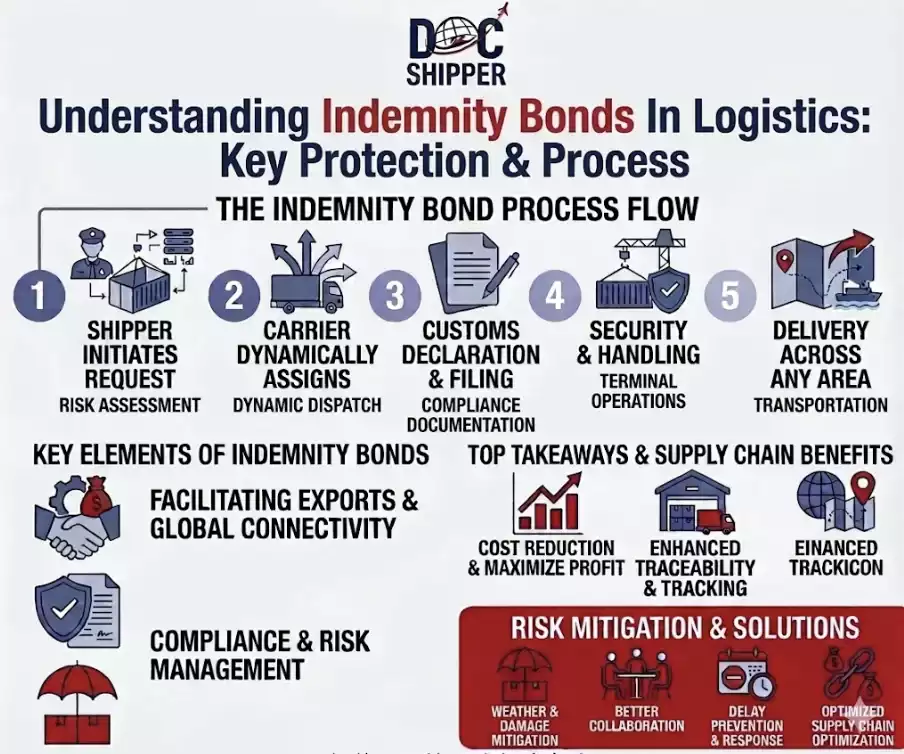
The bond typically involves three parties: the principal (importer), the obligee (carrier or customs), and the surety (bank or insurance company). The surety guarantees payment if the principal fails to fulfill obligations or if legal claims arise from document irregularities.
Validity periods range from six months to three years, depending on the cargo type and jurisdictional requirements. Shipping lines commonly require bonds covering 200-300% of cargo value to account for potential legal costs, interest, and consequential damages.
According to the International Maritime Organization, Indemnity Bonds must clearly specify covered risks, liability limits, and governing law. Ambiguous language can render the bond unenforceable in maritime courts.
Counter-indemnities are often required by banks issuing bonds on behalf of importers. This secondary guarantee protects the financial institution against losses if the original bond is called. At DocShipper, we systematically review bond terms to ensure they align with carrier requirements and minimize client exposure to unlimited liability clauses.
Key considerations include force majeure clauses, which may exempt carriers from liability under specific circumstances, and jurisdiction selection, which determines applicable legal standards and dispute resolution mechanisms. The bond must also address potential claims from multiple parties, including cargo owners, freight forwarders, and consignees.
Practical Applications & Cost Analysis
Indemnity Bonds are most frequently used in three scenarios: document loss, urgent delivery needs, and documentary credit discrepancies. Each scenario presents distinct cost-benefit calculations.
Comparative Cost Analysis
| Scenario | Cargo Value | Bond Cost | Alternative Cost | Time Saved |
|---|---|---|---|---|
| Lost Bill of Lading | $50,000 | $800-1,200 | $3,500 (demurrage 14 days) | 10-14 days |
| Perishable Goods | $120,000 | $2,000-3,000 | $48,000 (40% spoilage) | 5-7 days |
| Documentary Credit Issue | $200,000 | $3,500-5,000 | $15,000 (production halt) | 7-10 days |
Real-World Case Study
A European electronics importer faced a critical situation when original Bills of Lading were delayed due to courier strikes. The cargo, valued at $280,000, contained components for a time-sensitive production cycle. Demurrage charges accumulated at $450 per day.
By issuing an Indemnity Bond within 48 hours, the importer paid a one-time fee of $4,200 (1.5% of cargo value) and released the goods immediately. The alternative would have resulted in 18 days of storage fees totaling $8,100, plus production delays costing an estimated $22,000 in lost revenue.
Key Decision Factors
- Bond coverage ratio: Most carriers require 200-250% of cargo value; specialized goods may need 300%
- Issuance timeframe: Bank-issued bonds take 3-5 business days; insurance company bonds can be faster
- Counter-indemnity requirements: Expect collateral demands of 10-30% depending on creditworthiness
- Jurisdictional considerations: English law bonds are widely accepted; some countries require local legal frameworks
- Claim history impact: Previous bond claims can increase future premiums by 40-80%
At DocShipper, we maintain relationships with specialized maritime insurers to secure competitive bonding rates and expedite issuance for urgent shipments.
Conclusion
The Indemnity Bond is an indispensable tool for maintaining supply chain continuity when documentation challenges arise. Proper understanding of its legal structure and cost implications enables strategic decision-making in time-critical situations.
Need assistance with document irregularities or bond issuance? Contact DocShipper for expert guidance on navigating complex logistics scenarios.
📚 Quiz
Test Your Knowledge: Indemnity Bond
What is the primary purpose of an Indemnity Bond in international trade?
An importer believes an Indemnity Bond and a Letter of Indemnity are interchangeable instruments. Is this interpretation correct?
Your electronics shipment worth $280,000 is delayed due to missing Bills of Lading. Demurrage costs are $450/day. What is the most appropriate action?
🎯 Your Results
📞 Free Custom Quote in 24hFAQ | Indemnity Bond: Definition, Calculation & Concrete Examples
Once original documents are presented to the carrier, the Indemnity Bond is typically released and liability ceases. However, any claims filed before document surrender remain valid. The bond issuer should formally notify all parties of document receipt and request written confirmation of bond cancellation to avoid future disputes.
Yes, carriers retain the right to refuse bonds that don't meet their specific requirements regarding coverage amounts, surety creditworthiness, or legal jurisdiction. Major shipping lines publish bond templates that must be followed precisely. Non-standard language or insufficient coverage will result in rejection and continued cargo detention.
Standard bonds remain valid for one to three years from issuance date, regardless of whether original documents are later produced. The extended validity period protects carriers against delayed legal claims. Some jurisdictions impose statutory limitation periods that may supersede bond terms, typically ranging from three to six years for maritime claims.
A Letter of Indemnity is a simpler undertaking, often without third-party surety involvement, used for minor discrepancies. An Indemnity Bond involves a financial institution guaranteeing payment and is required for significant document issues like missing Bills of Lading. Bonds carry greater legal weight and are enforceable across jurisdictions more reliably than simple letters.
The importer or consignee typically bears all costs associated with bond issuance, including bank fees, insurance premiums, and legal review expenses. These costs are considered part of the landed cost of goods. In some cases, contractual terms may allow cost recovery from the party responsible for document loss or delay, such as a negligent freight forwarder.
Yes, partial release bonds are commonly used when containers hold multiple consignments or when certain goods have cleared customs while others remain pending. The bond value is calculated proportionally based on the specific cargo being released. This approach requires detailed cargo manifests and clear identification of released items to prevent disputes.
Unlimited liability clauses expose signatories to potentially catastrophic financial consequences if third-party claims arise. These can include legal fees, cargo loss compensation, environmental damage costs, or consequential losses to subsequent cargo owners. Always negotiate liability caps based on cargo value and ensure comprehensive insurance coverage before signing such instruments.
Customs treatment varies by country. EU and US customs generally accept bonds for temporary release pending document verification, but require additional security deposits. Some developing nations prohibit bond-based releases entirely, requiring original documents under all circumstances. Always verify local customs regulations before relying on bond mechanisms for clearance.
Electronic Bills of Lading systems like Bolero and essDOCS significantly reduce document loss risks and can accelerate transfers. However, not all carriers and jurisdictions accept digital alternatives, and technical failures can still occur. Indemnity Bonds remain necessary as a fallback mechanism when digital systems encounter legal recognition issues or system outages.
Essential elements include: precise cargo description, vessel and voyage details, Bill of Lading number, full party identifications, explicit coverage amount, surety financial guarantee, governing law clause, and signatures with dates. Missing or ambiguous information provides carriers grounds for rejection. Legal review before submission is strongly recommended to ensure enforceability.
Banks and insurance companies assess creditworthiness before issuing bonds. Poor credit history may result in higher premiums (50-100% increases), larger collateral requirements (up to 50% of bond value), or outright rejection. Established importers with strong financial records typically secure favorable terms and faster processing, making relationship banking valuable for logistics operations.
Standard bonds are non-transferable as they're issued based on specific party relationships and creditworthiness assessments. If cargo ownership changes after bond issuance, a new bond reflecting the current owner may be required. Transfer attempts without carrier consent can void the original bond and expose all parties to liability. Always obtain written approval before any assignment of rights or obligations.
Need Help with
Logistics or Sourcing ?
First, we secure the right products from the right suppliers at the right price by managing the sourcing process from start to finish. Then, we simplify your shipping experience - from pickup to final delivery - ensuring any product, anywhere, is delivered at highly competitive prices.


Fill the Form
Prefer email? Send us your inquiry, and we’ll get back to you as soon as possible.
Contact us




