


In short ⚡
EDIFACT (Electronic Data Interchange for Administration, Commerce, and Transport) is the international UN/EDIFACT standard for electronic business document exchange. It enables automated data transfer between trading partners worldwide, replacing paper-based processes with structured digital messages for orders, invoices, customs declarations, and shipping instructions across supply chains.Introduction
Many businesses struggle with manual document processing that creates delays, errors, and compliance risks in international trade. EDIFACT solves this by providing a universal language for business communication, eliminating the need for countless proprietary formats and manual data entry.
In global logistics, EDIFACT serves as the backbone for automated customs clearance, warehouse management, and carrier communications. This standardization reduces transaction costs, accelerates processing times, and ensures regulatory compliance across borders.
- Universal format: ISO 9735 standard recognized by governments and industries worldwide
- Message variety: Over 200 predefined message types (ORDERS, INVOIC, DESADV, IFTMIN, etc.)
- Syntax rules: Hierarchical structure with segments, data elements, and qualifiers
- Version control: Regular updates managed by UN/CEFACT ensuring backward compatibility
- Regulatory acceptance: Mandatory for customs declarations in EU, Australia, and many Asian countries
Technical Framework & Standards Architecture
EDIFACT operates through a hierarchical message structure where each document type follows predefined syntax rules. Messages consist of segments (like UNH for header, LIN for line items), which contain data elements separated by standardized delimiters. This structure ensures consistent interpretation across different systems and countries.
The standard supports multiple versions and subsets tailored to specific industries. For example, EANCOM is the retail sector’s EDIFACT subset, while IFCSUM serves container shipping. This flexibility allows organizations to adopt relevant message types without implementing the entire specification.
Transmission methods vary from traditional Value-Added Networks (VANs) to modern AS2 protocols and cloud-based APIs. Companies typically use EDI translation software to convert internal data formats into EDIFACT syntax and vice versa, maintaining seamless integration with ERP systems.
The mandatory compliance requirements differ by jurisdiction. EU customs authorities require EDIFACT CUSCAR and CUSDEC messages for import/export declarations. Non-compliance results in cargo holds, penalties, and supply chain disruptions.
At DocShipper, we implement EDIFACT integration for clients transitioning from manual processes, ensuring proper message mapping, testing with trading partners, and full compliance with local customs requirements before go-live.
Implementation Examples & Industry Applications
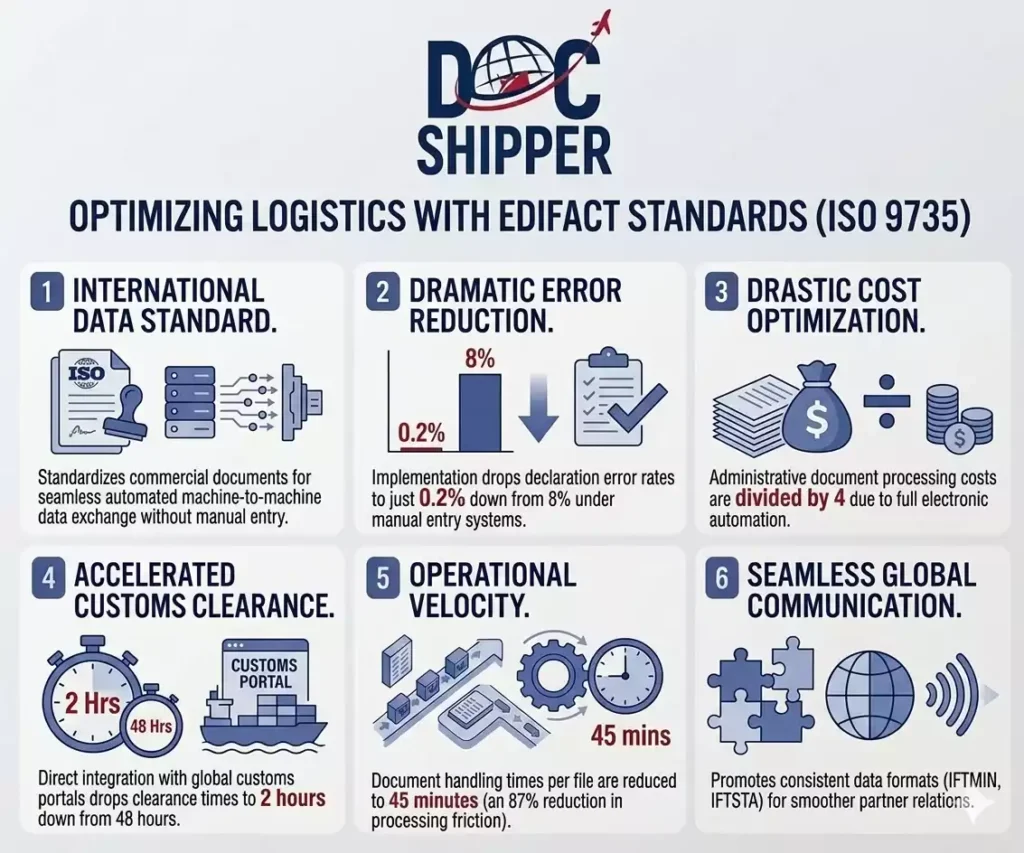
EDIFACT implementation delivers measurable efficiency gains across international trade operations. A mid-sized European importer processing 500 shipments monthly can reduce customs clearance time from 48 hours to 4 hours by automating CUSDEC transmissions, directly impacting cash flow and inventory turnover.
| Message Type | Business Function | Typical Users | Processing Time Reduction |
|---|---|---|---|
| ORDERS | Purchase order transmission | Retailers, manufacturers | 85% faster |
| INVOIC | Electronic invoicing | All commercial entities | 70% cost reduction |
| IFTMIN | Freight booking instructions | Freight forwarders, carriers | 60% fewer errors |
| CUSCAR | Cargo manifest declaration | Customs brokers, shipping lines | 90% compliance rate |
| DESADV | Advance shipping notification | Distributors, 3PLs | 50% receiving efficiency |
Real-world case: A pharmaceutical distributor shipping to 15 EU countries implemented EDIFACT for customs and logistics communications. Initial investment of €45,000 (software, training, integration) yielded annual savings of €180,000 through reduced manual processing, faster customs clearance, and elimination of paper documentation errors.
The automotive sector relies heavily on EDIFACT DELFOR (delivery forecast) and DELJIT (just-in-time delivery) messages to coordinate complex supply chains. Toyota’s European operations exchange over 50,000 EDIFACT messages daily with tier-1 suppliers, maintaining 99.8% on-time delivery rates.
For customs compliance, EDIFACT CUSDEC messages must include HS codes, country of origin, declared values, and documentary references. Syntax errors trigger automatic rejections, making pre-validation critical. DocShipper’s compliance team validates all EDIFACT customs submissions before transmission, preventing costly delays.
Modern implementations increasingly use hybrid approaches combining EDIFACT with APIs and XML for enhanced flexibility. Cloud-based EDI platforms now offer EDIFACT-to-JSON conversion, allowing businesses to maintain standard compliance while leveraging modern development frameworks.
Conclusion
EDIFACT remains the foundational standard for international trade communications, enabling seamless data exchange between governments, carriers, and commercial entities. Proper implementation reduces costs, accelerates transactions, and ensures regulatory compliance across global supply chains.
Need assistance implementing EDIFACT for your logistics operations? Contact DocShipper for expert guidance on standards compliance, system integration, and customs automation.
📚 Quiz
Test Your Knowledge: EDIFACT Standards
What is EDIFACT's primary function in international trade?
Which statement about EDIFACT message transmission is correct?
A European pharmaceutical distributor plans to automate customs declarations for 15 EU countries. What is the most appropriate EDIFACT implementation approach?
🎯 Your Result
📞 Free Quote in 24hFAQ | EDIFACT: Definition, Standards & Implementation Guide
EDI (Electronic Data Interchange) is the general concept of electronic business document exchange, while EDIFACT is one specific international standard for EDI. Other standards include ANSI X12 (primarily North America) and XML-based formats. EDIFACT dominates international trade, particularly in Europe, Asia-Pacific, and for customs communications worldwide.
Implementation costs range from €15,000 for small businesses using cloud-based solutions to €200,000+ for enterprise systems with complex integrations. Factors include number of trading partners, message types required, ERP integration complexity, and VAN subscription fees. Most companies achieve ROI within 12-18 months through labor savings and error reduction.
While technically possible, email transmission of EDIFACT messages is not recommended for commercial operations. Standard practice uses secure protocols like AS2, SFTP, or Value-Added Networks (VANs) that provide guaranteed delivery, non-repudiation, encryption, and audit trails required for legal and regulatory compliance.
The European Union, Australia, Singapore, South Korea, and UAE require EDIFACT formats for electronic customs declarations. China accepts EDIFACT alongside proprietary formats. The United States uses ANSI X12 rather than EDIFACT for customs (ABI/AMS systems). Specific message types and versions vary by jurisdiction, requiring careful verification before implementation.
Receiving systems automatically reject messages with syntax errors, generating CONTRL (control) acknowledgment messages indicating the specific errors. Common issues include incorrect segment order, missing mandatory elements, invalid code values, or delimiter problems. Most EDI software includes validators that check messages before transmission to prevent rejections.
UN/CEFACT releases new EDIFACT versions twice yearly (typically in January and July). However, most organizations update their implementations every 2-3 years rather than with each release. Backward compatibility is maintained, so older message versions remain valid. Industry subsets like EANCOM have their own update cycles aligned with sector-specific requirements.
Yes, cloud-based EDI platforms now widely support EDIFACT translation and transmission. Solutions like IBM Sterling B2B Integrator Cloud, SAP Integration Suite, and TrueCommerce offer EDIFACT capabilities with API interfaces, allowing seamless integration with modern cloud ERPs, WMS, and TMS systems without on-premise infrastructure.
UNH is the message header segment that identifies the message type, version, and control reference number. It appears at the start of every EDIFACT message after the interchange header (UNB). For example, "UNH+123456+ORDERS:D:96A:UN" indicates an ORDERS message using Directory version 96A. This segment is mandatory and critical for proper message routing.
Not necessarily. While Value-Added Networks provide reliable message delivery, tracking, and multi-partner connectivity, direct point-to-point connections using AS2 or SFTP protocols are increasingly common. The choice depends on trading partner requirements, transaction volumes, and internal IT capabilities. Many large retailers and customs authorities still mandate VAN usage for their connections.
EDIFACT supports various character sets through the UNB segment's syntax identifier. UNOA and UNOB cover ASCII-based languages, UNOC handles ISO 8859-1 (Western European), UNOD supports ISO 8859-2 (Central European), and UNOK enables UTF-8 for full Unicode support including Asian languages. Trading partners must agree on the character set before exchanging messages.
Blockchain initiatives like TradeLens and GSBN are exploring EDIFACT integration to combine standardized messaging with distributed ledger immutability. The concept involves converting EDIFACT messages into blockchain transactions for enhanced traceability and trust. However, adoption remains limited, with traditional EDIFACT transmission still dominating operational logistics in 2025.
Standard EDIFACT messages contain only structured data, not binary attachments. However, companion standards like APERAK (acknowledgment) can reference external documents. For document exchange, organizations typically combine EDIFACT with email attachments or use separate document management systems. Some modern EDI platforms offer hybrid solutions linking EDIFACT transactions to cloud-stored documents via reference numbers.
Need Help with
Logistics or Sourcing ?
First, we secure the right products from the right suppliers at the right price by managing the sourcing process from start to finish. Then, we simplify your shipping experience - from pickup to final delivery - ensuring any product, anywhere, is delivered at highly competitive prices.


Fill the Form
Prefer email? Send us your inquiry, and we’ll get back to you as soon as possible.
Contact us




