


In short ⚡
Electronic Funds Transfer (EFT) is a digital payment system that enables the transfer of money between bank accounts without physical cash or checks. In international logistics, EFT facilitates instant supplier payments, customs duties settlement, and freight charges, reducing transaction delays and improving cash flow management across global supply chains.
Introduction
Payment delays represent one of the most critical bottlenecks in international trade. Exporters wait for cleared funds while importers face penalties for late customs payments. Traditional wire transfers can take 3-5 business days, creating unnecessary friction.
EFT eliminates these delays by processing transactions electronically through secure banking networks. This technology has become the backbone of modern logistics finance, enabling real-time payment verification and automated accounting reconciliation.
Key characteristics of EFT in logistics operations:
- Speed: Transactions complete within hours rather than days
- Cost-efficiency: Lower processing fees compared to traditional banking methods
- Security: Encrypted transfers with multi-layer authentication protocols
- Traceability: Complete digital audit trail for compliance and accounting
- Automation: Integration with ERP systems and customs platforms
EFT Mechanisms & Technical Framework
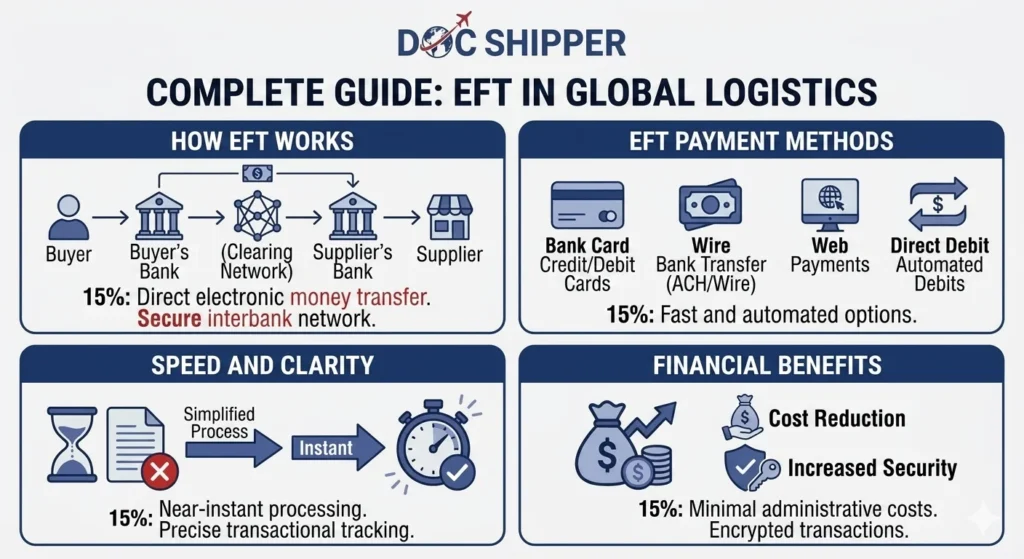
The EFT ecosystem operates through interconnected banking networks governed by international standards. SWIFT (Society for Worldwide Interbank Financial Telecommunication) serves as the primary messaging system for cross-border transfers, while domestic networks like ACH (Automated Clearing House) handle regional transactions.
When an importer initiates payment for a shipment, the process follows these steps: The originating bank validates account credentials and available funds. The transaction is encrypted and transmitted through secure channels. Intermediary banks process currency conversions if necessary. The beneficiary bank credits the exporter’s account.
According to SWIFT standards, cross-border EFT transactions must include specific identifiers: sender and receiver BIC codes, transaction reference numbers, and purpose codes for customs authorities. This standardization ensures regulatory compliance across jurisdictions.
SEPA (Single Euro Payments Area) revolutionized European logistics by creating a unified payment zone. Transactions between SEPA countries process as domestic transfers, eliminating currency conversion fees and reducing settlement times to one business day.
The integration of blockchain technology is transforming EFT capabilities. Smart contracts automatically release payments upon shipment milestone confirmation, eliminating manual intervention. DocShipper utilizes blockchain-verified EFT systems to provide clients with instant payment confirmation and reduced fraud risk.
Security protocols include two-factor authentication, biometric verification, and end-to-end encryption. Financial institutions must comply with PCI DSS (Payment Card Industry Data Security Standard) and local banking regulations. At DocShipper, we verify all EFT transactions through ISO-certified banking partners, ensuring full compliance with international financial regulations.
Practical Applications & Transaction Data
Understanding EFT through real-world scenarios demonstrates its impact on logistics efficiency. Consider these comparative transaction profiles:
| Payment Method | Processing Time | Average Cost | Tracking Capability |
|---|---|---|---|
| EFT Domestic | Same day – 24 hours | $0.25 – $1.50 | Real-time confirmation |
| EFT International | 1 – 3 business days | $15 – $45 | SWIFT tracking code |
| Wire Transfer | 3 – 5 business days | $35 – $60 | Manual inquiry required |
| Letter of Credit | 7 – 14 business days | $100 – $250 | Bank confirmation only |
Use Case: Customs Duty Payment
An importer receives a shipment valued at $50,000 with 8% customs duties due ($4,000). Using traditional methods, payment processing takes 3-5 days, incurring demurrage charges of $150 per day. Total delay cost: $450-$750.
With EFT integration through customs portals, payment processes within 2 hours. The shipment clears immediately, eliminating demurrage fees entirely. Annual savings for companies processing 50 shipments: $22,500-$37,500.
Industry statistics reveal EFT’s transformative impact:
- 78% of international logistics companies now require EFT capability from service providers
- Cross-border EFT volume increased by 34% year-over-year since 2021
- Transaction error rates dropped from 2.3% to 0.4% with automated EFT systems
- Average payment processing costs decreased by 62% compared to traditional wire transfers
DocShipper clients benefit from direct EFT integration with major customs authorities in 45 countries, ensuring immediate duty payment and cargo release coordination.
Conclusion
Electronic Funds Transfer has evolved from a convenience to an operational necessity in international logistics. Its speed, security, and cost-effectiveness directly impact supply chain efficiency and bottom-line profitability.
Need assistance implementing EFT solutions for your logistics operations? Contact DocShipper for integrated payment and shipping coordination.
📚 Quiz
Test Your Knowledge: Electronic Funds Transfer (EFT)
What is the primary function of Electronic Funds Transfer (EFT) in international logistics?
Which statement correctly describes the difference between EFT and wire transfer?
An importer needs to pay $4,000 in customs duties for a shipment. Traditional payment methods take 3-5 days and incur $150 daily demurrage charges. What is the cost advantage of using EFT?
🎯 Your Result
📞 Free Quote in 24hFAQ | EFT (Electronic Funds Transfer): Definition, Process & Practical Examples
EFT is an umbrella term covering all electronic money transfers, including ACH, direct deposits, and wire transfers. Wire transfers specifically refer to bank-to-bank transfers through networks like SWIFT or Fedwire. EFT typically costs less and processes faster for domestic transactions, while international wire transfers offer guaranteed same-day delivery at higher fees.
International EFT transactions typically clear within 1-3 business days depending on the destination country, banking networks involved, and time zones. SEPA transfers within Europe complete within 24 hours. Transfers to developing markets may take 3-5 days due to correspondent banking requirements and currency conversion processing.
EFT reversals depend on the transaction type and timing. ACH payments can be reversed within 5 business days if unauthorized or erroneous. International SWIFT transfers are generally irreversible once completed, though banks may initiate recall requests. This makes pre-transaction verification critical in logistics payments to prevent costly errors.
Domestic EFT requires: beneficiary account number, bank routing number, account holder name, and transaction amount. International transfers additionally need: beneficiary bank BIC/SWIFT code, IBAN (where applicable), beneficiary address, and transaction purpose code. Customs-related payments may require additional reference numbers for duty identification.
Yes, all EFT transactions generate unique reference numbers for tracking. Domestic ACH transfers provide confirmation codes accessible through online banking. International transfers receive SWIFT MT103 confirmation with complete routing information. Modern banking apps offer real-time status updates from initiation through final settlement.
Primary risks include phishing attacks targeting banking credentials, business email compromise schemes redirecting payments, and man-in-the-middle attacks intercepting transaction data. Mitigation strategies include multi-factor authentication, payment confirmation calls for large amounts, and using dedicated secure networks for financial transactions rather than public Wi-Fi.
Modern customs authorities operate electronic payment portals accepting direct EFT integration. Importers register their bank accounts within the customs system. Upon duty assessment, the system automatically initiates EFT payment, receives confirmation, and updates clearance status. This eliminates manual payment submission and accelerates cargo release procedures.
EFT reduces transaction costs by 60-80% compared to wire transfers. A $10,000 international payment costs $35-45 via EFT versus $100-150 for expedited wire transfer. Additionally, EFT eliminates check processing fees ($15-25 per transaction), reduces accounting labor by 40% through automated reconciliation, and prevents demurrage charges through faster customs clearance.
Yes, EFT systems process multi-currency transfers with automatic conversion at interbank exchange rates. The sender initiates payment in their local currency, and the recipient receives funds in theirs. Conversion fees typically range from 0.5-2% depending on currency pairs and transaction volume. Some platforms offer locked-in rates for pre-scheduled payments.
Failed EFT transactions trigger automatic notifications to both sender and recipient. Common failure reasons include insufficient funds, incorrect account details, or exceeded transaction limits. Funds return to the sender's account within 1-3 business days. Banks provide failure codes indicating specific issues, enabling quick correction and retransmission.
Banks impose daily and per-transaction EFT limits for security purposes. Standard accounts typically limit domestic transfers to $25,000-$100,000 daily. Commercial accounts supporting logistics operations offer customized limits reaching millions. International limits vary by destination country regulations. Freight forwarders should establish appropriate limits with their banks before peak shipping seasons.
While not legally mandated, EFT capability has become a practical requirement. Major customs authorities in the EU, US, Canada, and Asia now prioritize or exclusively accept electronic duty payments. Carriers increasingly require EFT for freight charges to reduce payment delays. Companies lacking EFT capability face operational disadvantages including longer clearance times and limited carrier options.
Need Help with
Logistics or Sourcing ?
First, we secure the right products from the right suppliers at the right price by managing the sourcing process from start to finish. Then, we simplify your shipping experience - from pickup to final delivery - ensuring any product, anywhere, is delivered at highly competitive prices.


Fill the Form
Prefer email? Send us your inquiry, and we’ll get back to you as soon as possible.
Contact us




:%20Definition,%20Process%20&%20Practical%20Examples)