


In short ⚡
An export license is a government-issued authorization permitting businesses to ship specific goods or technologies to foreign destinations. Required for controlled items—such as dual-use technologies, military equipment, or sanctioned products—this document ensures compliance with national security, trade policy, and international treaty obligations before goods cross borders.
Introduction
Shipping goods internationally seems straightforward—until customs authorities halt your shipment for lacking proper documentation. One of the most misunderstood regulatory requirements in global trade is the export license. Many exporters assume all products can be freely shipped, only to discover their items fall under controlled categories requiring government approval.
Export licenses exist to balance commercial freedom with national security and foreign policy objectives. They regulate the flow of sensitive technologies, strategic materials, and dual-use goods that could threaten international stability if misused.
- National security protection: Prevents sensitive technologies from reaching adversarial nations
- Treaty compliance: Ensures adherence to international arms control agreements and sanctions regimes
- Trade policy enforcement: Controls exports to embargoed countries or restricted end-users
- Economic leverage: Maintains strategic advantages in critical technology sectors
- Legal obligation: Violations carry severe penalties including fines, imprisonment, and export privilege denial
Regulatory Framework & Expertise
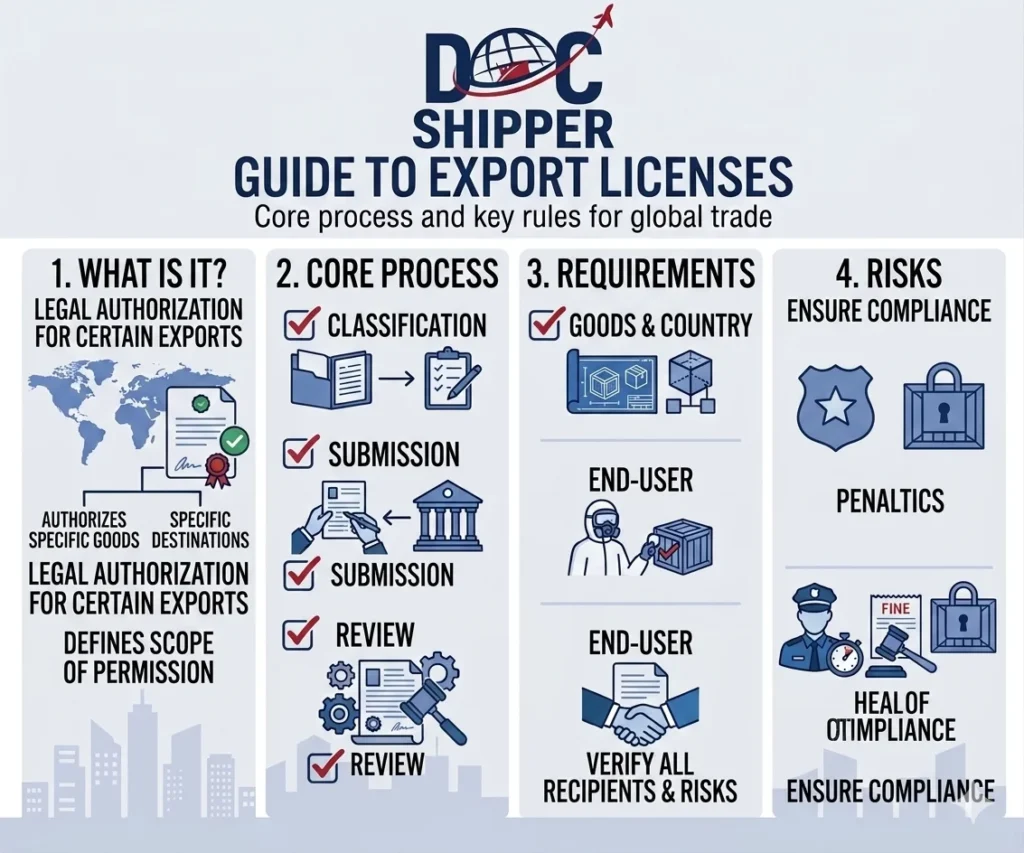
Export licensing systems vary by jurisdiction but share common principles. In the United States, the Bureau of Industry and Security (BIS) administers the Export Administration Regulations (EAR), while the Directorate of Defense Trade Controls oversees military items under ITAR. The European Union operates a dual-use goods regime coordinated across member states.
Understanding which licensing regime applies requires analyzing three critical factors. First, product classification determines whether items appear on controlled lists. Exporters must identify the correct Export Control Classification Number (ECCN) or determine if goods qualify as EAR99 (generally exempt from licensing). Second, destination country matters significantly—exports to Group D:5 countries face heightened scrutiny. Third, end-user and end-use verification prevents diversion to prohibited parties or military applications.
The licensing process typically involves submitting detailed technical specifications, end-user statements, and commercial documentation through electronic systems like SNAP-R (Simplified Network Application Process Redesign). Processing times range from days to months depending on product sensitivity and destination risk profile.
License exceptions provide conditional relief from full licensing requirements. Common exceptions include LVS (limited value shipments), TMP (temporary exports), and GBS (shipments to country group B destinations). However, misapplying exceptions represents a frequent violation trigger during compliance audits.
At DocShipper, we maintain a compliance database cross-referencing ECCNs with destination-specific requirements, enabling clients to determine licensing needs accurately before shipment preparation. This proactive approach prevents costly delays and regulatory violations.
Practical Examples & Data
Export licensing requirements manifest differently across industries and product categories. Consider these real-world scenarios illustrating when licenses become mandatory versus optional.
Case Study: Semiconductor Manufacturing Equipment
A California-based company manufactures photolithography systems capable of producing chips below 14nm. Exporting this equipment to China requires a BIS license due to ECCN 3B001 classification. The application must include:
- Technical specifications demonstrating performance characteristics
- End-user certificate from the Chinese purchasing entity
- Site verification documentation confirming civilian use
- Processing time: 45-90 days with potential for interagency review
Comparative Analysis: License Requirements by Product Category
| Product Category | ECCN Example | License Required To | Typical Processing |
|---|---|---|---|
| High-performance computers | 4A003 | China, Russia, Venezuela | 30-60 days |
| Encryption software | 5D002 | Most destinations (with exceptions) | 10-20 days |
| Carbon fiber materials | 1C010 | Comprehensive destinations | 45-75 days |
| Night vision devices | 6A003 | All non-NATO destinations | 60-120 days |
| Commercial satellites | 9A004 | Nearly all destinations | 90-180 days |
Statistical Snapshot
According to BIS data, approximately 35,000 export license applications are processed annually in the United States. Approval rates exceed 95% for properly documented applications, while denial rates increase significantly for sensitive destinations. Common rejection reasons include incomplete end-user documentation (42%), proliferation concerns (31%), and sanctioned party involvement (18%).
DocShipper conducts pre-export compliance reviews that have helped clients achieve a 98.7% first-submission approval rate by ensuring documentation completeness and regulatory alignment before filing.
Conclusion
Export licenses serve as critical gatekeepers in international trade, balancing commercial opportunity with national security imperatives. Proper classification, thorough documentation, and proactive compliance planning transform regulatory requirements from obstacles into manageable procedures.
Need expert guidance navigating export licensing requirements for your products? Contact DocShipper for comprehensive compliance support tailored to your specific trade scenarios.
📚 Quiz
Test Your Knowledge: Export License
What is the primary purpose of an export license?
A company ships controlled items valued at $800 to Germany using License Exception LVS. Which statement is correct?
Your company received a specific export license approval yesterday. Can you ship controlled semiconductor equipment to China today if the buyer suddenly changes?
🎯 Your Result
📞 Free Quote in 24hFAQ | Export License: Definition, Types & Practical Examples
Determine your product's Export Control Classification Number (ECCN) by reviewing technical specifications against the Commerce Control List. If no ECCN applies, items are typically classified EAR99 and may not require licensing except to embargoed destinations. Consult BIS guidelines or work with compliance specialists to ensure accurate classification, as misclassification carries serious penalties.
General licenses authorize categories of exports without individual application—essentially regulatory permission embedded in the rules themselves. Specific licenses require case-by-case government approval through formal application processes. Most controlled items need specific licenses, while general authorizations apply to lower-risk scenarios meeting defined conditions.
No. Exporting controlled items before receiving license approval constitutes an illegal export under EAR and ITAR regulations. Violations result in civil penalties up to $300,000 per violation, criminal fines reaching $1 million, and potential imprisonment. Always await formal approval before scheduling shipments of controlled goods.
Standard processing times range from 30 to 90 days depending on product sensitivity, destination country, and whether interagency review is required. Routine electronics to allied nations may clear in 2-3 weeks, while advanced technologies to higher-risk destinations can take 4-6 months. Incomplete applications extend timelines significantly.
Unlicensed exports of controlled items trigger severe consequences including administrative penalties ($330,194 per violation adjusted for inflation), criminal fines, denial of export privileges for your company, and personal criminal liability including imprisonment. Even inadvertent violations require costly voluntary self-disclosures and remediation programs.
Yes, the License Exception LVS permits certain controlled items valued under $1,500 (with specific ECCN restrictions) to designated countries. However, this exception excludes many sensitive ECCNs and doesn't apply to embargoed destinations. Always verify your specific product qualifies before invoking any license exception.
Absolutely. Technical data, software, and even verbal technical discussions with foreign nationals constitute "exports" under EAR. Encryption software (ECCN 5D002), design blueprints, and source code frequently require licensing. Cloud storage accessible to foreign persons may trigger deemed export rules requiring internal compliance protocols.
Applications are submitted electronically through the Simplified Network Application Process Redesign (SNAP-R) system maintained by BIS. Required information includes product technical specifications, ECCN classification, end-user details, destination country, intended end-use, and commercial documentation. First-time applicants should register company credentials before initiating applications.
No. Export licenses are transaction-specific and non-transferable. They authorize only the stated consignee, end-user, and quantities listed on the license. Any changes to these elements require applying for a new license or formally amending the existing authorization through BIS before shipment.
A deemed export occurs when controlled technology or technical data is released to foreign nationals within the United States. This includes hiring foreign engineers who access controlled information or allowing foreign visitors to tour facilities containing controlled technology. Deemed exports require the same license approvals as physical exports.
Standard export licenses remain valid for four years from issuance date, with usage permitted for the approved value and quantity. Once these parameters are exhausted or the license expires, new applications are required. Some temporary export licenses have shorter validity periods tied to specific exhibition or demonstration events.
Yes. Many controlled items benefit from license exceptions when exported to NATO allies and other trusted partners (Country Groups A:1, A:2). License Exception STA permits certain dual-use items to 36 designated countries meeting technology safeguard requirements. However, even allied exports may require licenses for highly sensitive technologies.
Need Help with
Logistics or Sourcing ?
First, we secure the right products from the right suppliers at the right price by managing the sourcing process from start to finish. Then, we simplify your shipping experience - from pickup to final delivery - ensuring any product, anywhere, is delivered at highly competitive prices.


Fill the Form
Prefer email? Send us your inquiry, and we’ll get back to you as soon as possible.
Contact us




