


In short ⚡
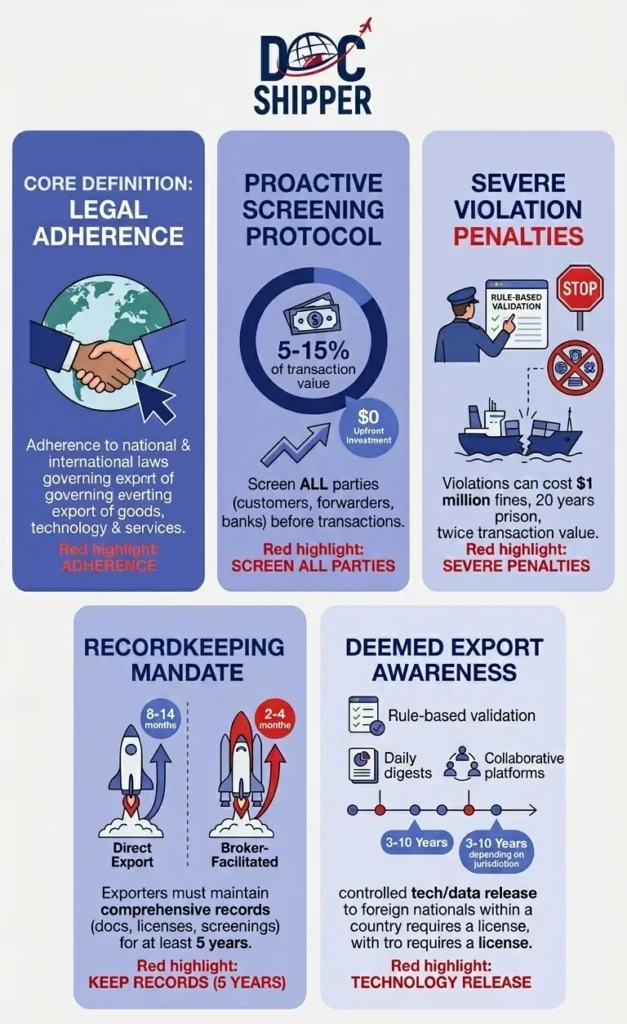
Export Compliance refers to the adherence to all national and international laws, regulations, and restrictions governing the export of goods, technology, and services. It ensures that shipments meet legal requirements, avoid prohibited destinations, and comply with licensing obligations to prevent penalties and trade disruptions.
Introduction
Many exporters face delays, fines, or shipment seizures because they underestimate the complexity of export compliance regulations. A single missing license or an incorrect classification can result in penalties exceeding hundreds of thousands of dollars and damage to business reputation.
Export compliance is not merely a bureaucratic formality. It is a strategic necessity for businesses engaged in international trade. It protects companies from legal risks while ensuring smooth cross-border operations.
Understanding export compliance involves mastering several critical dimensions:
- Export control classifications that determine which products require special authorization
- Destination screening to verify countries, entities, and individuals against restricted lists
- Licensing requirements based on product type, end-use, and recipient
- Recordkeeping obligations to maintain audit trails for government inspections
- Training programs ensuring staff understand compliance protocols
Regulatory Framework & Expertise
Export compliance operates within a complex ecosystem of multilayered regulations that vary by country, product category, and destination. In the United States, the primary frameworks include the Export Administration Regulations (EAR) administered by the Bureau of Industry and Security, and the International Traffic in Arms Regulations (ITAR) managed by the State Department.
The Export Control Reform Act modernized U.S. export controls by creating a unified control list and streamlining licensing procedures. Companies must classify their products using the Commerce Control List (CCL) and assign proper Export Control Classification Numbers (ECCN). Items without an ECCN designation fall under EAR99, which generally require no license for most destinations but still demand compliance verification.
The European Union operates under the EU Dual-Use Regulation, which controls goods that can serve both civilian and military purposes. This regulation mandates that exporters obtain authorization before shipping controlled items outside the EU. Authorization types include individual licenses, global licenses, and general export authorizations depending on the item and destination. You can review official EU guidelines at European Commission Trade Policy.
Denied party screening constitutes a critical compliance step. Exporters must check all transaction parties against government-maintained lists such as the Denied Persons List, Entity List, and Specially Designated Nationals list. Shipping to listed entities can result in criminal prosecution and civil penalties. At DocShipper, we integrate automated screening systems into our compliance protocols to flag potential risks before shipments proceed.
The concept of deemed exports extends compliance beyond physical goods. When foreign nationals access controlled technology or technical data within a country, this constitutes a deemed export to their home country. Companies must therefore screen employees and visitors who access sensitive information, particularly in research, engineering, and defense sectors.
Sanctions programs add another compliance layer. Countries under comprehensive sanctions face complete trade embargoes, while others operate under targeted restrictions. Exporters must navigate these constantly evolving requirements, as governments frequently update sanctions in response to geopolitical developments. At DocShipper, we monitor regulatory changes daily and adjust our compliance procedures to ensure client shipments remain authorized.
Practical Examples & Data
Understanding export compliance becomes clearer through real-world scenarios that illustrate regulatory application. Companies across industries face different compliance requirements based on their products and markets.
Use Case 1: Electronics Manufacturer
A U.S. company manufactures advanced semiconductors used in telecommunications equipment. These items fall under ECCN 3A001, which controls items based on performance characteristics. The company receives an order from a Chinese telecommunications firm. Before shipping, the exporter must:
- Verify the recipient against the Entity List, which includes many Chinese tech companies
- Determine whether the semiconductors exceed technical thresholds requiring a license
- Assess whether the end-use raises proliferation concerns
- Document the entire review process for audit purposes
In 2023, the Commerce Department imposed over $180 million in penalties for export control violations, with semiconductor cases representing a significant portion. This demonstrates the financial risk of non-compliance in this sector.
Use Case 2: Pharmaceutical Company
A pharmaceutical manufacturer exports medical equipment to multiple countries. While most medical devices face minimal export controls, certain items like biosafety cabinets or freeze-dryers may require licenses under the Commerce Control List. The company implements a compliance program that includes:
- Pre-shipment classification reviews conducted by trained specialists
- Quarterly training sessions for sales and logistics teams
- Automated screening of all orders against restricted party lists
- Maintenance of export records for five years as required by regulation
Comparative Table: License Types & Processing Times
| License Type | Typical Processing Time | Approval Rate | Primary Use Cases |
|---|---|---|---|
| EAR Individual License | 30-60 days | 87% | Single transaction, specific item |
| ITAR DSP-5 License | 60-90 days | 72% | Defense articles export |
| EU Individual License | 45-75 days | 82% | Dual-use items to specific destinations |
| EU Global License | 60-120 days | 68% | Multiple transactions, approved destinations |
Key Compliance Metrics Companies Should Track:
- Classification accuracy rate – Percentage of products correctly classified before export
- Screening hit resolution time – Average time to clear potential denied party matches
- License application success rate – Percentage of applications approved on first submission
- Training completion rates – Percentage of staff completing required compliance education
- Audit readiness score – Assessment of documentation completeness and accessibility
According to trade compliance data, companies with dedicated compliance programs reduce violation risks by over 75% compared to those relying on ad-hoc procedures. The investment in compliance infrastructure pays dividends through avoided penalties and operational continuity.
Conclusion
Export compliance represents a strategic imperative for any business engaged in international trade. Mastering regulatory frameworks, implementing robust screening procedures, and maintaining detailed records protects companies from significant legal and financial risks while enabling smooth global operations.
Need expert guidance on export compliance for your shipments? Contact DocShipper for comprehensive compliance support tailored to your industry and destinations.
📚 Quiz
Test Your Knowledge: Export Compliance
What does Export Compliance primarily ensure?
A "deemed export" occurs when:
Your U.S. electronics company receives an order from a Chinese telecommunications firm. Before shipping semiconductors classified under ECCN 3A001, you must:
🎯 Your Result
📞 Free Quote in 24hFAQ | Export Compliance: Definition, Regulations & Practical Examples
The Export Administration Regulations (EAR) control dual-use and commercial items, while the International Traffic in Arms Regulations (ITAR) specifically govern defense articles and services. ITAR applies to items on the United States Munitions List and generally requires more stringent licensing. EAR covers a broader range of items with varying control levels based on technical specifications and destinations.
Start by classifying your product using the Commerce Control List to assign an ECCN. Then check if your destination country requires a license for that ECCN. Consider the end-user and end-use to determine if additional licensing applies. When uncertain, you can submit a classification request to the Bureau of Industry and Security for official determination.
Civil penalties can reach up to $330,000 per violation or twice the transaction value, whichever is greater. Criminal penalties include fines up to $1 million and imprisonment up to 20 years for willful violations. Additionally, companies may face denial of export privileges, which prohibits all export activities and can effectively end international business operations.
U.S. regulations require maintaining export records for five years from the date of export, the date of license expiration, or the date of any compliance transaction. These records include export licenses, shipping documents, classification determinations, and screening results. Records must be readily accessible for government audits and inspections.
A deemed export occurs when controlled technology or technical data is released to a foreign national within a country. This release is considered an export to the person's home country and may require a license. Companies must therefore screen employees, contractors, and visitors who access controlled information, particularly in research and development environments.
Yes, exporters must screen all parties to a transaction, including customers, freight forwarders, banks, and end-users, against government-maintained restricted party lists. This screening should occur before finalizing transactions and periodically throughout ongoing business relationships. Automated screening systems help manage this requirement efficiently.
EAR99 designates items subject to Export Administration Regulations but not listed on the Commerce Control List with a specific ECCN. Most commercial products fall under EAR99. While these items generally require no license for most destinations, exporters must still comply with embargo restrictions and denied party screening requirements.
Companies can self-classify products by comparing technical specifications against Commerce Control List criteria. However, classification requires technical expertise and careful analysis. Incorrect classification can lead to violations. Companies may request commodity classifications from the Bureau of Industry and Security to obtain official determinations when facing complex or uncertain situations.
Embargoed countries face comprehensive trade prohibitions with limited exceptions for humanitarian goods. Sanctioned countries may face targeted restrictions on specific sectors, entities, or individuals rather than complete trade bans. The Office of Foreign Assets Control maintains lists of both types of restrictions, which exporters must consult before shipping.
Initial comprehensive training should occur when employees begin roles involving export activities. Annual refresher training helps maintain compliance awareness and addresses regulatory updates. Additional training should follow significant regulatory changes or when audit findings reveal knowledge gaps. Documentation of all training activities is essential for demonstrating compliance efforts.
An export compliance program establishes policies, procedures, and controls to ensure adherence to export regulations. Effective programs include management commitment, written procedures, product classification systems, screening protocols, training programs, recordkeeping systems, and audit mechanisms. The comprehensiveness of the program should match the company's export volume and product complexity.
Companies should immediately conduct an internal investigation to determine violation facts. Voluntary self-disclosure to appropriate government agencies significantly reduces potential penalties. The disclosure should include comprehensive information about the violation, affected transactions, and corrective actions implemented. Legal counsel specializing in export controls should guide this process to protect company interests.
Need Help with
Logistics or Sourcing ?
First, we secure the right products from the right suppliers at the right price by managing the sourcing process from start to finish. Then, we simplify your shipping experience - from pickup to final delivery - ensuring any product, anywhere, is delivered at highly competitive prices.


Fill the Form
Prefer email? Send us your inquiry, and we’ll get back to you as soon as possible.
Contact us




