


In short ⚡
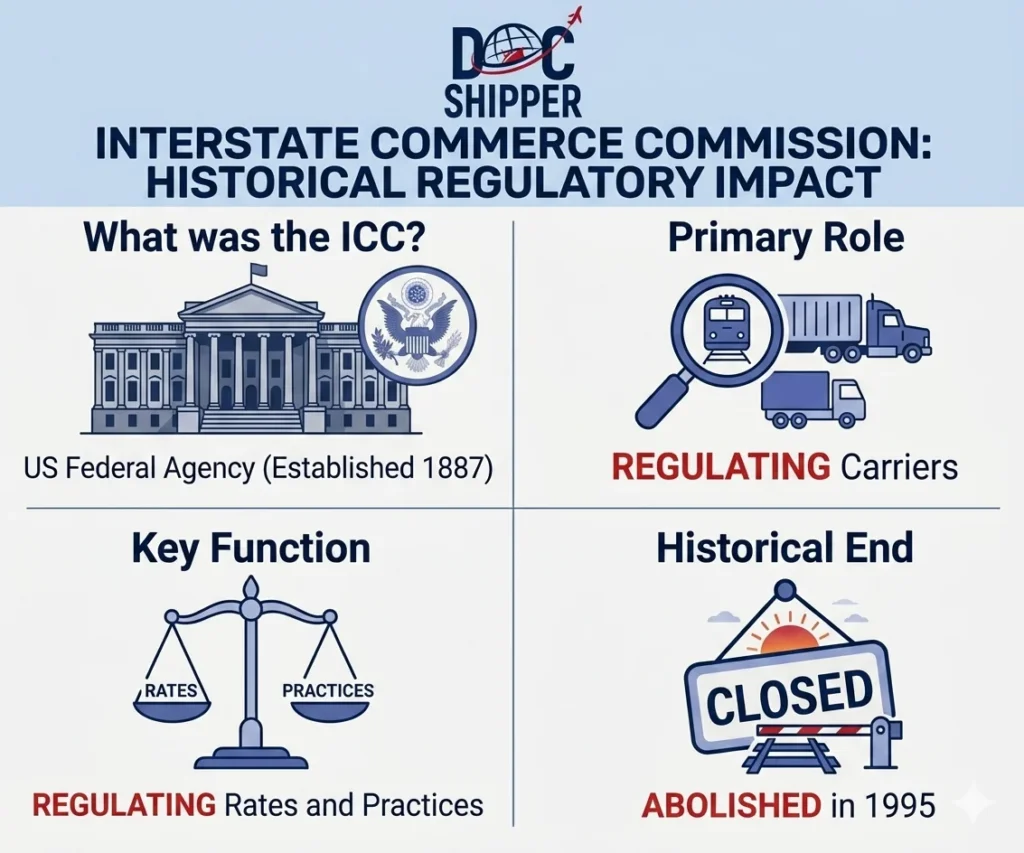
The Interstate Commerce Commission (ICC) was the first independent federal regulatory agency in the United States, established in 1887 to regulate railroads and later expanded to oversee trucking, buses, freight forwarders, water carriers, and pipeline transportation. Though abolished in 1995, its regulatory framework shaped modern transportation law and influenced international shipping regulations still used today.
Introduction
Many importers and logistics professionals encounter the term “ICC” in shipping documentation, rate structures, and regulatory references without fully understanding its historical significance. While the Interstate Commerce Commission no longer exists, its legacy permeates modern transportation regulations, particularly in cross-border North American trade.
Understanding the ICC’s role is crucial for anyone involved in U.S.-based import/export operations. The commission’s dissolution didn’t eliminate its principles—it redistributed them across multiple agencies that govern freight transportation today.
Key characteristics of the ICC’s regulatory approach:
- Rate regulation: Controlled pricing structures to prevent monopolistic practices by railroads and carriers
- Entry control: Required carriers to obtain operating authority before conducting interstate commerce
- Service standards: Established minimum service requirements and liability frameworks
- Anti-discrimination provisions: Ensured equal treatment of shippers regardless of size or location
- Safety oversight: Set standards for equipment, operations, and personnel qualifications
Regulatory Evolution & Legal Framework
The ICC emerged during the Gilded Age when railroad monopolies controlled transportation pricing and could charge discriminatory rates. The Interstate Commerce Act of 1887 created the commission with a mandate to ensure “reasonable and just” rates and eliminate preferential treatment.
Over its 108-year existence, the ICC’s jurisdiction expanded significantly. The Motor Carrier Act of 1935 brought trucking under its authority. The Transportation Act of 1940 added water carriers and freight forwarders. By mid-century, the commission regulated virtually all interstate commercial transportation except aviation.
The regulatory framework established several foundational concepts still relevant today. Common carrier obligations required transporters to serve all customers without discrimination. Published tariffs mandated transparent pricing accessible to all shippers. Certificate requirements created barriers to entry that protected existing carriers while ensuring service reliability.
Deregulation movements in the 1970s-1980s fundamentally changed this approach. The Motor Carrier Act of 1980 and Staggers Rail Act of 1980 dramatically reduced ICC authority, allowing market forces greater influence over rates and routes. According to the U.S. Department of Transportation, these reforms reduced shipping costs while maintaining service quality.
The ICC Termination Act of 1995 officially dissolved the commission. Its remaining functions transferred to the newly created Surface Transportation Board (STB), which continues oversight of rail mergers, rate disputes, and certain trucking matters. At DocShipper, we navigate these successor agencies daily, ensuring our clients’ shipments comply with current regulations derived from ICC precedents.
Practical Impact & Modern Implications
Though defunct, ICC regulations established templates that international shipping still follows. The bill of lading standards, liability limitations, and claims procedures used globally trace their lineage to ICC frameworks.
Modern regulatory successors and their jurisdictions:
| Agency | Jurisdiction | Key Functions |
|---|---|---|
| Surface Transportation Board | Rail carriers, some trucking | Rate reasonableness, mergers, service disputes |
| FMCSA | Motor carriers, buses | Safety regulations, operating authority, insurance |
| Federal Maritime Commission | Ocean shipping | International shipping agreements, tariffs |
Practical case study: A manufacturer importing machinery from Germany to Chicago illustrates ICC legacy impacts. The ocean carrier operates under FMC jurisdiction derived from ICC principles. Upon U.S. arrival, FMCSA-registered truckers (requiring authority once issued by ICC) transport cargo inland. If rail is used, STB oversees rate disputes using ICC-established reasonableness standards.
Documentation requirements show ICC influence clearly. The Uniform Straight Bill of Lading, standardized by ICC in 1922, remains the template for domestic shipments. Liability limits of $0.50 per pound for freight claims trace directly to ICC Order 19 from 1972, still referenced in carrier tariffs.
For international shippers, understanding ICC precedents helps navigate disputes. Claims procedures, filing deadlines, and burden of proof standards established by ICC rulings inform modern arbitration and litigation. At DocShipper, we leverage this historical knowledge when resolving carrier disputes, often citing ICC decisions that current agencies recognize as persuasive authority.
The commission’s anti-discrimination rules evolved into modern service contract regulations. Shippers can negotiate confidential rates with carriers—impossible under strict ICC regulation—but must do so within frameworks ensuring competitive access. This balance between market freedom and fairness reflects ICC’s foundational mission adapted to contemporary commerce.
Conclusion
The Interstate Commerce Commission’s abolition marked deregulation’s triumph, yet its regulatory philosophy persists across multiple successor agencies. For logistics professionals, recognizing ICC origins in current rules provides strategic advantage when navigating complex transportation regulations. Need guidance on regulatory compliance for your shipments? Contact DocShipper for expert support.
📚 Quiz
Test Your Knowledge: Interstate Commerce Commission (ICC)
What was the primary original purpose of the Interstate Commerce Commission when established in 1887?
Which statement accurately describes the ICC's legacy after its abolition in 1995?
A logistics manager discovers their shipment documentation references "$0.50 per pound liability limitation." What is the correct interpretation?
🎯 Your Result
📞 Free Quote in 24hFAQ | Interstate Commerce Commission (ICC): Definition, History & Impact on Logistics
The ICC officially dissolved on December 31, 1995, under the ICC Termination Act. Its regulatory functions transferred to the Surface Transportation Board (STB), which began operations January 1, 1996. Some administrative duties moved to the Federal Motor Carrier Safety Administration, created in 2000.
Congress established the ICC through the Interstate Commerce Act of 1887 to regulate railroad monopolies that charged discriminatory rates. Farmers and small businesses faced exorbitant shipping costs while large corporations received secret rebates. The commission aimed to ensure reasonable, transparent, and non-discriminatory pricing for all shippers.
The STB is the ICC's primary successor agency, inheriting jurisdiction over rail economic regulation, certain trucking matters, and pipeline disputes. It maintains more limited authority than the ICC had, focusing on competition issues, rate reasonableness for captive shippers, and rail mergers rather than comprehensive rate-setting.
Not directly. The Motor Carrier Act of 1980 largely deregulated trucking before the ICC dissolved. Today, the Federal Motor Carrier Safety Administration (FMCSA) regulates motor carriers, focusing on safety, operating authority, and insurance rather than rates. However, certain liability standards and documentation requirements originated from ICC frameworks.
Studies show deregulation reduced shipping costs significantly. Rail freight rates declined approximately 45% in real terms between 1980-2000. Trucking costs fell 25-35% after the 1980 Motor Carrier Act. Efficiency improvements and competitive pricing outweighed concerns about service reductions, though some rural areas experienced decreased carrier options.
ICC MC (Motor Carrier) numbers were authority identifiers issued to trucking companies. While the ICC no longer exists, MC numbers remain valid and are now administered by FMCSA. Carriers operating with pre-1995 ICC authority didn't need to reapply—their MC numbers simply transferred to the new regulatory system.
Yes, through successor agencies. Rail shippers can challenge unreasonable rates at the Surface Transportation Board using procedures similar to ICC processes. Motor carrier rate disputes typically resolve through commercial arbitration rather than regulatory proceedings, reflecting deregulation's market-based approach.
ICC established bill of lading standards, liability frameworks, and claims procedures adopted internationally. The Carmack Amendment (1906), an ICC-era law, still governs interstate cargo liability. Many countries modeled their transportation regulations on ICC structures, making its influence global despite being a U.S. agency.
The standard limitation of $0.50 per pound for lost or damaged freight originated from ICC regulations and persists in many carrier tariffs. Shippers can declare higher values and pay additional charges for increased coverage. This system balances carrier risk with shipper protection—a compromise developed during the ICC era.
Uniform bills of lading, freight bills, delivery receipts, and claims forms largely follow ICC-established formats. These standardized documents facilitate smooth transactions across carriers and shippers. Even electronic equivalents maintain structures ICC created for paper documentation, ensuring continuity and legal validity.
Understanding ICC history explains why current regulations exist and how they interconnect. Legal disputes often reference ICC precedents. Contract negotiations benefit from knowing regulatory boundaries. Transportation economics reflect deregulation's impacts. For professionals managing complex supply chains, this knowledge provides context for strategic decision-making.
ICC regulatory approaches informed trade agreement transportation provisions, particularly NAFTA (now USMCA). Principles of non-discrimination, reasonable rates, and transparent tariffs appear in international frameworks. The ICC's common carrier concept influenced how countries structure transportation access in bilateral and multilateral trade deals.
Need Help with
Logistics or Sourcing ?
First, we secure the right products from the right suppliers at the right price by managing the sourcing process from start to finish. Then, we simplify your shipping experience - from pickup to final delivery - ensuring any product, anywhere, is delivered at highly competitive prices.


Fill the Form
Prefer email? Send us your inquiry, and we’ll get back to you as soon as possible.
Contact us




:%20Definition,%20History%20&%20Impact%20on%20Logistics)