


In short ⚡
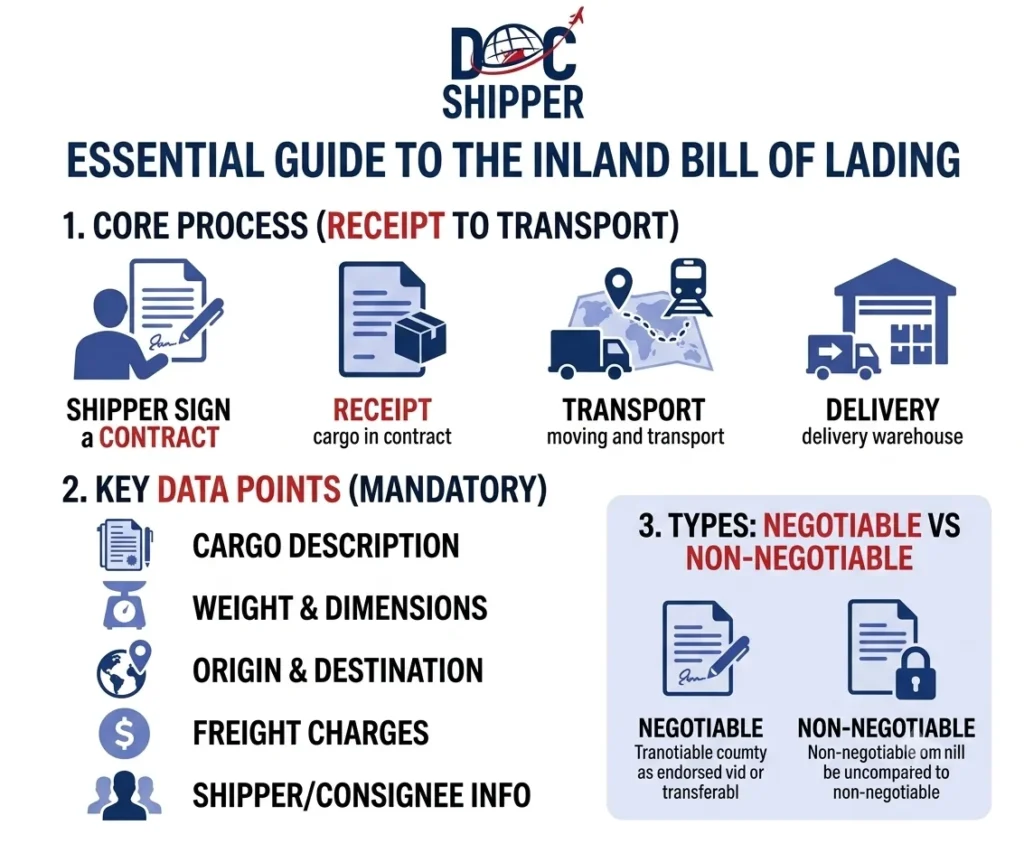
The Inland Bill of Lading is a transport document issued for the domestic movement of goods between an inland origin point and a seaport or airport. It serves as a receipt, a contract of carriage, and proof of ownership for cargo traveling exclusively within a country's borders before international shipment.
Introduction
Many importers and exporters mistakenly believe all Bills of Lading function identically across domestic and international segments. This confusion leads to documentation errors, liability disputes, and shipment delays.
The Inland Bill of Lading specifically governs domestic transportation legs that precede or follow international transit. Understanding its distinct role is essential for seamless multimodal logistics operations.
- Non-negotiable document: Unlike Ocean Bills of Lading, most inland versions cannot transfer ownership through endorsement
- Regulated by domestic law: Subject to national transport regulations rather than international conventions like Hague-Visby Rules
- Multimodal integration: Connects rail, truck, or barge movements to ocean or air freight segments
- Liability framework: Establishes carrier responsibility for cargo damage or loss during inland transit
- Customs prerequisite: Required documentation for cargo moving from inland manufacturing sites to export terminals
Mechanisms & Legal Implications
The Inland Bill of Lading operates under distinct legal frameworks compared to its ocean counterpart. In the United States, it’s governed by the Carmack Amendment under federal transportation law, while European inland movements follow national transport codes and EU regulations.
Unlike negotiable ocean bills, the inland version typically functions as a straight consignment document. This means ownership cannot be transferred through endorsement. The named consignee holds exclusive rights to claim the cargo upon arrival at the destination terminal.
The document establishes a carrier-shipper contract with specific liability limits. Carriers assume responsibility from the moment goods are loaded until delivery at the designated inland terminal. At DocShipper, we systematically verify these liability clauses to ensure clients understand their coverage limits during domestic segments.
For multimodal shipments, the inland bill creates a documentary chain connecting inland and international transport. When goods move from a factory in Lyon to Le Havre port, the inland bill covers the domestic truck segment while the ocean bill governs sea transit. Both documents must align perfectly to avoid customs clearance issues.
The customs implications are significant. Export authorities require inland bills to verify cargo origin and pre-carriage routing. Import customs use them to track goods from the port of entry to final inland destinations, ensuring proper duty assessment and regulatory compliance.
Practical Examples & Data
Consider a manufacturer in Munich shipping automotive parts to Shanghai. The logistics chain involves two distinct Bills of Lading:
| Document Type | Coverage Segment | Governing Law | Negotiability |
|---|---|---|---|
| Inland Bill of Lading | Munich to Hamburg Port | German HGB Transport Code | Non-negotiable |
| Ocean Bill of Lading | Hamburg to Shanghai Port | Hague-Visby Rules | Negotiable |
Use Case: Agricultural Export from Kansas to Vietnam
A grain exporter ships 500 metric tons of soybeans from a Kansas farm to Ho Chi Minh City. The inland bill covers rail transport from the farm silo to New Orleans port—approximately 1,800 kilometers. The carrier’s liability under the Carmack Amendment is limited to $50 per ton unless higher declared value insurance is purchased.
The inland bill lists:
- Shipper: Kansas Agricultural Cooperative
- Consignee: New Orleans Terminal Operator
- Notify Party: Vietnamese Importer’s Agent
- Freight Terms: Prepaid to port, collect for ocean segment
- Special Instructions: Temperature monitoring required during 72-hour rail transit
At the New Orleans terminal, the inland bill is surrendered, and an ocean bill is issued for the sea voyage. This document handover point represents a critical liability transition where cargo custody transfers from the rail carrier to the ocean carrier.
Industry data shows that approximately 40% of shipment delays in multimodal logistics stem from mismatched information between inland and ocean bills. Common discrepancies include incorrect consignee names, weight variances, or missing Harmonized System (HS) codes.
Conclusion
The Inland Bill of Lading serves as the critical bridge between domestic production sites and international shipping terminals, establishing clear liability and ownership for the inland transport segment.
Need expert assistance coordinating your multimodal documentation? Contact DocShipper for comprehensive freight forwarding support.
📚 Quiz
Test Your Knowledge: Inland Bill of Lading
What is the primary scope of an Inland Bill of Lading?
Which statement correctly describes the negotiability of most Inland Bills of Lading?
A manufacturer in Chicago ships machinery to Tokyo. Which document should cover the rail transport from Chicago to Los Angeles port?
🎯 Your Result
📞 Free Quote in 24hFAQ | Inland Bill of Lading: Definition, Uses & Practical Examples
An Inland Bill of Lading covers domestic transportation within a single country, while an Ocean Bill governs international sea freight. The inland version is typically non-negotiable and subject to national transport laws, whereas ocean bills are negotiable instruments governed by international maritime conventions like the Hague-Visby Rules. They also have different liability frameworks and insurance requirements.
Most inland bills are issued as straight (non-negotiable) consignment documents, meaning ownership cannot be transferred through endorsement. However, some jurisdictions allow negotiable inland bills under specific conditions. The document will clearly state "Negotiable" or "To Order" if it permits ownership transfer. Always verify the document type with your carrier or freight forwarder before assuming negotiability.
The domestic carrier handling the inland leg issues this document. For truck transport, a trucking company issues it; for rail, the railway operator. In comprehensive logistics arrangements, freight forwarders like DocShipper may coordinate issuance on behalf of the actual carrier while maintaining clear liability documentation throughout the transport chain.
While not universally mandatory for purely domestic shipments, it becomes essential when goods are destined for international export or arriving from international import. Customs authorities require it to establish the cargo's domestic routing, origin verification, and pre-carriage details. For internal domestic shipments with no international component, a simpler consignment note may suffice.
Essential elements include shipper and consignee details, pickup and delivery locations, cargo description with weight and volume, number of packages, special handling instructions, freight charges and payment terms, carrier identification, and date of issuance. Additional fields may include declared value for liability purposes, HS codes for customs, and reference numbers linking to the corresponding ocean bill.
Liability varies by jurisdiction but typically follows the principle of common carrier responsibility. In the US, the Carmack Amendment establishes strict liability with standardized limits (often $50 per ton unless higher value is declared). European carriers operate under national transport codes with similar frameworks. Carriers are responsible for loss or damage from the moment of loading until proper delivery, unless caused by force majeure or shipper negligence.
No. A through Bill of Lading covering door-to-door transport exists, but it differs from using a single document. The through bill is issued by a freight forwarder assuming responsibility for the entire journey, but separate underlying carrier documents still exist. Most scenarios require distinct inland and ocean bills to clearly delineate liability and comply with different regulatory frameworks governing each transport mode.
Discrepancies can cause serious delays at the port of loading or discharge. Customs may hold cargo until documentation is corrected. Common mismatches include weight differences, incorrect consignee information, or missing HS codes. The solution involves issuing corrected documents, often requiring coordination between the inland carrier, ocean carrier, and customs brokers. Prevention through careful documentation review is far more efficient than post-shipment corrections.
Yes, separate cargo insurance for inland transit is highly recommended. Standard carrier liability under inland bills offers minimal coverage (often $50-100 per ton). Comprehensive cargo insurance should cover the entire transport chain from origin to final destination, including inland legs. Insurance premiums for domestic segments are typically lower than ocean coverage due to reduced risk, but gaps in coverage create vulnerability.
Unlike ocean bills with specific validity periods, inland bills remain effective until cargo delivery is completed and the document is surrendered. However, carriers impose practical time limits—cargo not claimed within 5-15 days after arrival may incur storage fees. For export shipments, the inland bill must align with vessel sailing schedules to avoid missed connections at the port terminal.
Electronic bills are increasingly accepted for inland transport, particularly in jurisdictions with advanced digital trade frameworks. The US ESIGN Act and EU eIDAS regulation provide legal validity to electronic transport documents. However, adoption varies by carrier and region. Some traditional rail and trucking operators still require physical documents, while modern logistics providers offer fully digital solutions with blockchain-verified authenticity.
For exports, customs authorities use the inland bill to verify cargo origin, ensure proper export licensing, and confirm the shipper's identity. For imports, it proves the cargo's journey from the port of entry to the final inland destination, essential for calculating duties, applying preferential trade agreements, and ensuring regulatory compliance. Incomplete or inaccurate inland bills can trigger customs audits or shipment holds.
Need Help with
Logistics or Sourcing ?
First, we secure the right products from the right suppliers at the right price by managing the sourcing process from start to finish. Then, we simplify your shipping experience - from pickup to final delivery - ensuring any product, anywhere, is delivered at highly competitive prices.


Fill the Form
Prefer email? Send us your inquiry, and we’ll get back to you as soon as possible.
Contact us




