


In short ⚡
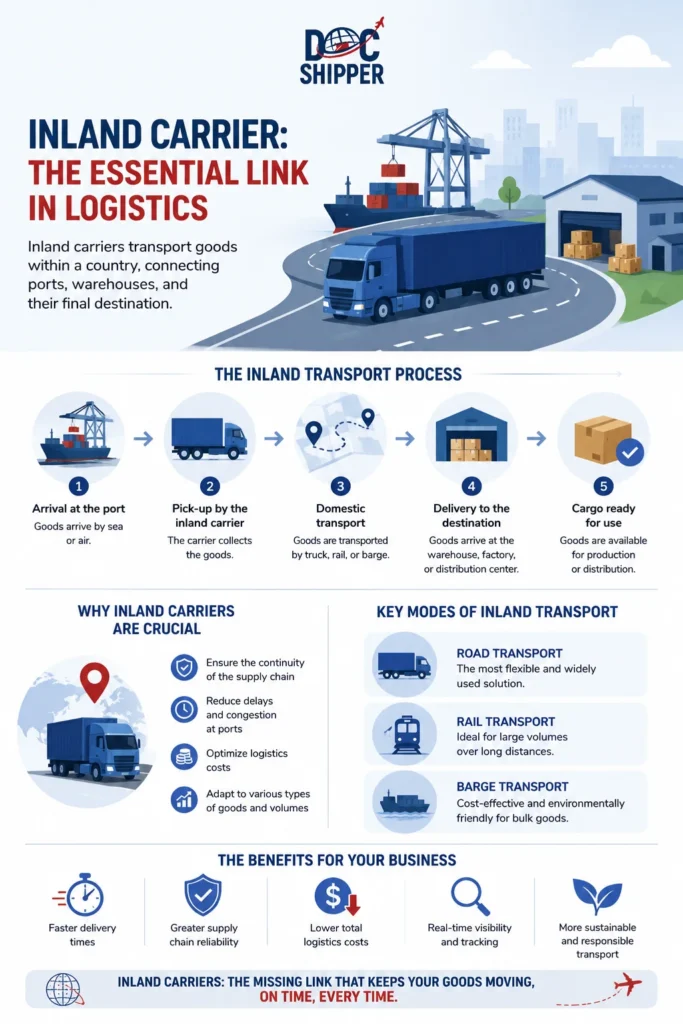
An Inland Carrier is a transportation company responsible for moving goods overland—by truck, rail, or barge—between inland locations and ports, warehouses, or distribution centers. This carrier handles the critical first-mile or last-mile segments of international shipments, bridging the gap between maritime or air terminals and final destinations.
Introduction
Many importers mistakenly assume their cargo journey ends when a container arrives at the port. In reality, the inland leg often represents the most complex—and costly—segment of the supply chain. Without a reliable inland carrier, shipments face delays, customs bottlenecks, and compliance failures.
Inland carriers operate within national borders, executing ground transportation that connects international gateways to businesses. They manage regulatory paperwork, coordinate with customs brokers, and navigate infrastructure challenges. Their efficiency directly impacts total transit time and landed costs.
Key characteristics of inland carriers include:
- Multimodal capability: Operating trucks, trains, or river barges depending on geography and cargo type.
- Customs coordination: Ensuring documentation complies with national import/export regulations.
- Last-mile delivery: Transporting goods from consolidation points to warehouses or retail locations.
- Liability coverage: Assuming responsibility for cargo safety during overland transit.
- Regional expertise: Navigating local road regulations, weight limits, and delivery windows.
Role & Operational Expertise
Inland carriers function as critical links between international transport legs and final consignees. Unlike ocean or air carriers, they operate exclusively within a country’s borders, handling freight after customs clearance or before export consolidation.
Their responsibilities extend beyond simple haulage. Documentation management includes coordinating delivery orders, preparing CMR consignment notes (in Europe), or BOL (Bill of Lading) domestically. They verify that cargo matches customs declarations to avoid penalties during inland transit inspections.
Intermodal coordination requires synchronizing with port operators, rail terminals, and bonded warehouses. For containerized shipments, inland carriers arrange drayage—the short-distance movement of containers between terminals and depots—ensuring equipment returns within free-time limits to avoid demurrage charges.
Regulatory compliance varies significantly by region. In the European Union, cabotage rules restrict foreign carriers from performing domestic transport, requiring partnerships with licensed operators. The U.S. mandates specific permits for hazardous materials (HAZMAT) and oversized loads. According to FMCSA regulations, carriers must maintain safety ratings and undergo regular inspections.
At DocShipper, we coordinate directly with certified inland carriers across continents to ensure seamless door-to-door delivery. Our network includes partners compliant with ADR (Europe), TDG (Canada), and RID (rail) standards, eliminating delays caused by documentation errors or carrier non-compliance.
Technology integration has transformed inland operations. Modern carriers deploy GPS tracking, electronic proof-of-delivery (ePOD) systems, and route optimization algorithms. These tools provide real-time visibility, reducing average delivery delays by 18% compared to traditional dispatch methods.
Practical Examples & Data
Understanding inland carrier operations requires examining real-world scenarios and cost structures. The following table compares typical inland transport modes for a 20-foot container moving 300 kilometers from a European port to an inland warehouse:
| Transport Mode | Average Cost (EUR) | Transit Time | CO₂ Emissions (kg) | Best For |
|---|---|---|---|---|
| Road (Truck) | €450–650 | 4–6 hours | 85 | Time-sensitive cargo |
| Rail | €280–400 | 12–18 hours | 28 | High-volume shipments |
| Barge (River) | €220–350 | 24–36 hours | 19 | Bulk/non-urgent goods |
Case Study: Automotive Parts Import
A German importer receives 240 tons of automotive components monthly from Shanghai. After ocean freight to Hamburg, an inland carrier transports containers to Munich (780 km). By switching from road to rail intermodal service, the company reduced inland costs by 34% and cut emissions by 67%, while accepting a 10-hour longer transit window.
Key operational considerations include:
- Port congestion impact: During peak seasons, truck dwell times at U.S. West Coast ports average 3.2 hours, adding $150–200 per container in driver wait fees.
- Customs clearance timing: Pre-clearing cargo before inland movement reduces total delivery time by 12–18 hours compared to destination clearance.
- Equipment positioning: Chassis shortages can delay truck dispatches by 24–48 hours; carriers with owned equipment fleets minimize this risk.
- Fuel surcharges: Diesel price fluctuations cause quarterly adjustments ranging from 8–15% of base rates.
- Return loads: Carriers offering backhaul options reduce empty-mile costs, passing 10–20% savings to shippers on regular lanes.
In North America, drayage rates from Los Angeles/Long Beach ports to inland distribution centers 60 miles away typically range from $275–$450 per container, depending on chassis fees, fuel costs, and appointment scheduling. Carriers charging premium rates often guarantee delivery within 48-hour windows, critical for just-in-time manufacturing.
Conclusion
The inland carrier forms the essential bridge between global trade arteries and local commerce. Selecting partners with proven compliance records, technology integration, and regional expertise directly impacts supply chain resilience and cost predictability.
Need expert coordination of your inland transport operations? Contact DocShipper for tailored logistics solutions across all transport modes.
📚 Quiz
Test Your Knowledge: Inland Carrier
Question 1: What is the primary operational scope of an inland carrier?
Question 2: Which statement correctly describes inland carrier responsibilities?
Question 3: A German importer receives containers at Hamburg port destined for Munich (780 km). Which inland transport mode would offer the lowest cost and emissions?
🎯 Your Result
📞 Free Quote in 24hFAQ | Inland Carrier: Definition, Role & Practical Examples
An inland carrier physically transports goods using owned or contracted vehicles (trucks, trains, barges). A freight forwarder arranges transportation but typically doesn't own transport assets. Forwarders book inland carriers as part of multimodal shipments, handling documentation and coordination rather than actual haulage.
Payment responsibility depends on Incoterms. Under DDP (Delivered Duty Paid), the seller covers all inland costs to the buyer's location. With FOB or EXW terms, the buyer arranges and pays for inland transport from the port or factory. Clarifying this upfront prevents billing disputes.
Transit times vary by distance and mode. Truck deliveries within 200 km usually complete in 4–8 hours. Rail shipments covering 500–1,000 km take 12–36 hours. Cross-country movements (e.g., Los Angeles to New York) require 5–7 days by truck, 7–10 days by rail intermodal.
Yes, carriers assume liability under national transport laws. In the U.S., motor carriers face liability up to $0.50 per pound unless higher declared value is stated. European CMR Convention limits liability to approximately €8.33 per kilogram. Shippers should verify coverage and purchase supplemental cargo insurance for high-value goods.
Essential documents include the Bill of Lading or delivery order, customs release notification, commercial invoice, and packing list. For bonded movements, carriers need in-bond documentation. Hazardous cargo requires MSDS sheets and special permits. Missing paperwork can delay pickup by 24–72 hours.
Specialized carriers transport out-of-gauge freight using flatbeds, lowboys, or heavy-haul trailers. This requires route surveys, overweight permits, and sometimes police escorts. Costs increase 150–300% versus standard container moves. Planning lead time of 2–4 weeks is typical for permit acquisition.
Most carriers apply weekly or monthly fuel surcharges based on national diesel price indexes. Rates adjust as a percentage of base freight (typically 15–25% of total invoice). Long-term contracts often cap surcharge volatility, while spot market rates fluctuate more dramatically with fuel prices.
Drayage refers to short-distance container transport between ports, rail terminals, and nearby warehouses—typically under 100 miles. Drayage carriers specialize in this segment, managing chassis, appointment scheduling, and rapid turnaround. Many inland carriers offer drayage as part of integrated door-to-door services.
Modern carriers provide online portals or EDI integrations offering real-time GPS tracking, estimated arrival times, and proof-of-delivery uploads. Request tracking capabilities during carrier selection. Basic services may only offer daily phone updates, while premium carriers provide geofencing alerts and automated notifications.
Missed appointments can trigger warehouse receiving fees, labor charges, or production delays. Review carrier service agreements for guaranteed delivery windows and penalty clauses. Reputable carriers maintain 95%+ on-time performance metrics and offer service credits for failures caused by carrier error rather than external factors like weather.
Yes. Hazardous materials require ADR/IMDG certification and special permits. Perishable goods need temperature-controlled equipment. Certain jurisdictions prohibit oversized loads during peak traffic hours. Carriers specializing in specific commodity types (chemicals, food-grade, pharmaceuticals) maintain required certifications and equipment standards.
Consider urgency, volume, and infrastructure availability. Trucks offer fastest delivery (best for under 500 km). Rail provides cost efficiency for high volumes over 800+ km with 67% lower emissions. Barges suit bulk cargo on navigable waterways, offering lowest per-ton costs but slowest transit. Evaluate total landed cost, not just freight rates.
Need Help with
Logistics or Sourcing ?
First, we secure the right products from the right suppliers at the right price by managing the sourcing process from start to finish. Then, we simplify your shipping experience - from pickup to final delivery - ensuring any product, anywhere, is delivered at highly competitive prices.


Fill the Form
Prefer email? Send us your inquiry, and we’ll get back to you as soon as possible.
Contact us




