


In short ⚡
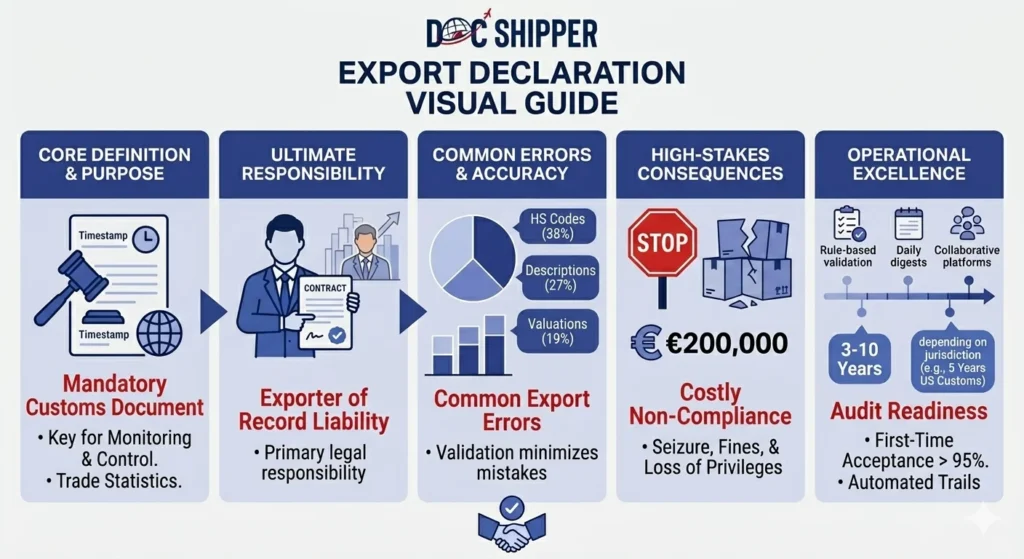
An export declaration is a mandatory customs document that provides detailed information about goods leaving a country's territory. It serves as the official record for customs authorities to monitor, control, and collect statistics on international trade flows. This document includes product descriptions, values, destinations, and compliance with export regulations.
Introduction
Many exporters struggle with the complexity of export documentation, often underestimating the critical role of proper declarations. A single error in your export declaration can lead to shipment delays, financial penalties, or even legal consequences.
In international trade, the export declaration serves as the cornerstone of customs clearance. It establishes the legal basis for goods to exit a country while ensuring compliance with trade agreements, security protocols, and statistical requirements.
- Legal compliance: Ensures adherence to national export laws and international trade agreements
- Statistical tracking: Enables governments to monitor trade balances and economic indicators
- Security screening: Identifies potentially restricted or prohibited goods before departure
- Tax determination: Facilitates proper calculation of export duties and VAT refunds
- Documentation chain: Creates an audit trail linking seller, buyer, and customs authorities
Understanding Export Declaration Requirements & Legal Framework
The export declaration process varies by jurisdiction, but most countries have transitioned to electronic systems for submission. In the European Union, the Export Control System (ECS) manages all outbound declarations, while the United States uses the Automated Export System (AES) administered by Census Bureau and CBP.
Essential information required includes the HS code (Harmonized System classification), which determines applicable regulations and potential licensing requirements. The accurate classification is critical—misclassification represents one of the most common compliance violations, according to European Commission Taxation and Customs Union.
The document must contain the declared value, typically the transaction value as defined by WTO Valuation Agreement. This figure impacts statistical records and, in some cases, determines whether export licenses are needed. Countries set monetary thresholds—goods below certain values may qualify for simplified declarations.
Country of destination matters significantly for compliance purposes. Certain destinations trigger enhanced scrutiny due to sanctions, embargoes, or dual-use goods regulations. The exporter of record bears ultimate responsibility for declaration accuracy, even when using customs brokers or freight forwarders.
At DocShipper, we systematically verify all export declaration elements before submission, cross-checking HS codes against current regulations and ensuring complete documentation to prevent costly delays or rejected shipments. Our compliance team stays updated on regulatory changes across multiple jurisdictions.
Practical Examples & Compliance Data
Consider a practical scenario: A French electronics manufacturer exports €50,000 worth of computer components to Singapore. The export declaration process unfolds as follows:
| Declaration Element | Requirement | Impact if Incorrect |
|---|---|---|
| HS Code | 8473.30 (Parts for computers) | Wrong duty rate, possible licensing issues |
| Origin | FR (Made in France) | Loss of preferential treatment, higher import duties |
| Statistical Value | €50,000 FOB | Inaccurate trade statistics, audit triggers |
| Procedure Code | 10 00 000 (Permanent export) | Wrong customs regime, compliance violations |
| Transport Mode | 4 (Air transport) | Logistical confusion, routing errors |
According to 2023 customs data, approximately 12% of export declarations contain errors requiring amendment. The most common mistakes include incorrect HS codes (38%), incomplete commercial descriptions (27%), and valuation discrepancies (19%).
Case Study: A German automotive supplier failed to declare proper dual-use characteristics for specialized sensors. The shipment was held for 14 days pending license verification, resulting in production line stoppages at the destination facility and contractual penalties exceeding €200,000.
Key compliance indicators to monitor:
- Declaration acceptance rate: Target above 95% first-time acceptance
- Amendment frequency: Should remain below 5% of total declarations
- Audit findings: Zero critical non-conformities in customs audits
- Processing time: Average 2-4 hours for standard declarations
- Licensing compliance: 100% coverage for controlled goods
DocShipper maintains a declaration accuracy rate exceeding 98% through systematic pre-submission validation protocols. We leverage automated classification tools combined with expert review to catch discrepancies before customs submission, minimizing client exposure to penalties or delays.
Conclusion
The export declaration represents far more than administrative formality—it’s a legal commitment affecting customs clearance, trade statistics, and regulatory compliance. Proper preparation prevents costly disruptions to international supply chains.
Need expert assistance with export documentation and compliance? Contact DocShipper for comprehensive customs support tailored to your specific export requirements.
📚 Quiz
Test Your Knowledge: Export Declaration
What is the primary legal purpose of an export declaration?
Who bears ultimate legal responsibility for export declaration accuracy?
A German company exports €45,000 worth of specialized automotive sensors to Singapore without declaring their dual-use characteristics. What is the most likely consequence?
🎯 Your Result
📞 Free Quote in 24hFAQ | Export Declaration: Definition, Process & Practical Examples
Thresholds vary by country. In the EU, goods valued over €1,000 or weighing more than 1,000 kg generally require full declarations. The US requires Electronic Export Information (EEI) filing for shipments exceeding $2,500 per Schedule B classification to most destinations. Some countries require declarations regardless of value for statistical or security purposes.
The exporter of record bears ultimate legal responsibility, even when using customs brokers or freight forwarders. While agents can file on behalf of exporters, liability for false information, incorrect classifications, or omitted details remains with the principal party. This makes thorough documentation and verification processes essential for exporters.
Retention periods typically range from 3 to 10 years depending on jurisdiction. The EU requires 3 years from declaration year-end. US regulations mandate 5 years from export date. Many companies maintain records longer to support audits, dispute resolution, or preferential origin claims which may have extended verification periods.
Yes, post-departure amendments are generally possible within specified timeframes. In the EU, you can request invalidation or amendment through customs systems. The US allows post-departure filing corrections within specific periods. However, amendments may trigger audits and should be avoided through proper initial filing. Systematic errors may result in penalties.
Failure to declare dual-use characteristics can result in severe consequences: shipment seizure, export privilege revocation, substantial financial penalties, and potential criminal prosecution. Dual-use items require export licenses from relevant authorities. Even unintentional violations can lead to multi-year debarment from exporting and damage to business reputation.
No, declaration requirements vary based on destination country relationships, trade agreements, and security concerns. Exports to countries under sanctions require enhanced due diligence. Free trade agreement shipments need additional origin documentation. Some high-risk destinations trigger automatic reviews regardless of commodity type, extending clearance timeframes.
Export declarations typically require FOB (Free On Board) values for statistical purposes, regardless of negotiated incoterms. When sales occur under different terms (CIF, DDU, etc.), exporters must calculate the FOB equivalent by deducting international freight and insurance costs. Accurate conversion ensures proper statistical reporting and valuation consistency across jurisdictions.
Supporting documents typically include commercial invoice, packing list, transport documents (bill of lading or airway bill), export licenses if applicable, and certificates of origin when required. For controlled goods, technical specifications and end-user statements may be necessary. Customs may request additional documentation based on commodity type or destination.
Yes, Authorized Economic Operator (AEO) programs and similar trusted trader schemes offer benefits including simplified declarations, reduced guarantees, and priority processing. These programs require demonstrating compliant track records, robust internal controls, and financial solvency. Application processes are rigorous but provide significant operational advantages for high-volume exporters.
Electronic systems enable real-time validation of HS codes, automatic calculation of duties, and immediate error detection before submission. They integrate with license databases to verify authorization status and maintain audit trails automatically. System-generated risk scores help customs prioritize physical inspections, accelerating clearance for compliant traders while enhancing security screening.
Penalties vary by violation severity and jurisdiction. Minor errors may result in warnings or administrative fines ranging from hundreds to thousands of dollars. Intentional misclassification or value manipulation can lead to penalties equal to shipment value plus additional fines. Serious violations involving restricted goods may result in criminal prosecution, imprisonment, and permanent export bans.
While declarations are generally subject to disclosure under trade statistics requirements, most jurisdictions protect commercially sensitive details. Specific customer names, pricing formulas, and proprietary technical specifications receive confidentiality protection. However, basic commodity descriptions, values, and statistical data become public information. Exporters should understand their jurisdiction's specific confidentiality provisions.
Need Help with
Logistics or Sourcing ?
First, we secure the right products from the right suppliers at the right price by managing the sourcing process from start to finish. Then, we simplify your shipping experience - from pickup to final delivery - ensuring any product, anywhere, is delivered at highly competitive prices.


Fill the Form
Prefer email? Send us your inquiry, and we’ll get back to you as soon as possible.
Contact us




