


In short ⚡
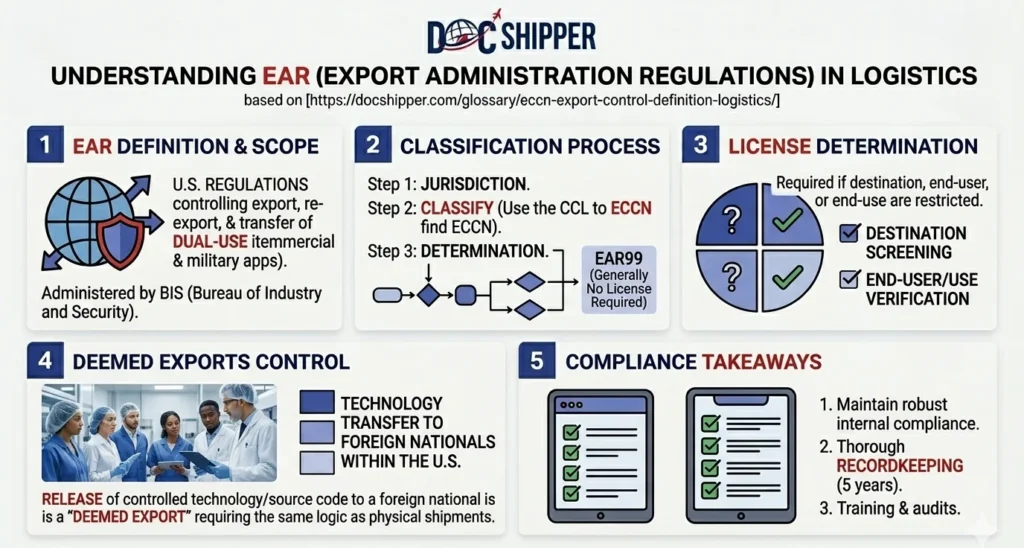
Export Administration Regulations (EAR) are U.S. federal rules administered by the Bureau of Industry and Security (BIS) that control the export, re-export, and transfer of commercial and dual-use items. These regulations determine whether an export license is required based on product classification, destination country, end-user, and intended application.
Introduction
Many exporters mistakenly believe that only military items require export licenses. In reality, thousands of commercial products fall under U.S. export controls through the EAR framework.
These regulations affect manufacturers, freight forwarders, and trading companies shipping from or through the United States. Non-compliance can result in severe penalties, including fines exceeding $1 million and imprisonment.
The EAR system is essential because it:
- Protects national security interests by preventing sensitive technology from reaching hostile entities
- Enforces foreign policy objectives through targeted export restrictions and embargoes
- Prevents the proliferation of weapons of mass destruction and their delivery systems
- Maintains strategic trade advantages in critical technology sectors
- Establishes clear compliance frameworks for dual-use items with both civilian and military applications
Understanding EAR classification and licensing requirements is not optional—it’s a legal obligation for anyone involved in international commerce involving U.S.-origin goods or technology.
Understanding the EAR Framework & Export Control Classification
The EAR system operates through a comprehensive classification structure centered on the Commerce Control List (CCL). This list organizes controlled items into ten categories, from nuclear materials to telecommunications equipment.
Every product subject to EAR receives an Export Control Classification Number (ECCN), a five-character alphanumeric code that determines licensing requirements. Items not listed on the CCL receive the designation EAR99, which generally requires no license for most destinations.
The determination process involves analyzing four critical factors. First, the product specification must be matched against technical parameters in the CCL. Second, the destination country determines baseline restrictions—countries are grouped into country groups A through E based on their relationship with the United States.
Third, the end-user identity requires screening against restricted party lists, including the Entity List and Denied Persons List. Fourth, the end-use application must be verified—even unrestricted items require licenses if intended for weapons development or nuclear proliferation.
The regulations distinguish between exports, re-exports, and deemed exports. A deemed export occurs when foreign nationals access controlled technology within the United States, requiring the same licensing considerations as physical shipments.
At DocShipper, we systematically verify ECCN classifications and screen shipments against restricted party lists before processing any U.S.-origin cargo, ensuring our clients avoid costly compliance violations and customs delays.
Practical Compliance Examples & Case Studies
Understanding EAR compliance becomes clearer through real-world scenarios that illustrate how different factors interact to determine licensing requirements.
Case Study 1: Industrial Lasers to China
A U.S. manufacturer exports industrial cutting lasers classified under ECCN 6A005. While these lasers are approved for export to most countries, shipments to China require a license due to their potential dual-use applications in precision manufacturing. The export value was $450,000, and failure to obtain the required license resulted in a BIS investigation and a civil penalty of $180,000.
Case Study 2: Encryption Software to Germany
A software company distributes encryption products classified under ECCN 5D002. While Germany is a favorable destination (Country Group A:1), mass-market encryption with key lengths exceeding 64 bits still requires classification review and reporting. The company utilized the License Exception ENC after proper registration, avoiding the standard license process while maintaining full compliance.
| Scenario | ECCN | Destination | License Required | Reason |
|---|---|---|---|---|
| Commercial aircraft parts | 9A991 | Canada | No | License Exception applies |
| High-performance computers | 4A003 | Russia | Yes | National security controls |
| Night vision equipment | 6A003 | UAE | Yes | Regional stability concerns |
| Basic semiconductors | EAR99 | Japan | No | Not controlled, favorable destination |
| Marine navigation systems | 7A994 | Iran | Yes | Comprehensive embargo |
Key Compliance Metrics:
- Average license processing time: 45-60 days for standard applications
- Civil penalty range for violations: $250,000 to $1,000,000 per violation
- Items on the Commerce Control List: over 2,300 ECCNs
- Annual EAR violation cases filed by BIS: 150-200 enforcement actions
- Percentage of exports requiring no license (EAR99): approximately 85%
These examples demonstrate that EAR compliance extends beyond simple product classification. Exporters must maintain comprehensive documentation, including end-user statements, technical specifications, and destination verification records for audit purposes.
Conclusion
The Export Administration Regulations establish a complex but navigable framework for controlling U.S. exports. Proper classification, destination screening, and license determination protect both national security interests and business operations.
Need expert guidance on EAR compliance for your international shipments? Contact DocShipper for comprehensive export control consultation and logistics support.
📚 Quiz
Test Your Knowledge: Export Administration Regulations (EAR)
What is the primary scope of Export Administration Regulations (EAR)?
A U.S. company allows a Chinese engineer to access controlled semiconductor manufacturing technology at their California facility. Does this trigger EAR requirements?
Your product is classified as EAR99 and destined for Germany. What is the correct interpretation?
🎯 Your Result
📞 Free Compliance Quote in 24hFAQ | EAR (Export Administration Regulations): Definition, Compliance & Practical Examples
EAR controls commercial and dual-use items managed by the Department of Commerce, while ITAR (International Traffic in Arms Regulations) controls defense articles and services under the Department of State. ITAR covers military-specific items, whereas EAR applies to items with both civilian and potential military applications. ITAR violations carry more severe penalties, and ITAR licensing is generally more restrictive.
Begin by classifying your product against the Commerce Control List to identify its ECCN. Then conduct the "Five Step Process": determine jurisdiction, classify the item, identify the destination, check end-user screening lists, and verify the end-use application. If any reason for control applies to your destination country, a license is likely required unless a License Exception applies.
License Exceptions are authorizations that allow exports without individual licenses under specific conditions. Common exceptions include TMP (temporary exports), GBS (shipments to Country Group B countries), and ENC (encryption items). Each exception has specific eligibility criteria, reporting requirements, and limitations. Exporters must self-certify eligibility and maintain supporting documentation.
Civil penalties reach up to $300,000 per violation (adjusted for inflation), while criminal violations carry fines up to $1,000,000 and imprisonment up to 20 years. Administrative penalties include export privilege denial, meaning companies or individuals lose the ability to participate in export transactions. Voluntary self-disclosure can significantly reduce penalties.
Yes, through the "de minimis" rule. Foreign-made items incorporating controlled U.S.-origin content above certain thresholds (typically 25% for most countries, 10% for embargoed destinations) require EAR authorization for re-export. The Foreign Direct Product Rule also subjects foreign-produced items to EAR if they are the direct product of certain U.S. technology or software.
A deemed export occurs when controlled technology or source code is released to a foreign national within the United States, including visual inspection, oral exchanges, or hands-on application. This applies to foreign employees, visiting researchers, or international students. The foreign national's country of citizenship determines licensing requirements, not their physical location.
Standard license applications typically take 45-60 days for BIS review. Applications requiring interagency review may extend to 90 days or longer. Expedited processing is available for certain humanitarian or safety-related exports. Incomplete applications significantly delay processing, making thorough initial documentation critical.
The Entity List identifies foreign parties whose activities pose national security or foreign policy concerns. Exports to listed entities require a license regardless of ECCN classification, with a presumption of denial for most applications. The list includes specific companies, research institutions, and government organizations from various countries.
Yes, technology and software face specific controls under EAR. Technology means information necessary for product development, production, or use. Even publicly available information may be controlled if it meets specific technical parameters. Cloud computing and remote access to controlled technology also trigger EAR requirements.
EAR99 designates items subject to EAR jurisdiction but not listed on the Commerce Control List. These items generally require no license except when destined for embargoed countries, restricted end-users, or prohibited end-uses. EAR99 represents the majority of U.S. commercial exports.
BIS conducts investigations through its Office of Export Enforcement, which includes special agents with law enforcement authority. Enforcement actions result from routine audits, whistleblower reports, shipping document reviews, and intelligence sharing. Companies should implement Internal Compliance Programs (ICPs) to demonstrate good faith compliance efforts.
Yes, License Exception TMP allows temporary exports for specific purposes including exhibitions, demonstrations, and testing. Items must return to the United States within specified timeframes (typically one year), and certain recordkeeping requirements apply. This exception significantly simplifies logistics for temporary international business activities.
Need Help with
Logistics or Sourcing ?
First, we secure the right products from the right suppliers at the right price by managing the sourcing process from start to finish. Then, we simplify your shipping experience - from pickup to final delivery - ensuring any product, anywhere, is delivered at highly competitive prices.


Fill the Form
Prefer email? Send us your inquiry, and we’ll get back to you as soon as possible.
Contact us




:%20Definition,%20Compliance%20&%20Practical%20Examples)