


In short ⚡
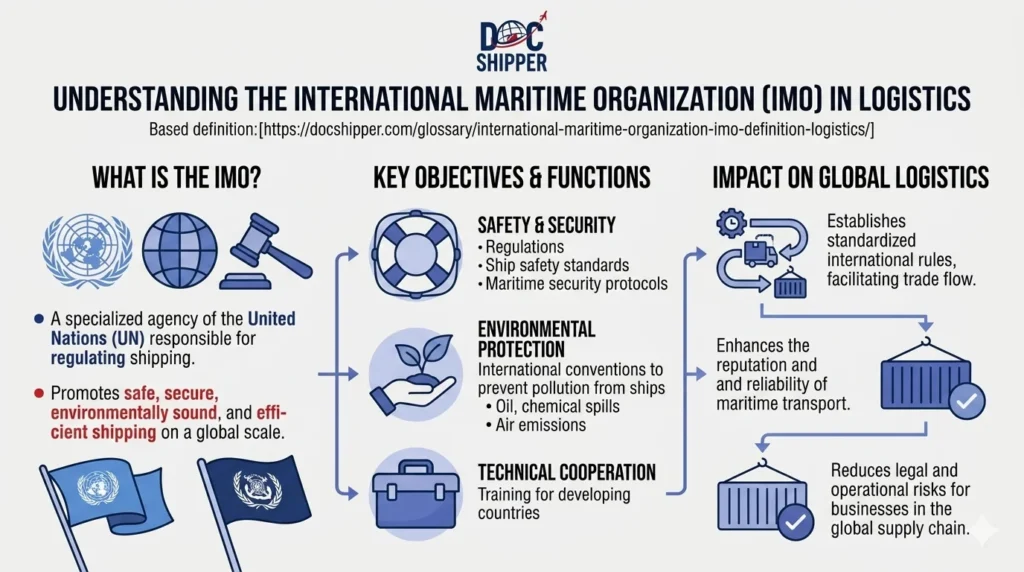
The International Maritime Organization (IMO) is the United Nations specialized agency responsible for regulating international shipping. Established in 1948, it sets global standards for maritime safety, security, and environmental protection, ensuring that shipping operations remain safe, efficient, and sustainable across all oceans.
Introduction
Many importers and exporters mistakenly believe maritime regulations are managed by individual countries. In reality, 95% of global trade moves by sea under standards unified by the IMO, making it the invisible backbone of international logistics.
Founded in 1948 and operational since 1958, the IMO ensures that shipping practices remain harmonized worldwide. Without this coordination, each nation could impose conflicting rules, creating chaos for freight forwarders, shipowners, and cargo owners alike.
Understanding the IMO’s role is crucial for anyone involved in import/export operations because:
- Safety protocols directly affect vessel certification and cargo handling procedures
- Environmental regulations like MARPOL impact shipping costs and route planning
- Security measures such as ISPS Code influence port access and documentation requirements
- Container standards ensure global compatibility and prevent costly delays
- Liability frameworks determine insurance obligations and claims procedures
The organization’s 175 member states collaborate to update regulations that reflect technological advances, environmental challenges, and security threats. These decisions ripple through every Bill of Lading, every customs clearance, and every logistics contract worldwide.
IMO Regulatory Framework & Expertise
The IMO operates through a sophisticated committee structure that develops binding international conventions. These legal instruments become incorporated into national maritime laws, creating a seamless regulatory environment across borders.
The organization’s primary regulatory frameworks include:
SOLAS (Safety of Life at Sea Convention) establishes minimum safety standards for ship construction, equipment, and operation. Originally created after the Titanic disaster, SOLAS now covers everything from fire protection systems to mandatory cargo securing equipment. Every commercial vessel carrying international freight must obtain SOLAS certification, which freight forwarders verify before booking space.
MARPOL (Marine Pollution Prevention) regulates discharge of oil, chemicals, sewage, garbage, and air emissions from ships. The 2020 sulfur cap regulation reduced allowable sulfur content in marine fuels from 3.5% to 0.5%, fundamentally changing bunker fuel markets and increasing operational costs by 15-25% across many routes.
ISPS Code (International Ship and Port Facility Security) mandates security measures to protect vessels and port facilities from terrorist threats. Implementation requires detailed security plans, designated officers, and regular audits—all of which affect port turnaround times and documentation requirements for cargo release.
ISM Code (International Safety Management) requires shipping companies to establish documented safety management systems. This operational framework ensures that every vessel follows standardized procedures for cargo handling, maintenance, and emergency response, reducing the risk of cargo damage during international transit.
Ballast Water Management Convention controls the transfer of invasive aquatic species through ballast water. Compliance requires specialized treatment systems costing $1-5 million per vessel, costs that ultimately factor into freight rates and surcharges on import shipments.
According to the official IMO website, these conventions undergo continuous revision through the Maritime Safety Committee, the Marine Environment Protection Committee, and other specialized bodies that meet regularly to address emerging challenges.
At DocShipper, we monitor IMO regulatory updates to ensure our clients’ shipments comply with the latest requirements. Our customs brokerage teams stay informed about convention amendments that might affect documentation, packaging standards, or vessel eligibility for specific routes.
Concrete Applications & Impact Data
The IMO’s regulations create tangible effects on everyday logistics operations. Understanding these impacts helps importers and exporters anticipate costs, timelines, and compliance requirements.
Comparative Impact of Key IMO Regulations
| Regulation | Primary Impact | Cost Implication | Compliance Timeline |
|---|---|---|---|
| MARPOL Annex VI (2020) | Low-sulfur fuel mandate | +15-25% bunker costs | Immediate (January 2020) |
| Verified Gross Mass (VGM) | Mandatory container weighing | $15-50 per container | Required since July 2016 |
| Ballast Water Management | Treatment system installation | $1-5M per vessel (capital) | Phased (2017-2024) |
| Container Inspection Programs | Enhanced cargo securing checks | Potential port delays (2-4 hours) | Ongoing enforcement |
| ISPS Code Compliance | Port security protocols | Varies by facility | Mandatory since 2004 |
Real-World Case Study: VGM Regulation Impact
In July 2016, the IMO’s Verified Gross Mass requirement fundamentally changed container shipping procedures. Previously, shippers could declare container weights based on calculations or estimates. The new rule mandates actual weighing before loading.
Business Impact: A European electronics importer shipping 500 containers monthly from China suddenly needed to implement certified weighing procedures at origin. The company faced three options:
- Install certified scales at their consolidation warehouse ($75,000 capital investment)
- Use terminal weighing services ($25-35 per container)
- Outsource to a freight forwarder with existing infrastructure
The company chose option three, working with DocShipper’s Asian network to integrate VGM compliance into their existing logistics workflow. This avoided capital expenses while ensuring 100% regulatory compliance and preventing costly shipment rejections at loading ports.
Five Critical IMO Developments Affecting 2024-2025 Operations
1. Carbon Intensity Indicators (CII): Vessels now receive annual efficiency ratings (A to E). Ships with poor ratings face operational restrictions, potentially forcing cargo onto more expensive “green” vessels or indirect routing.
2. IMO 2030 GHG Strategy: Targeting 40% carbon intensity reduction by 2030 compared to 2008 levels. This drives investment in alternative fuels (LNG, methanol, ammonia) whose infrastructure costs will influence future freight rates.
3. Electronic Bill of Lading Standards: IMO facilitation committee promotes digital documentation to reduce processing times. Adoption remains uneven but accelerating, potentially cutting document handling time by 75%.
4. Revised SOLAS Container Inspection Guidelines: Enhanced focus on misdeclared dangerous goods following several major container ship fires. Expect more rigorous documentation checks and potential delays for chemical shipments.
5. Arctic Shipping Code Expansion: As climate change opens northern routes, IMO regulations now govern previously inaccessible passages. New compliance requirements affect vessels transiting these waters, creating opportunities for shortened Asia-Europe routes.
Conclusion
The International Maritime Organization remains the essential regulatory authority ensuring that international shipping operates safely, securely, and sustainably. Its conventions directly shape documentation requirements, vessel standards, and operational procedures that importers and exporters encounter daily.
Navigating IMO regulations requires specialized knowledge and proactive compliance monitoring. Need expert guidance on maritime regulatory compliance for your shipments? Contact DocShipper today for comprehensive logistics support.
📚 Quiz
Test Your Knowledge: International Maritime Organization (IMO)
What is the primary function of the International Maritime Organization?
Which statement correctly describes the IMO's enforcement authority?
A shipper asks why their container was rejected at the port in July 2016. The most likely regulatory cause is:
🎯 Your Result
📞 Free Quote in 24hFAQ | International Maritime Organization (IMO): Definition, Role & Concrete Examples
The IMO develops and maintains international conventions, codes, and guidelines governing maritime safety, security, environmental protection, and operational efficiency. It creates legally binding frameworks that member states incorporate into national law, ensuring consistent global shipping standards.
As of 2024, the IMO comprises 175 member states plus three associate members. This near-universal membership ensures that maritime regulations apply consistently across virtually all international shipping routes and ports worldwide.
No. The IMO creates international standards, but enforcement responsibility lies with flag states (countries where vessels are registered), port states (countries where vessels call), and coastal states. The organization conducts audits and promotes compliance but lacks direct enforcement authority.
SOLAS (Safety of Life at Sea) establishes minimum safety standards for commercial vessels. It affects cargo operations through requirements for container securing, dangerous goods handling, fire protection, and structural integrity. Non-compliant vessels cannot legally carry international cargo.
The 2020 regulation reduced allowable sulfur in marine fuels from 3.5% to 0.5%. Low-sulfur fuels cost significantly more, increasing bunker expenses by 15-25% on many routes. Carriers passed these costs to shippers through bunker adjustment factors (BAF) and environmental surcharges.
VGM mandates that shippers provide verified container weights before loading, using either certified weighing equipment or weighing the packed container at a certified facility. Containers without proper VGM documentation cannot be loaded onto vessels, preventing shipment delays.
The International Ship and Port Facility Security Code requires vessels and terminals to implement detailed security plans, conduct regular drills, and maintain designated security officers. This increases documentation requirements, extends cargo release procedures, and restricts port access for unauthorized personnel.
MARPOL (Marine Pollution Prevention) addresses six categories of pollution through separate annexes: oil, noxious liquid substances, harmful packaged goods, sewage, garbage, and air emissions. Compliance affects everything from bunker fuel specifications to waste disposal procedures during voyages.
While IMO regulations themselves don't modify private contracts, new compliance requirements often trigger force majeure clauses or allow carriers to impose surcharges. Most shipping contracts include provisions allowing cost adjustments when regulatory changes affect operational expenses.
The IMO adopted an initial GHG strategy in 2018, targeting at least 50% total emissions reduction by 2050 compared to 2008. Implementation includes the Carbon Intensity Indicator, Energy Efficiency Design Index for new vessels, and ongoing discussions about market-based measures like carbon pricing.
The IMO's Maritime Safety Committee develops guidelines for container construction, inspection, and securing. These standards ensure containers meet structural requirements, undergo regular safety inspections, and are properly secured aboard vessels to prevent cargo loss or vessel stability issues.
The IMO publishes regulatory updates through its official website, GISIS database, and member state circulars. Practical compliance guidance comes from freight forwarders, shipping associations, and logistics providers like DocShipper who monitor regulatory developments and translate them into operational requirements for clients.
Need Help with
Logistics or Sourcing ?
First, we secure the right products from the right suppliers at the right price by managing the sourcing process from start to finish. Then, we simplify your shipping experience - from pickup to final delivery - ensuring any product, anywhere, is delivered at highly competitive prices.


Fill the Form
Prefer email? Send us your inquiry, and we’ll get back to you as soon as possible.
Contact us




:%20Definition,%20Role%20&%20Concrete%20Examples)