


In short ⚡
Goods are tangible physical products that can be moved, stored, and traded across borders, forming the foundation of international commerce. In logistics, goods encompass all items subject to transportation, customs clearance, and delivery—from raw materials to finished consumer products.Introduction
Many businesses struggle to distinguish between goods, services, and intangible assets when planning international shipments. This confusion can lead to incorrect customs declarations, unexpected duties, or shipment delays. Understanding what qualifies as “goods” is essential for proper documentation, HS code classification, and compliance with trade regulations.
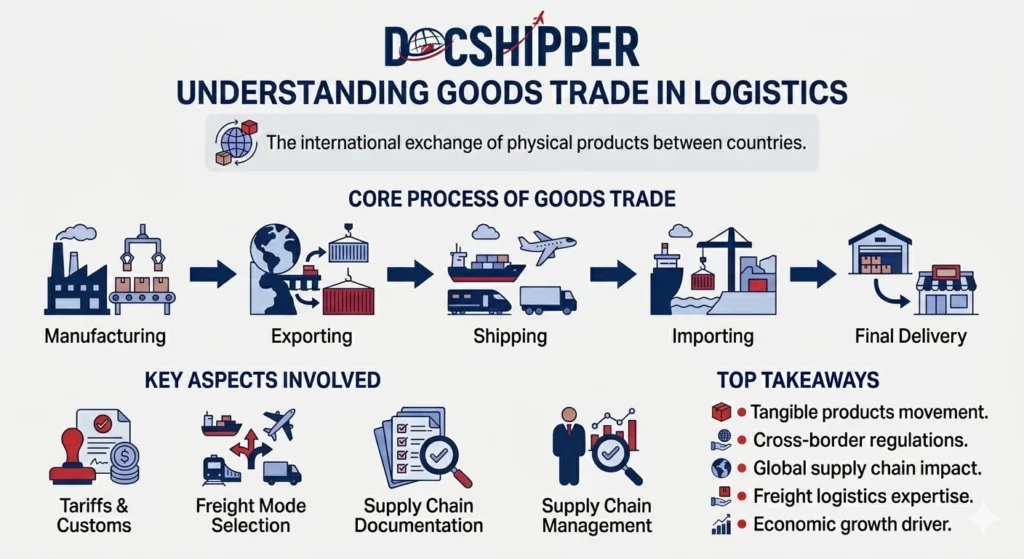
In the global supply chain, goods represent the physical backbone of international trade. They are subject to customs inspections, tariffs, and transport regulations that don’t apply to services or digital products. Whether you’re shipping electronics from China or exporting machinery to Europe, the classification and handling of your goods determines your logistics strategy.
Key characteristics of goods in international logistics include:
- Physical tangibility: Goods can be touched, measured, and physically inspected
- Movability: They can be transported via sea, air, road, or rail freight
- Ownership transfer: Goods change legal ownership through commercial transactions
- Customs classification: All goods require HS code identification for border clearance
- Storage capability: Goods can be warehoused, inventoried, and preserved
Classification & Regulatory Framework
The international trade system categorizes goods using the Harmonized System (HS) code, a standardized six-digit classification maintained by the World Customs Organization. This universal nomenclature enables customs authorities worldwide to identify products, apply appropriate tariffs, and enforce trade restrictions. Each country extends the HS code with additional digits for more specific national classifications.
Goods fall into three primary categories for logistics purposes: raw materials (unprocessed resources like minerals or agricultural products), intermediate goods (components used in manufacturing), and finished goods (consumer-ready products). This distinction affects documentation requirements, duty rates, and inspection procedures at customs checkpoints.
Regulatory frameworks differentiate between general cargo and specialized categories requiring additional compliance. Dangerous goods must follow IMDG, IATA DGR, or ADR regulations depending on transport mode. Perishable goods need temperature-controlled shipping and phytosanitary certificates. High-value goods often require insurance certificates and secure transport arrangements.
The legal definition of goods extends to dutiable status. Most physical products crossing borders trigger customs duties based on their HS classification, origin country, and applicable trade agreements. Free Trade Agreements (FTAs) can reduce or eliminate duties on eligible goods meeting rules of origin requirements. For detailed regulations, consult the World Customs Organization database or your country’s customs authority.
Trade compliance requires accurate goods description on commercial invoices, packing lists, and certificates of origin. Misclassification—intentional or accidental—can result in penalties, shipment seizures, or blacklisting from customs programs. At DocShipper, we systematically verify goods classification and ensure all documentation aligns with customs requirements to prevent clearance delays.
Certain goods face import/export restrictions based on international conventions. CITES regulates endangered species products, the Wassenaar Arrangement controls dual-use technologies, and various countries maintain prohibited goods lists. Understanding these restrictions before shipping prevents costly rejections and legal complications.
Practical Examples & Trade Data
To illustrate how goods classification impacts logistics operations, consider three common scenarios that businesses encounter when organizing international shipments. Each demonstrates different regulatory requirements and cost implications.
Comparative Scenario: Electronics Shipment
| Category | Smartphones (HS 8517.12) | Laptops (HS 8471.30) |
|---|---|---|
| EU Import Duty | 0% (ITA Agreement) | 0% (ITA Agreement) |
| US Import Duty | 0% (MFN rate) | 0% (MFN rate) |
| Documentation | CE marking, battery certificates | CE marking, battery certificates |
| Inspection Rate | 15-20% (counterfeits risk) | 8-12% (standard) |
| Average Transit Time | 30-35 days (sea), 5-7 days (air) | 30-35 days (sea), 5-7 days (air) |
Use Case: Textile Goods Import
A European retailer imports 5,000 cotton t-shirts (HS 6109.10) from Bangladesh. The goods benefit from GSP (Generalized System of Preferences) duty exemption, requiring a Form A certificate of origin. Without proper classification, standard EU duty of 12% would apply, adding €6,000 to import costs on a €50,000 shipment.
The shipment requires specific documentation: commercial invoice listing fabric composition, packing list with carton breakdown, and textile label compliance (fiber content, care instructions, country of origin). Customs conducts random textile inspections to verify labeling accuracy and detect quota violations.
Trade Volume Insights
According to WTO statistics, global merchandise trade (goods) reached $25.3 trillion in 2023, representing 80% of total world trade value. The remaining 20% consists of services. The top traded goods categories include:
- Machinery and transport equipment: 38% of global goods trade
- Manufactured goods: 24% (textiles, chemicals, metals)
- Fuels and mining products: 16% of total trade value
- Agricultural products: 9% (food, beverages, raw materials)
- Other goods: 13% (miscellaneous articles, special transactions)
Dangerous Goods Example
Lithium-ion batteries (UN 3480) represent a growing goods category with strict transport rules. A shipment of 500 battery packs requires UN 38.3 testing certificates, Class 9 dangerous goods declaration, and specialized packaging meeting IATA Packing Instruction 965. Non-compliance can result in shipment refusal, airline fines up to $10,000, and potential criminal liability.
Conclusion
Understanding goods classification is fundamental to successful international trade operations. Proper identification ensures regulatory compliance, accurate cost calculation, and efficient customs clearance across all transport modes.
Need assistance with goods classification or international shipping documentation? Contact DocShipper for expert guidance on your specific logistics requirements.
📚 Quiz
Test Your Knowledge: Goods in International Trade
Which statement best defines "goods" in international logistics?
A company wants to import downloadable software licenses. How are these classified for customs purposes?
Your textile shipment qualifies for GSP duty exemption. What happens if you fail to provide the required Form A certificate of origin?
🎯 Your Result
📞 Free Quote in 24hFAQ | Goods: Definition, Classification & Practical Examples in International Trade
Goods are tangible physical products that can be transported, stored, and physically transferred between parties. Services are intangible activities or work performed, such as consulting, software licenses, or financial services. Goods require customs clearance and physical shipping, while services typically cross borders digitally or through personnel movement. This distinction affects taxation, documentation, and regulatory compliance significantly.
Start by consulting your country's customs tariff database or the World Customs Organization's HS nomenclature. Identify your product's material composition, primary function, and processing level. Most customs authorities provide online search tools. When uncertain, request a binding tariff ruling from customs or consult a licensed customs broker. Incorrect classification can result in duty overpayment or underpayment penalties.
Generally no. Digital products like software downloads, e-books, or streaming services are classified as intangible services rather than goods. However, physical media containing software (USB drives, CDs) are treated as goods requiring customs clearance. The distinction matters because goods face import duties and physical inspections, while digital services may be subject to VAT or digital services taxes but not customs duties.
Standard documentation includes a commercial invoice, packing list, bill of lading or airway bill, and certificate of origin. Depending on goods type, additional documents may include import licenses, sanitary certificates, dangerous goods declarations, or product-specific certifications. Documentation requirements vary by destination country, product category, and trade agreements. Incomplete documentation causes customs delays and potential penalties.
No. Many goods face import/export restrictions based on international treaties, national security concerns, health regulations, or environmental protection. Prohibited goods include certain weapons, narcotics, endangered species, and hazardous materials. Restricted goods require special licenses or permits. Always verify destination country regulations before shipping. Violation of trade restrictions can result in seizure, fines, and criminal prosecution.
Customs value typically follows the transaction value method based on the price actually paid or payable for goods, plus certain additions like freight, insurance, and royalties. The WTO Valuation Agreement establishes six valuation methods applied hierarchically. Accurate valuation requires detailed commercial invoices showing complete pricing breakdowns. Undervaluation or misrepresentation constitutes customs fraud with serious legal consequences.
Capital goods are machinery, equipment, or tools used in production processes rather than for final consumption—such as industrial robots, manufacturing equipment, or construction machinery. Consumer goods are purchased by end-users for personal use. This distinction affects duty rates, depreciation treatment, and import regulations. Many countries offer favorable duty treatment for capital goods to encourage industrial development.
Goods in transit (passing through a country without entering domestic commerce) typically undergo simplified transit procedures rather than full import clearance. Transit requires a transit declaration, customs seals, and sometimes a bond guarantee. Goods must remain in customs-bonded transport and cannot be unloaded except at designated transit points. Transit violations can result in duties, penalties, and shipment seizure.
General cargo consists of standard-sized goods shipped in containers or conventional packaging—like palletized products or cartons. Project cargo refers to oversized, overweight, or highly specialized goods requiring customized transport solutions—such as industrial machinery, wind turbine components, or construction equipment. Project cargo demands specialized handling equipment, route surveys, and often multiple transport modes with complex logistics coordination.
FTAs can reduce or eliminate customs duties on eligible goods originating in member countries. However, goods must meet specific rules of origin criteria to qualify for preferential treatment. This requires proof of origin through certificates or declarations. The HS code classification determines which tariff line receives preferential treatment. Even within FTAs, some sensitive goods may be excluded from benefits or subject to quotas.
Responsibility depends on the Incoterms agreed upon and when damage occurred. Cargo insurance covers most risks during transit. Upon delivery, conduct immediate inspection and document damage with photos and written surveys. File claims with the carrier within specified timeframes (typically 3-7 days for visible damage). Insurance claims require supporting documentation including commercial invoice, packing list, survey reports, and proof of value.
Yes. Commercial samples require customs declaration and may face duties unless shipped under specific sample provisions. Many countries allow duty-free entry for samples of negligible value clearly marked as samples and rendered commercially unsuitable for sale. Carnet systems (ATA Carnet) facilitate temporary admission of professional samples. Permanent importation of samples follows standard customs procedures with full duty assessment unless exempted by value thresholds.
Need Help with
Logistics or Sourcing ?
First, we secure the right products from the right suppliers at the right price by managing the sourcing process from start to finish. Then, we simplify your shipping experience - from pickup to final delivery - ensuring any product, anywhere, is delivered at highly competitive prices.


Fill the Form
Prefer email? Send us your inquiry, and we’ll get back to you as soon as possible.
Contact us




