


In short ⚡
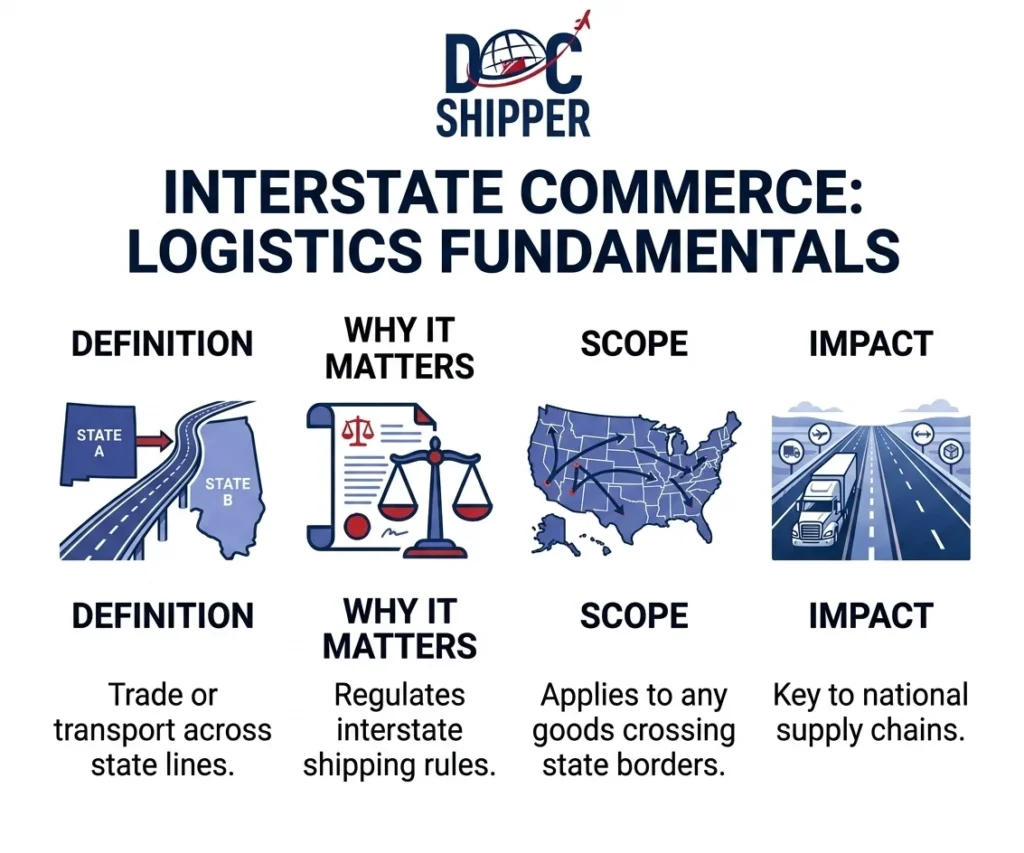
Interstate commerce refers to the trade, transportation, or movement of goods, services, or people across state lines within a country. In logistics, it encompasses all commercial activities that cross state boundaries, subject to federal regulations and oversight by agencies like the Department of Transportation (DOT) and Federal Motor Carrier Safety Administration (FMCSA).
Introduction
Many businesses underestimate the complexity of moving products between states. A shipment departing California for New York faces entirely different regulations than local delivery within a single state. Understanding interstate commerce becomes critical for compliance, insurance coverage, and operational efficiency.
This concept shapes nearly every aspect of domestic logistics in the United States. From trucking companies crossing multiple state lines to e-commerce retailers shipping nationwide, interstate commerce regulations impact millions of daily transactions. The distinction between interstate and intrastate commerce determines which laws apply, what permits carriers need, and how shipments are tracked.
Key characteristics of interstate commerce include:
- Federal jurisdiction – Activities fall under U.S. federal law rather than state-specific regulations
- Cross-border movement – Goods, services, or passengers must physically cross state boundaries
- Commercial intent – Transactions involve business purposes, not personal or private activities
- DOT number requirements – Motor carriers operating interstate must register with federal authorities
- Uniform compliance standards – Federal regulations supersede conflicting state laws for interstate operations
Regulatory Framework & Compliance Requirements
Interstate commerce operates under the Commerce Clause of the U.S. Constitution, granting Congress authority to regulate trade between states. This constitutional foundation enables federal agencies to establish uniform standards that streamline nationwide logistics operations while ensuring safety and fair competition.
The Federal Motor Carrier Safety Administration (FMCSA) governs most interstate trucking activities. Carriers must obtain a USDOT number before operating commercially across state lines. This identifier tracks safety records, inspections, and compliance history. Companies hauling freight for hire also need Motor Carrier (MC) authority, which authorizes interstate transportation of goods.
Safety regulations form the backbone of interstate commerce compliance. The Hours of Service (HOS) rules limit driving time to prevent fatigue-related accidents. Drivers cannot exceed 11 hours behind the wheel after 10 consecutive hours off duty. Electronic Logging Devices (ELDs) became mandatory in 2017 to enforce these limits automatically, eliminating paper logbook manipulation.
Insurance requirements escalate significantly for interstate operations. Carriers transporting general freight must maintain $750,000 minimum liability coverage. This increases to $5 million for hazardous materials. These thresholds protect shippers and the public from financial losses due to accidents or cargo damage. At DocShipper, we verify insurance certificates for all carrier partners to ensure your shipments remain protected throughout interstate transit.
The Unified Carrier Registration (UCR) system requires annual fees based on fleet size. This interstate agreement replaced the older Single State Registration System in 2007. Fees fund state enforcement programs that monitor compliance with federal safety regulations. According to the FMCSA official website, over 650,000 motor carriers currently operate under interstate authority, demonstrating the scale of this regulated environment.
Weight and dimension limits present another compliance layer. While states set their own restrictions for intrastate travel, federal bridge formulas establish maximum weights for interstate highways. The standard limit remains 80,000 pounds gross vehicle weight on Interstate highways, though special permits allow oversize loads under specific conditions. These regulations protect infrastructure while maintaining consistent national standards.
Practical Applications & Industry Data
Understanding interstate commerce extends beyond regulatory theory. Real-world scenarios illustrate how these rules impact daily logistics decisions. Consider a manufacturer in Michigan shipping automotive parts to assembly plants in Tennessee and South Carolina. This operation clearly constitutes interstate commerce, requiring full DOT compliance even if the company operates only five trucks.
The definition of interstate commerce can surprise businesses. A shipment originating and terminating within the same state might still qualify as interstate if it passes through another state during transit. For example, transporting goods from northern California to southern California via Nevada triggers interstate commerce regulations despite both pickup and delivery occurring in California. This “through movement” principle catches many regional carriers off guard.
E-commerce transformed interstate commerce dynamics. Online retailers shipping to customers nationwide automatically engage in interstate commerce. Amazon alone processes over 10 million packages daily across state lines, relying on interstate commerce infrastructure. Third-party logistics providers (3PLs) help smaller merchants navigate this complexity by managing carrier relationships and compliance requirements.
| Aspect | Interstate Commerce | Intrastate Commerce |
|---|---|---|
| Regulatory Authority | Federal (DOT, FMCSA) | State agencies |
| Minimum Insurance | $750,000 – $5,000,000 | Varies by state ($300,000+) |
| DOT Number | Required | Sometimes required |
| ELD Mandate | Mandatory (with exceptions) | State-dependent |
| Hours of Service | Federal HOS rules apply | May follow state rules |
Case study: A Texas-based produce distributor expanded from local deliveries to regional distribution. Their fleet of 12 trucks began crossing into Louisiana, Oklahoma, and New Mexico. This transition from intrastate to interstate commerce required obtaining MC authority, upgrading insurance coverage from $500,000 to $1,000,000, and implementing ELD systems. The upfront investment totaled approximately $45,000, but opened access to markets generating an additional $2.3 million annually.
Technology platforms now simplify interstate commerce management. Load boards connect shippers with carriers holding proper authority. Transportation Management Systems (TMS) automatically verify carrier credentials before booking shipments. These tools reduce compliance risk while improving operational efficiency. DocShipper integrates these verification systems to ensure every interstate shipment moves with properly authorized and insured carriers, protecting your supply chain integrity.
Border states experience unique interstate commerce challenges. A carrier based in Kansas City, Missouri, might complete dozens of interstate trips weekly given the city’s location on the Missouri-Kansas border. This geographic reality requires constant compliance awareness that single-state operators don’t face. Training programs emphasizing interstate commerce fundamentals become essential for drivers and dispatchers in these regions.
Conclusion
Interstate commerce forms the foundation of America’s domestic logistics network, enabling the free flow of goods while maintaining safety and accountability standards. Understanding its regulatory requirements and practical implications ensures compliance and operational success for any business shipping across state lines.
Need expert guidance navigating interstate commerce regulations for your supply chain? Contact DocShipper for comprehensive logistics support that keeps your shipments compliant and moving efficiently.
📚 Quiz
Test Your Knowledge: Interstate Commerce
1. What is the core defining characteristic of interstate commerce?
2. A California company ships goods from San Diego to Sacramento, but the truck travels through Nevada to save time. Which statement is correct?
3. A motor carrier operates 8 trucks, conducting both interstate deliveries (60% of business) and intrastate deliveries (40%). Which regulatory framework applies to their operations?
🎯 Your Results
📞 Free Custom QuoteFAQ | Interstate Commerce: Definition, Regulations & Practical Examples
Interstate commerce involves any commercial activity crossing state boundaries, including transportation of goods, services, or passengers between states. Intrastate commerce occurs entirely within one state's borders. The distinction matters because interstate operations fall under federal jurisdiction (DOT, FMCSA), while intrastate activities may follow state-specific regulations. Even shipments starting and ending in the same state can be interstate if they physically travel through another state during transit.
Yes, commercial motor carriers operating interstate must obtain a USDOT number from the Federal Motor Carrier Safety Administration. This applies to vehicles with gross weight over 10,001 pounds, those transporting hazardous materials requiring placards, or vehicles designed to carry 9+ passengers for compensation. The USDOT number identifies your company in safety records, inspections, and compliance reviews. Registration costs nothing but requires detailed company information.
Minimum liability insurance for interstate motor carriers transporting general freight is $750,000. This increases to $1,000,000 for carriers hauling certain commodities, and $5,000,000 for hazardous materials. Cargo insurance typically ranges from $100,000 to $250,000 depending on shipment value. These requirements protect shippers and the public from financial losses due to accidents or cargo damage during interstate transportation.
Federal Hours of Service regulations limit property-carrying interstate drivers to 11 hours of driving time following 10 consecutive hours off duty. Drivers cannot work more than 14 consecutive hours after coming on duty, regardless of time spent driving versus other tasks. A 30-minute break is required after 8 cumulative hours of driving. These rules prevent fatigue-related accidents and are enforced through Electronic Logging Devices (ELDs) that automatically record driving time.
Yes, many carriers conduct both interstate and intrastate operations. However, once a carrier engages in any interstate commerce, federal regulations apply to all their operations, even trips entirely within one state. This means a truck making interstate deliveries must comply with federal Hours of Service rules, ELD mandates, and insurance requirements even when hauling intrastate loads. Carriers cannot selectively apply regulations based on individual trip characteristics.
The UCR is an annual registration system for interstate motor carriers, brokers, freight forwarders, and leasing companies. It replaced the Single State Registration System in 2007. Fees vary based on fleet size, ranging from $76 for carriers with 2 or fewer vehicles to $62,676 for fleets exceeding 100,000 vehicles. Revenue funds state enforcement of federal safety regulations. Registration must be renewed yearly, with deadlines typically falling December 31st.
Federal law establishes 80,000 pounds as the maximum gross vehicle weight on Interstate highways for most commercial trucks. This includes the weight of the vehicle, cargo, and fuel. Individual axle weights cannot exceed 20,000 pounds on a single axle or 34,000 pounds on tandem axles. Bridge formulas calculate safe weights based on axle spacing. States may grant special permits for overweight loads, but federal limits govern interstate highways to protect infrastructure.
Motor Carrier (MC) authority is federal permission to operate as a for-hire carrier in interstate commerce. Carriers transporting regulated commodities (most freight) need MC authority in addition to their USDOT number. The application costs $300 and requires proof of insurance, designation of process agents, and Unified Carrier Registration. Brokers arranging transportation also need separate broker authority (MC number). Operating without proper authority can result in fines up to $16,000 per violation.
Yes, most interstate commercial motor carriers must use Electronic Logging Devices to record Hours of Service compliance. The ELD mandate took effect December 2017, replacing paper logbooks. Exemptions exist for vehicles manufactured before model year 2000, drivers using short-haul exceptions (within 150 air-miles), and those conducting drive-away-tow-away operations. ELDs automatically sync with vehicle engines to record driving time, location, and distance traveled.
E-commerce retailers shipping products to customers in multiple states engage in interstate commerce, even if using third-party carriers. This means ensuring chosen carriers maintain proper federal authority, insurance, and safety ratings. Businesses shipping via parcel carriers (UPS, FedEx) indirectly participate in interstate commerce but don't need their own DOT numbers. However, companies operating private fleets for multi-state delivery must obtain USDOT numbers and comply with all federal motor carrier regulations.
Penalties vary by violation severity. Operating without required USDOT or MC authority can result in fines up to $16,000 per offense and vehicle impoundment. Hours of Service violations range from $1,000 to $16,000 depending on circumstances. Insurance violations trigger immediate out-of-service orders until proper coverage is proven. Serious safety violations can lead to carrier safety ratings downgrades, restricting business opportunities. Repeated violations may result in revocation of operating authority.
State borders trigger federal jurisdiction even for short trips. A carrier based in Maryland making deliveries to Virginia (just across the Potomac River) must comply with full interstate commerce regulations despite minimal distance traveled. This includes federal Hours of Service rules, ELD mandates, and insurance requirements. Border-state carriers face constant regulatory oversight that single-state operators avoid. Geographic proximity to state lines significantly impacts compliance complexity and operational planning.
Need Help with
Logistics or Sourcing ?
First, we secure the right products from the right suppliers at the right price by managing the sourcing process from start to finish. Then, we simplify your shipping experience - from pickup to final delivery - ensuring any product, anywhere, is delivered at highly competitive prices.


Fill the Form
Prefer email? Send us your inquiry, and we’ll get back to you as soon as possible.
Contact us




