


In short ⚡
Classification Rating is a standardized evaluation system used in international logistics to assess the quality, risk level, and reliability of cargo, carriers, or freight forwarders. This rating determines insurance premiums, handling procedures, and regulatory compliance requirements throughout the supply chain.
Introduction
Shippers frequently underestimate how classification ratings directly impact their shipping costs and delivery timelines. A single misclassification can trigger customs delays, insurance disputes, or regulatory penalties worth thousands of dollars.
In global trade, classification ratings serve as the universal language between manufacturers, logistics providers, customs authorities, and insurers. They establish objective criteria for evaluating everything from hazardous materials to carrier performance metrics.
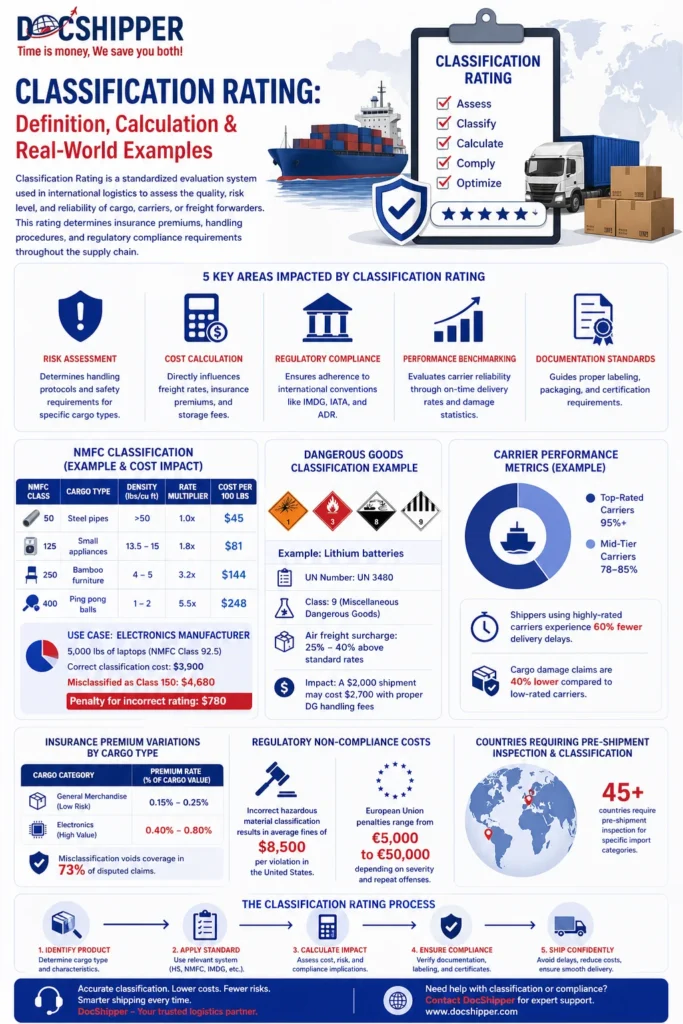
- Risk Assessment: Determines handling protocols and safety requirements for specific cargo types
- Cost Calculation: Directly influences freight rates, insurance premiums, and storage fees
- Regulatory Compliance: Ensures adherence to international conventions like IMDG, IATA, and ADR
- Performance Benchmarking: Evaluates carrier reliability through on-time delivery rates and damage statistics
- Documentation Standards: Guides proper labeling, packaging, and certification requirements
Technical Framework & Regulatory Implications
Classification rating systems operate through multiple standardized frameworks depending on cargo type and transport mode. The Harmonized System (HS) provides the foundation for customs classification, while specialized systems address specific cargo categories.
For dangerous goods, the UN Classification System divides materials into nine primary classes based on hazard characteristics. Class 1 covers explosives, Class 3 addresses flammable liquids, and Class 8 includes corrosive substances. Each class requires distinct packaging specifications, labeling protocols, and transport restrictions. According to UNECE regulations, shippers must obtain proper certifications before transporting classified dangerous goods internationally.
Carrier classification ratings evaluate operational performance through metrics like on-time delivery percentage, cargo damage rates, and customer satisfaction scores. Organizations like the Federal Maritime Commission (FMC) and International Air Transport Association (IATA) maintain rating databases that influence shipper selection decisions.
The National Motor Freight Classification (NMFC) system assigns freight classes from 50 to 500 based on four transportation characteristics: density, stowability, handling requirements, and liability risk. Higher class numbers indicate greater handling complexity and typically result in higher shipping costs.
Insurance underwriters use cargo classification ratings to determine premium structures. High-value electronics receive different ratings than bulk agricultural products, directly affecting coverage costs. At DocShipper, we verify classification accuracy before shipment to prevent insurance claim disputes and ensure proper coverage levels.
Practical Applications & Data Analysis
Understanding how classification ratings translate into operational decisions requires examining real-world scenarios and comparative data. The following analysis demonstrates cost implications across different rating categories.
| NMFC Class | Cargo Type | Density (lbs/cu ft) | Rate Multiplier | Cost per 100 lbs |
|---|---|---|---|---|
| 50 | Steel pipes | >50 | 1.0x | $45 |
| 125 | Small appliances | 13.5-15 | 1.8x | $81 |
| 250 | Bamboo furniture | 4-5 | 3.2x | $144 |
| 400 | Ping pong balls | 1-2 | 5.5x | $248 |
Use Case: Electronics Manufacturer — A company shipping 5,000 lbs of laptops (NMFC Class 92.5, density 13.5 lbs/cu ft) from Los Angeles to New York faces a base rate of $78 per 100 lbs. Total freight cost: $3,900. If misclassified as Class 150, costs increase to $4,680—a $780 penalty for incorrect rating.
Dangerous Goods Scenario: Lithium battery shipments fall under UN 3480 (Class 9). Air carriers impose surcharges of 25-40% above standard rates. A 500 kg shipment costing $2,000 at standard rates jumps to $2,700 with proper dangerous goods classification and handling fees.
Carrier Performance Metrics: Top-rated ocean carriers maintain 95%+ schedule reliability. Mid-tier carriers average 78-85%. Shippers using highly-rated carriers experience 60% fewer delivery delays and 40% lower cargo damage claims according to industry benchmarks.
Insurance Premium Variations: General merchandise rated as low-risk carries premiums of 0.15-0.25% of cargo value. High-value electronics increase to 0.4-0.8%. Properly classified shipments prevent claim denials—misclassification voids coverage in 73% of disputed cases.
Regulatory Compliance Impact: Incorrect hazardous material classification results in average fines of $8,500 per violation in the United States. European Union penalties range from €5,000 to €50,000 depending on severity and repeat offenses.
Conclusion
Classification rating mastery directly impacts your bottom line through optimized shipping costs, reduced regulatory risks, and improved supply chain efficiency. Accurate classification prevents costly delays and ensures compliance across international borders.
Need expert guidance on cargo classification or carrier selection? Contact DocShipper for comprehensive logistics support tailored to your specific requirements.
📚 Quiz
Test Your Knowledge: Classification Rating
Q1 — What does a Classification Rating primarily determine in international logistics?
Q2 — In the NMFC system, a higher freight class number (e.g., Class 400 vs. Class 50) means:
Q3 — A shipper sends 5,000 lbs of laptops but accidentally classifies them under a higher NMFC class than correct. What is the most likely consequence?
🎯 Your Result
📞 Free Quote in 24hFAQ | Classification Rating: Definition, Calculation & Real-World Examples
HS codes identify products for customs purposes globally, while NMFC classifications determine freight rates based on shipping characteristics like density and handling requirements within domestic US transport.
NMFC updates occur quarterly. HS codes undergo major revisions every five years through the World Customs Organization. Carrier performance ratings update monthly or quarterly depending on the rating organization.
Yes. Submit a formal reclassification request with supporting documentation proving correct density, dimensions, and handling characteristics. The National Motor Freight Traffic Association reviews disputes within 30-45 days.
US Department of Transportation fines range from $500 to $81,993 per violation. Criminal penalties include imprisonment up to five years for knowingly falsifying hazardous material documentation.
Higher risk classifications increase premiums proportionally. Electronics may cost 0.6% of value, while general cargo averages 0.2%. Dangerous goods add 50-150% surcharges depending on UN class designation.
HS codes are universal for customs. Transport classifications vary: NMFC applies in North America, while Europe uses different national systems. Dangerous goods follow UN standards globally with regional variations.
Bill of lading, commercial invoice, packing list, Material Safety Data Sheet (for hazmat), and classification certificates from accredited testing labs provide verification for customs and carriers.
Density inversely correlates with freight class. Items exceeding 50 lbs/cubic foot qualify for Class 50 (lowest cost). Items under 1 lb/cubic foot fall into Class 500 (highest cost).
Accurate pre-classification enables faster processing. Customs prioritizes correctly documented shipments, reducing clearance from 3-5 days to 24-48 hours for low-risk classifications.
Carrier ratings indicate reliability and service quality. Shippers prioritizing schedule certainty select carriers with 90%+ on-time ratings, while cost-focused shippers may accept 75-85% ratings for lower rates.
Major platforms integrate automated classification tools using product attributes. Amazon FBA requires sellers to provide accurate NMFC codes; incorrect classification triggers inventory holds and additional fees.
NMFC tariff database, ClassIT tool from NMFTA, customs brokers, and freight forwarders provide classification guidance. Professional classification audits cost $200-$500 but prevent costly errors.
Need Help with
Logistics or Sourcing ?
First, we secure the right products from the right suppliers at the right price by managing the sourcing process from start to finish. Then, we simplify your shipping experience - from pickup to final delivery - ensuring any product, anywhere, is delivered at highly competitive prices.


Fill the Form
Prefer email? Send us your inquiry, and we’ll get back to you as soon as possible.
Contact us




