


In short ⚡
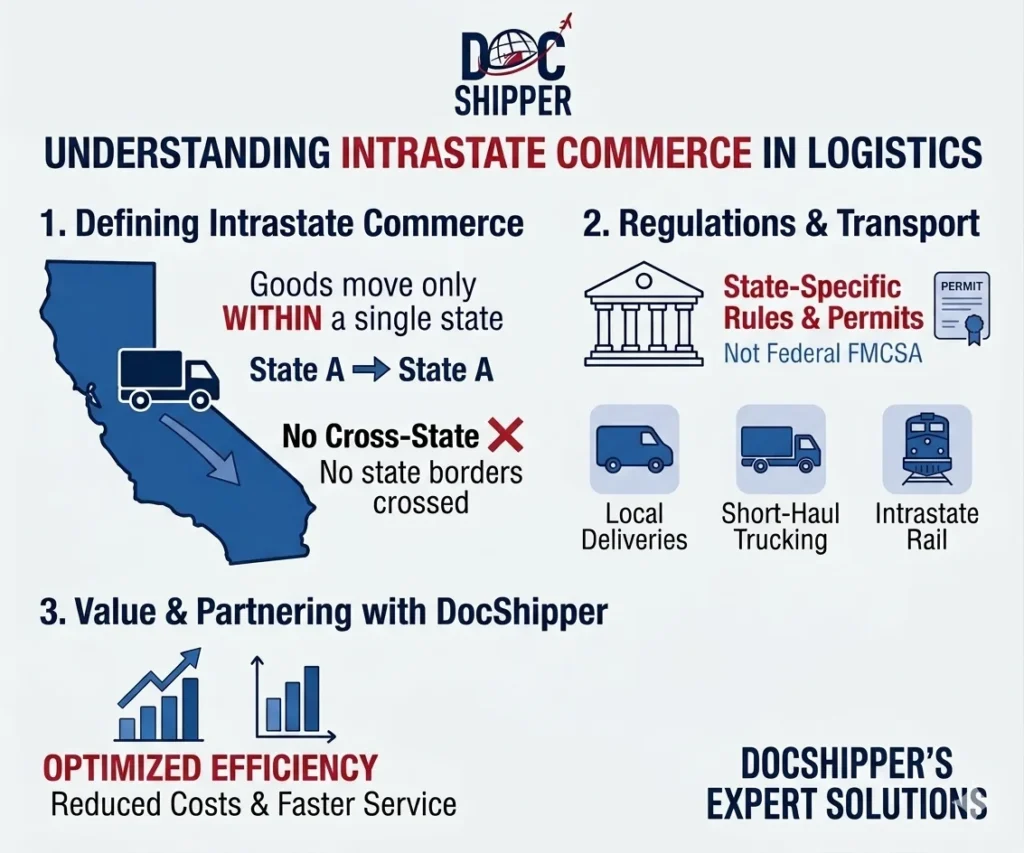
Intrastate commerce refers to the trade, transportation, or exchange of goods and services that occurs entirely within the boundaries of a single state or jurisdiction. Unlike interstate commerce, which crosses state lines and falls under federal regulation, intrastate commerce is primarily governed by state-level laws and regulations, making compliance simpler but requiring careful attention to local rules.
Introduction
Many logistics professionals mistakenly assume that all commercial transportation requires federal oversight. This confusion often leads to unnecessary compliance costs and operational delays. Understanding the distinction between intrastate and interstate commerce is crucial for optimizing supply chains and ensuring legal compliance.
In the logistics industry, intrastate commerce plays a vital role in regional distribution networks, local manufacturing supply chains, and state-specific retail operations. For businesses operating exclusively within one state, recognizing this classification can unlock significant advantages.
Key characteristics of intrastate commerce include:
- Geographic limitation: All activities occur within a single state’s borders
- State-level regulation: Governed primarily by state transportation and commerce laws
- Simplified documentation: Often requires less paperwork than interstate operations
- Local licensing requirements: Carriers need state-specific permits rather than federal authority
- Tax implications: Subject to state sales tax and local taxation rules
Regulatory Framework & Legal Implications
The legal framework governing intrastate commerce differs fundamentally from interstate operations. While interstate commerce falls under the Interstate Commerce Clause of the U.S. Constitution and is regulated by federal agencies like the Federal Motor Carrier Safety Administration (FMCSA), intrastate commerce remains within state jurisdiction.
Each state maintains its own Public Utilities Commission or equivalent body that establishes regulations for intrastate carriers. These agencies set requirements for vehicle safety, driver qualifications, insurance minimums, and operational permits. According to the FMCSA guidelines, carriers operating solely within state boundaries may be exempt from certain federal regulations, though they must still comply with state-level equivalents.
The distinction becomes particularly important for commercial motor vehicle operators. A driver transporting goods from Los Angeles to San Diego operates under California state regulations. However, if that same driver crosses into Nevada, the operation immediately becomes interstate and triggers federal oversight.
One critical aspect involves insurance requirements. Intrastate carriers typically need lower minimum coverage amounts compared to interstate operators. For example, federal law requires interstate carriers to maintain $750,000 in liability insurance for non-hazardous freight, while many states require only $300,000 to $500,000 for intrastate operations.
At DocShipper, we systematically verify state-specific requirements for our clients operating within single jurisdictions, ensuring full compliance while avoiding unnecessary federal filing costs. Understanding these nuances can save businesses thousands in annual regulatory expenses.
Practical Examples & Compliance Data
To illustrate how intrastate commerce functions in real-world logistics, consider these practical scenarios and comparative data.
Case Study: Regional Food Distribution
A dairy cooperative in Wisconsin operates 15 refrigerated trucks delivering milk and cheese products to retailers throughout the state. This operation qualifies as intrastate commerce. The company requires:
- Wisconsin motor carrier authority (not USDOT number)
- State-level insurance minimum of $500,000
- Compliance with Wisconsin Department of Transportation regulations
- Wisconsin sales tax collection and remittance
- State-specific driver qualification requirements
Annual compliance costs for this intrastate operation: approximately $8,000. If classified as interstate, costs would increase to roughly $18,000 due to federal filing requirements and higher insurance minimums.
Comparative Analysis: Intrastate vs. Interstate Requirements
| Requirement | Intrastate Commerce | Interstate Commerce |
|---|---|---|
| Regulatory Authority | State PUC/DOT | FMCSA (Federal) |
| Registration | State motor carrier permit | USDOT + MC number |
| Insurance Minimum | $300K-$500K (varies by state) | $750K-$5M (federal) |
| Hours of Service | State-specific rules | Federal HOS regulations |
| Annual Compliance Cost | $5K-$10K | $15K-$25K |
Key Operational Distinctions:
- Documentation simplicity: Intrastate shipments typically require 40% less paperwork than interstate movements
- Border considerations: Even temporary border crossings convert operations to interstate status
- State tax nexus: Intrastate commerce clearly establishes single-state tax obligations
- Exemption opportunities: Many states offer small carrier exemptions for local operations
- Competitive advantage: Lower compliance costs enable more competitive pricing for regional services
According to industry data, approximately 35% of commercial trucking operations in the United States qualify as purely intrastate, representing a significant portion of the logistics sector that operates under simplified regulatory frameworks.
Conclusion
Understanding intrastate commerce enables businesses to optimize regulatory compliance, reduce operational costs, and streamline regional logistics operations. Proper classification ensures legal compliance while avoiding unnecessary federal oversight expenses.
Need guidance on intrastate commerce regulations or supply chain optimization? Contact DocShipper for expert assistance tailored to your specific operational needs.
📚 Quiz
Test Your Knowledge: Intrastate Commerce
Question 1: Which statement correctly defines intrastate commerce?
Question 2: A carrier operating exclusively within California makes a single delivery to Nevada. What is the regulatory impact?
Question 3: What is a key operational advantage of intrastate commerce classification?
🎯 Your Result
📞 Free Quote in 24hFAQ | Intrastate Commerce: Definition, Regulation & Practical Examples
Intrastate commerce occurs entirely within one state's boundaries and is regulated by state authorities, while interstate commerce crosses state lines and falls under federal jurisdiction. This distinction determines which regulations apply, insurance requirements, and registration obligations. Intrastate operations typically face simpler compliance requirements and lower costs.
Generally, no. Most states do not require USDOT numbers for purely intrastate operations. However, you will need state-specific motor carrier authority or permits. Some states have exceptions for vehicles exceeding certain weight thresholds or carrying hazardous materials. Check your state's Department of Transportation requirements for specific guidance.
Yes, absolutely. If a carrier operating within one state makes even a single delivery across state lines, the entire operation becomes subject to interstate commerce regulations. This includes temporary border crossings for pickup or delivery. Once interstate status is triggered, federal compliance requirements immediately apply, including USDOT registration and federal insurance minimums.
Insurance requirements vary by state but typically range from $300,000 to $500,000 in liability coverage for non-hazardous freight. This is significantly lower than the federal interstate requirement of $750,000. States also set specific requirements for cargo insurance, which may differ from federal standards. Always verify your state's exact requirements with the relevant regulatory body.
Hours-of-service regulations for intrastate drivers are set by individual states and may differ significantly from federal rules. Many states adopt federal HOS regulations voluntarily, but some maintain their own standards with different driving limits, rest period requirements, and record-keeping obligations. Drivers must comply with their operating state's specific rules.
Yes, each state establishes its own weight limits for intrastate operations, which may differ from federal interstate limits. Some states allow heavier loads on state highways compared to federal interstate system limits. Texas, for example, permits higher gross vehicle weights on designated state routes for intrastate commerce compared to interstate highways.
Even accidental or brief border crossings convert your operation to interstate commerce, triggering federal compliance requirements. You would need proper federal authority, insurance, and documentation. To avoid this, plan routes carefully and understand where state boundaries exist. Some businesses maintain dual compliance status to handle occasional interstate needs.
Federal ELD mandates apply only to interstate carriers. However, many states have adopted similar ELD requirements for intrastate operations. Currently, about half of U.S. states require ELDs for commercial intrastate drivers. Check your state's specific regulations, as requirements continue to evolve and expand across jurisdictions.
Intrastate commerce creates clear nexus in a single state, requiring businesses to collect and remit sales tax according to that state's rules. This simplifies tax compliance compared to interstate commerce, which may trigger nexus requirements in multiple states. Intrastate sellers need only understand one state's tax structure, rates, and exemptions.
Yes, many carriers maintain dual operating authority to handle both types of commerce. This requires compliance with both state and federal regulations, maintaining appropriate registrations, and ensuring proper documentation for each shipment type. While more complex administratively, dual authority provides maximum operational flexibility and market access.
Penalties can be severe and include substantial fines from federal regulators, vehicle out-of-service orders, and potential criminal charges for willful violations. Fines typically range from $1,000 to $25,000 per violation. Additionally, insurance claims may be denied if operations exceeded policy coverage limitations, exposing businesses to significant liability.
Many states offer exemptions for small carriers operating within limited geographic areas or below certain revenue thresholds. These exemptions vary widely by state but commonly apply to vehicles under 10,000 pounds or carriers generating less than $500,000 annually. Exemptions may reduce registration requirements and insurance minimums but don't eliminate all regulatory obligations.
Need Help with
Logistics or Sourcing ?
First, we secure the right products from the right suppliers at the right price by managing the sourcing process from start to finish. Then, we simplify your shipping experience - from pickup to final delivery - ensuring any product, anywhere, is delivered at highly competitive prices.


Fill the Form
Prefer email? Send us your inquiry, and we’ll get back to you as soon as possible.
Contact us




