


In short ⚡
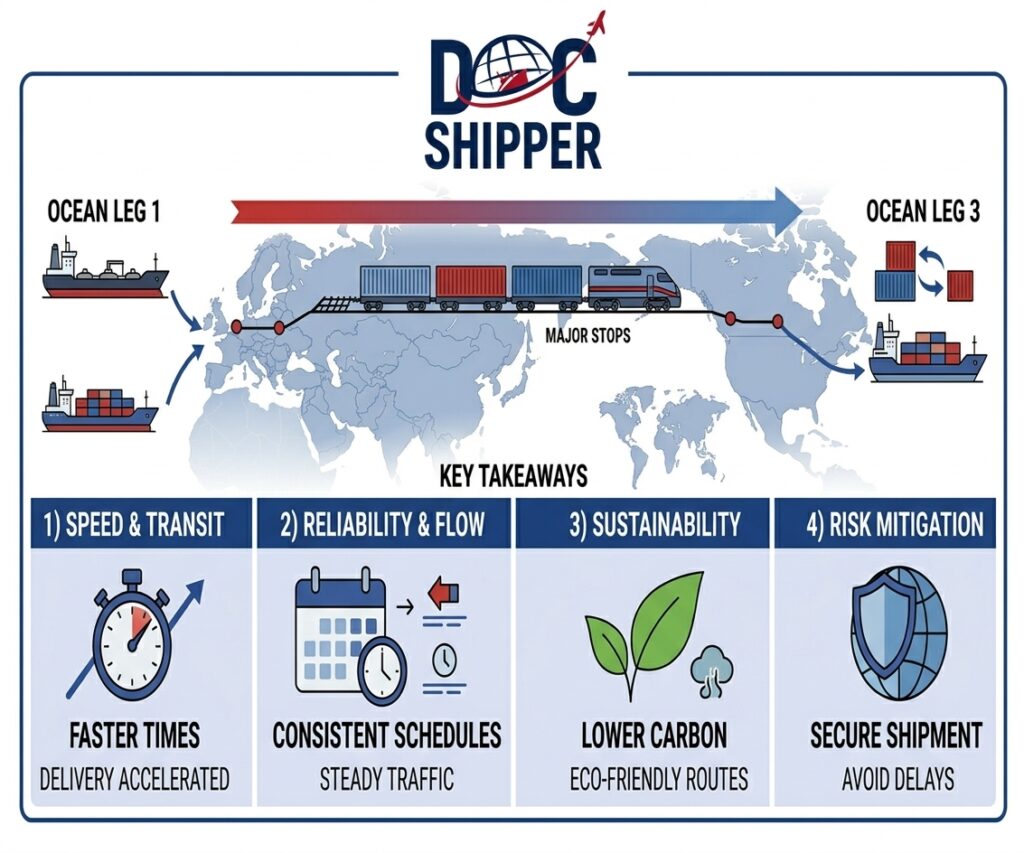
A land bridge is an intermodal transport route combining sea and rail/road segments across a continental landmass, connecting two oceanic regions. This logistics strategy reduces transit time and costs compared to all-water routes, enabling faster cargo movement between distant markets while maintaining competitive freight rates.
Introduction
When shipping cargo from Asia to Europe or vice versa, businesses face a critical choice: use traditional all-water routes through the Suez Canal, or leverage transcontinental rail corridors that dramatically cut transit times. This dilemma highlights the strategic importance of land bridge solutions in modern supply chain management.
Land bridges have revolutionized international freight by offering a middle ground between expensive air cargo and slow ocean transport. They exploit geographic advantages, particularly in North America and Eurasia, where rail infrastructure connects major ports across vast territories.
Key characteristics of land bridge logistics:
- Intermodal integration: Seamless transfer between ocean vessels, trains, and trucks
- Time savings: Typically 7-15 days faster than all-water alternatives
- Cost efficiency: 30-50% cheaper than air freight for similar transit speeds
- Flexibility: Multiple routing options with varying speed/cost profiles
- Reduced canal dependency: Avoids congestion at Suez or Panama
Types of Land Bridges & Strategic Advantages
Three distinct land bridge configurations serve global trade, each with specific operational characteristics and regulatory frameworks. Understanding these variants enables optimal route selection based on cargo urgency, budget constraints, and destination markets.
The American Land Bridge (ALB) connects Asian ports with U.S. East Coast destinations via West Coast ports and transcontinental rail. Cargo arrives at Los Angeles or Seattle, then travels by double-stack trains to New York or other Atlantic hubs. This route saves approximately 10 days compared to Panama Canal transit, making it ideal for time-sensitive containerized goods.
The Siberian Land Bridge (SLB) or Trans-Siberian Railway links Asian manufacturing centers with European markets through Russian territory. Spanning over 9,000 kilometers from China to Europe, this route reduces ocean transit by 15-20 days compared to Suez Canal routing. However, geopolitical considerations and customs complexity require careful planning. According to World Trade Organization data, this corridor handles significant electronics and automotive components traffic.
The China-Europe Railway Express (also called New Silk Road or Belt and Road rail corridor) represents the modern evolution of land bridge concepts. With multiple entry points through Kazakhstan, Mongolia, and Russia, this network offers flexible routing options and competitive pricing. Transit times average 14-18 days from Chinese manufacturing hubs to European distribution centers.
The Mini Land Bridge (MLB) concept applies when cargo originates and terminates within the same continent but uses a transcontinental rail segment. For instance, Asian goods destined for U.S. Midwest markets arrive on the West Coast and rail directly inland, avoiding costly trucking or coastal shipping.
At DocShipper, we evaluate land bridge viability based on your specific cargo profile, considering factors like customs documentation requirements, seasonal weather impacts on rail operations, and real-time port congestion data to recommend the most efficient routing solution.
Practical Examples & Comparative Data
Real-world applications demonstrate how land bridges transform supply chain economics. A European electronics retailer importing components from Shenzhen faces three primary routing options, each with distinct cost and time implications.
| Route | Transit Time | Cost per TEU | Best For |
|---|---|---|---|
| All-Water (Suez Canal) | 35-40 days | $2,500-$3,200 | High-volume, low-urgency |
| Trans-Siberian Rail | 18-22 days | $4,500-$5,800 | Balanced speed/cost |
| Air Freight | 5-7 days | $18,000-$25,000 | Critical, high-value goods |
For a pharmaceutical company shipping temperature-controlled vaccines from New Jersey to Tokyo, the American Land Bridge reverse routing provides unexpected advantages. Rather than direct ocean transit from East Coast ports, cargo trains to Los Angeles, then ships across the Pacific. Total transit time: 16 days versus 21 days via Panama Canal, with 22% cost savings on refrigerated container rates.
Case study highlights from 2023 industry data:
- Automotive parts: German manufacturers using China-Europe Railway reduced inventory holding costs by $1.2M annually through faster replenishment cycles
- Consumer electronics: 34% of Apple suppliers switched to Trans-Siberian routing during pandemic-related port congestion
- Fashion retail: Fast-fashion brands achieved 40% faster market responsiveness using Mini Land Bridge to U.S. regional distribution centers
- Machinery exports: Heavy equipment shippers saved $8,000 per FEU (40-foot container) using American Land Bridge versus all-water Panama routing
- Perishables: Agricultural exporters maintained 98% quality retention using refrigerated land bridge versus 89% on longer ocean voyages
Seasonal variations significantly impact land bridge performance. Winter operations on Trans-Siberian routes may add 2-3 days due to extreme weather protocols, while summer typhoon season in the Pacific makes land bridge alternatives more attractive for Asia-Europe flows.
Conclusion
Land bridge strategies represent essential tools for optimizing international logistics, offering speed advantages over ocean and cost benefits compared to air freight. The choice between all-water routes and land bridge alternatives depends on cargo characteristics, market timing requirements, and total landed cost calculations.
Need expert guidance on selecting the optimal land bridge routing for your shipments? Contact DocShipper for customized logistics solutions that balance speed, cost, and reliability.
📚 Quiz
Test Your Knowledge: Land Bridge
What is the primary defining characteristic of a land bridge in international logistics?
Which statement correctly describes the typical transit time and cost advantage of land bridges?
A European electronics retailer needs to import components from Shenzhen with moderate urgency and cost-consciousness. According to the comparative data, which routing offers the best balance?
🎯 Your Result
📞 Free Personalized QuoteFAQ | Land Bridge: Definition, Types & Practical Examples in International Logistics
A land bridge specifically refers to transcontinental rail segments connecting two ocean regions, forming a continuous international route. Traditional intermodal may involve shorter domestic rail or truck segments without the oceanic connection component. Land bridges are strategic routing alternatives to all-water paths, while intermodal is simply a transport method combining multiple modes.
Land bridge cargo undergoes customs clearance at the entry port, receives inland transit authorization, then clears again at the exit port or destination country. Documentation like T1 (Europe) or IT (In-Transit) bonds facilitate this process. Goods remain under customs supervision throughout the land segment, requiring proper sealing and tracking to maintain duty-free status during transcontinental movement.
Reliability depends on carrier selection, season, and cargo type. Established operators provide consistent 18-22 day transit with tracking systems and insurance options. However, geopolitical tensions, winter weather delays, and customs bureaucracy can introduce variability. Experienced freight forwarders maintain contingency routing and proactive communication to mitigate these risks for time-sensitive shipments.
High-value electronics, automotive components, fashion merchandise, and industrial equipment gain maximum advantage due to their sensitivity to transit time and inventory costs. Perishables benefit from reduced voyage duration. However, heavy bulk commodities or low-value goods rarely justify the premium over all-water routing. The decision threshold typically centers on whether time savings offset the 40-80% cost increase versus ocean-only transport.
Yes, but with limitations. American and Siberian rail systems accommodate flat racks, open tops, and specialized heavy-haul equipment. Maximum dimensions vary by corridor: North American double-stack trains handle containers up to 4.3m height, while Siberian routes accept larger individual pieces. Weight restrictions typically cap at 80-100 metric tons per railcar, requiring engineering assessments for exceptional loads.
Land bridge rates typically run 15-40% higher than Panama Canal all-water routes for equivalent origin-destination pairs. However, faster transit reduces inventory financing costs, potential obsolescence, and enables higher inventory turns. Total landed cost analysis often favors land bridges for goods with high carrying costs or rapid market depreciation, despite higher freight rates.
Essential documents include: bill of lading (through or combined), commercial invoice, packing list, certificates of origin, customs transit bonds, rail waybills, and marine insurance certificates. Land bridge shipments require precise HS code classification since cargo crosses multiple jurisdictions. Temperature-controlled goods need additional cold chain documentation and sensor data logs to prove continuous compliance.
Rail transport generates approximately 70-80% less CO2 per ton-kilometer than ocean vessels and 90% less than air freight. However, total emissions depend on route efficiency and rail energy sources. Electrified European rail offers maximum sustainability, while diesel-powered American transcontinental segments provide moderate benefits. Companies pursuing carbon neutrality increasingly factor these differences into modal selection decisions.
Liability follows the transport convention governing each leg: Hague-Visby Rules for ocean, CMR or national rail regulations for land segments. Through bills of lading from a single carrier simplify claims by establishing one responsible party. Comprehensive cargo insurance is essential since proving where damage occurred across multiple modes and jurisdictions can be complex. Document container condition at each transfer point with photos and seal verification.
Yes, when transitioning from air to rail-based land bridges. Companies face increasing pressure to report Scope 3 emissions, and substituting air freight with land bridge options can reduce reported transport emissions by 85-90%. However, transparency requires accurate data from carriers regarding energy sources and load factors. Third-party verification through platforms like Smart Freight Centre ensures credible sustainability claims.
Decision factors include: cargo urgency (how much premium justifies time savings), value density (high-value goods absorb transport costs better), volume consistency (regular shipments justify routing optimization), seasonal timing (weather impacts specific corridors), and total supply chain costs (inventory, obsolescence, stockout risks). Experienced freight forwarders model these variables using your specific parameters to recommend optimal routing that balances competing priorities.
Key trends include: expansion of China-Europe rail corridors with additional route redundancy, electrification of North American rail reducing carbon intensity, digital customs platforms enabling faster border processing, and autonomous train technology improving schedule reliability. Geopolitical realignments may shift traffic between corridors, while climate-related disruptions to ocean routes (Arctic ice melt, Panama Canal drought) could increase land bridge attractiveness for certain trade lanes.
Need Help with
Logistics or Sourcing ?
First, we secure the right products from the right suppliers at the right price by managing the sourcing process from start to finish. Then, we simplify your shipping experience - from pickup to final delivery - ensuring any product, anywhere, is delivered at highly competitive prices.


Fill the Form
Prefer email? Send us your inquiry, and we’ll get back to you as soon as possible.
Contact us




