


In short ⚡
Days of Inventory (DOI), also called Days Inventory Outstanding or Days Sales of Inventory (DSI), is a financial metric measuring the average number of days a company holds inventory before converting it into sales. It quantifies inventory turnover efficiency and working capital management in logistics operations.Introduction
Many importers struggle with a common dilemma: holding too much inventory ties up capital, yet insufficient stock causes stockouts and lost sales. Days of Inventory provides the answer by revealing exactly how long goods sit in your warehouse before reaching customers.
In international trade, this metric becomes even more critical. Long lead times from overseas suppliers, customs delays, and seasonal demand fluctuations make inventory optimization a strategic imperative rather than a simple accounting exercise.
- Measures operational efficiency by tracking inventory velocity through the supply chain
- Directly impacts cash flow management and working capital requirements
- Reveals potential issues with overstocking, obsolescence, or demand forecasting
- Enables comparison across competitors and industry standards
- Influences decisions on warehouse sizing, purchasing frequency, and supplier terms
Understanding DOI Mechanics & Strategic Implications
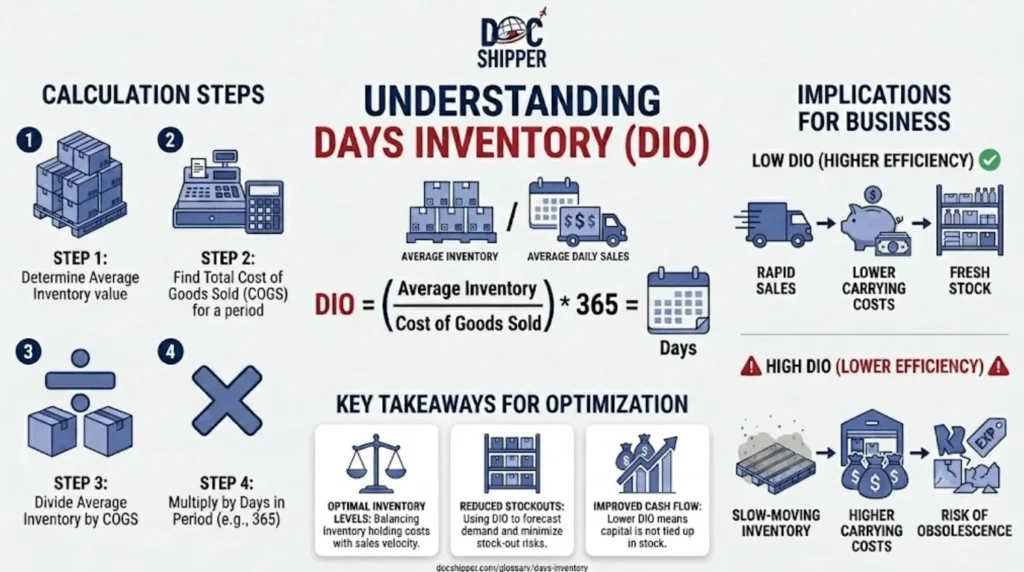
The Days of Inventory calculation reveals how efficiently a company converts raw materials or finished goods into revenue. A lower DOI indicates faster inventory turnover, meaning products move quickly from warehouse to customer. Conversely, higher DOI suggests slower movement, potentially signaling demand issues or purchasing inefficiencies.
From a logistics perspective, DOI directly influences warehouse costs, insurance premiums, and obsolescence risk. Perishable goods, fashion items, and technology products face particularly high risks with extended DOI periods. Each additional day inventory sits increases storage fees while products lose value through depreciation or market shifts.
International traders face unique challenges. Maritime shipments from Asia to Europe typically require 30-45 days transit time. Adding customs clearance, inland transport, and safety stock considerations, importers often maintain 60-90 days of inventory. This extended DOI requires careful cash flow planning and creates vulnerability to demand fluctuations.
The metric also reveals supply chain vulnerabilities. Companies with exceptionally low DOI may operate just-in-time systems that minimize storage costs but increase supply disruption risks. The COVID-19 pandemic demonstrated this fragility when lean inventories couldn’t absorb sudden demand spikes or supplier shutdowns.
At DocShipper, we help clients optimize their DOI by coordinating faster customs clearance, consolidating shipments to reduce lead times, and implementing inventory visibility systems. Our experience shows that reducing DOI by even 10-15 days can free substantial working capital while maintaining service levels.
Regulatory compliance also connects to DOI management. The European Union customs procedures require accurate inventory records for duty calculations, particularly under customs warehousing arrangements where duties are suspended until goods enter free circulation.
Calculation Methods & Industry Benchmarks
The standard formula for Days of Inventory calculates the metric using either Cost of Goods Sold (COGS) or revenue as the denominator:
DOI = (Average Inventory / Cost of Goods Sold) × 365
Average Inventory is calculated as: (Beginning Inventory + Ending Inventory) / 2. This smooths seasonal fluctuations and provides a more representative figure than a single point-in-time measurement.
| Industry Sector | Average DOI | Characteristics |
|---|---|---|
| Grocery Retail | 30-40 days | Perishable goods, high turnover, frequent deliveries |
| Fashion/Apparel | 80-120 days | Seasonal collections, style obsolescence risk |
| Electronics | 45-60 days | Rapid product cycles, depreciation concerns |
| Automotive Parts | 60-90 days | SKU complexity, service level requirements |
| Pharmaceutical | 90-150 days | Regulatory compliance, batch tracking, expiration management |
Practical Case Study: A European electronics importer sources smartphones from China with the following annual figures:
- Average Inventory Value: €2,500,000
- Annual Cost of Goods Sold: €18,000,000
- Calculation: (€2,500,000 / €18,000,000) × 365 = 50.7 days
This 51-day DOI means the company holds roughly 7 weeks of inventory. Given a 35-day ocean transit from Shenzhen to Rotterdam plus 5-7 days customs clearance, the company maintains approximately 2 weeks of safety stock. This balance protects against minor supply disruptions without excessive capital tie-up.
If the company reduced DOI to 40 days, it would free approximately €500,000 in working capital (€2,500,000 × 20% reduction). However, this requires more frequent shipments, potentially increasing per-unit logistics costs and supply chain risk exposure.
The inverse metric, Inventory Turnover Ratio, provides complementary insights: Turnover = 365 / DOI. In this example: 365 / 51 = 7.2 times annually. This means the company completely cycles through its inventory roughly every 7 weeks.
Conclusion
Days of Inventory serves as a critical barometer for supply chain health, balancing the competing demands of capital efficiency and operational resilience. Optimizing this metric requires understanding your specific industry dynamics, lead times, and risk tolerance.
Need expert guidance on optimizing your inventory management and international logistics? Contact DocShipper for tailored solutions that reduce DOI while maintaining service levels.
📚 Quiz
Test Your Knowledge: Days of Inventory
What does Days of Inventory (DOI) primarily measure?
A company has DOI of 25 days in the grocery retail sector. What does this indicate?
An electronics importer sources from China with €2.5M average inventory and €18M annual COGS. Should they calculate DOI using revenue instead of COGS to show better performance?
🎯 Your Result
📞 Free Quote in 24hFAQ | Days of Inventory: Definition, Calculation & Concrete Examples
Days of Inventory measures time (how many days inventory sits), while Inventory Turnover measures frequency (how many times inventory cycles annually). They're mathematical inverses: Turnover = 365 / DOI. Both reveal efficiency but from different perspectives—time versus cycles.
Not necessarily. Extremely low DOI increases stockout risks, forces frequent small shipments (raising logistics costs), and reduces negotiating power with suppliers. The optimal DOI balances working capital efficiency against operational resilience and total supply chain costs.
Inventory "in transit" typically counts toward your total inventory until goods reach your warehouse. For ocean freight (30-45 days), this significantly inflates DOI. Some companies exclude in-transit inventory to measure warehouse efficiency separately, but standard accounting includes all owned goods regardless of location.
Always use Cost of Goods Sold (COGS) for accurate DOI measurement. Using revenue inflates the denominator, artificially lowering DOI. Since inventory is valued at cost, COGS provides the appropriate comparison basis. Revenue-based calculations compare unlike values and distort the metric.
Monthly calculations reveal trends and seasonal patterns. Quarterly reviews align with financial reporting cycles. Annual figures smooth volatility but miss emerging issues. High-velocity businesses benefit from weekly tracking, while slower-moving industries can rely on monthly assessments supplemented by quarterly deep dives.
This varies dramatically by industry. Grocery retailers target 30-40 days due to perishability. Luxury goods may maintain 120+ days to showcase extensive selection. Compare your DOI against direct competitors and industry benchmarks rather than absolute standards. Improvement matters more than arbitrary targets.
Seasonal businesses experience significant DOI fluctuations. Retailers build inventory before holiday periods, spiking DOI by 50-100%. Post-season, DOI drops as excess inventory clears. Use rolling 12-month averages to normalize seasonal effects when comparing year-over-year performance or benchmarking against competitors.
Yes. Excessively low DOI signals potential stockout risks, customer dissatisfaction, and lost sales. During the 2020-2021 supply crisis, companies with ultra-lean inventories couldn't fulfill orders when suppliers faced disruptions. Adequate safety stock—reflected in slightly higher DOI—provides essential business continuity insurance.
Goods in bonded customs warehouses remain in your inventory count but duty payments are deferred. This arrangement can extend DOI while preserving cash flow, particularly for high-duty products. However, warehouse fees accumulate daily, so the extended DOI must justify the storage costs versus immediate customs clearance.
Days of Inventory directly consumes working capital. Each day inventory sits represents invested cash not available for other purposes. Reducing DOI by 15 days on €3 million average inventory frees approximately €123,000 in working capital (€3M × 15/365), improving financial flexibility and potentially reducing financing costs.
Implement demand forecasting systems, negotiate faster supplier lead times, use air freight for high-value items, adopt vendor-managed inventory arrangements, improve sales data visibility, reduce SKU complexity, and establish safety stock formulas based on demand variability. Gradual DOI reduction with continuous monitoring minimizes disruption risks.
Standard DOI calculations include all inventory categories: raw materials, work-in-progress (WIP), and finished goods. Manufacturers may calculate separate metrics for each category to identify specific bottlenecks. Importers dealing primarily with finished goods typically focus on finished goods DOI, as WIP is less relevant to their operations.
Need Help with
Logistics or Sourcing ?
First, we secure the right products from the right suppliers at the right price by managing the sourcing process from start to finish. Then, we simplify your shipping experience - from pickup to final delivery - ensuring any product, anywhere, is delivered at highly competitive prices.


Fill the Form
Prefer email? Send us your inquiry, and we’ll get back to you as soon as possible.
Contact us




