


In short ⚡
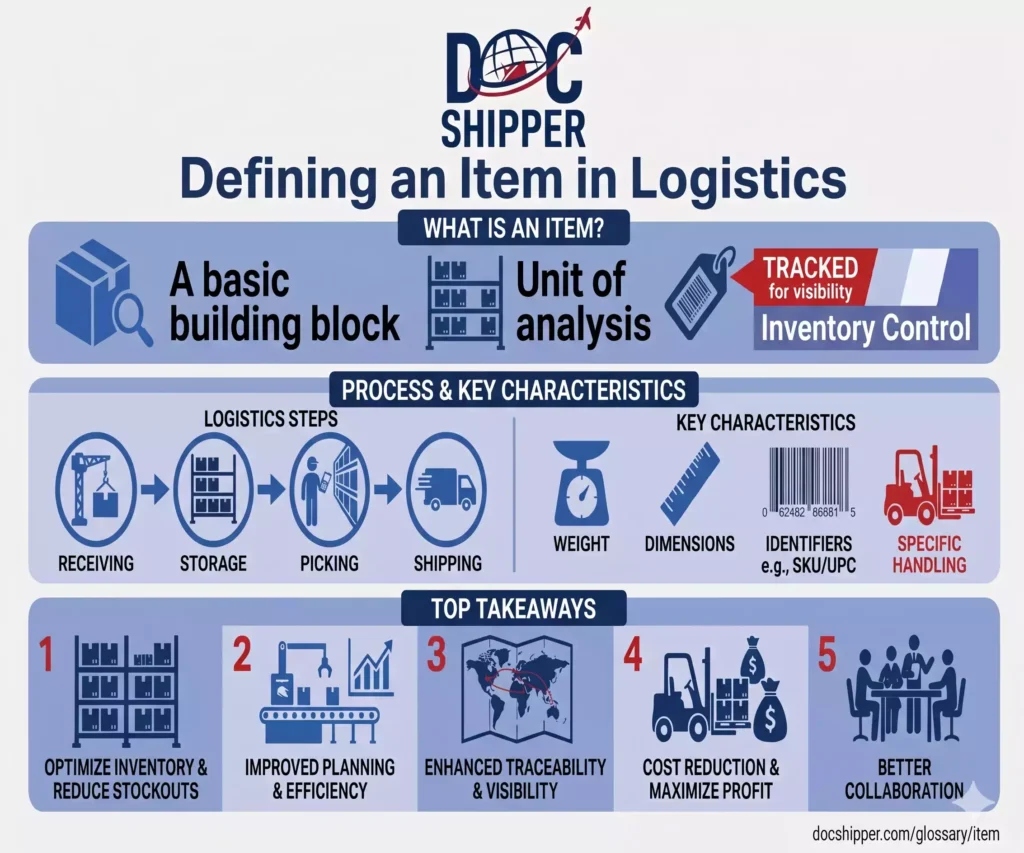
Item refers to an individual unit or distinct product within a shipment, inventory system, or commercial transaction. In international logistics, each item represents a separately identifiable good with unique characteristics, HS codes, and commercial value, forming the fundamental counting unit for customs declarations, warehouse management, and freight documentation.Introduction
Confusion often arises between “items,” “SKUs,” “packages,” and “shipments” in international trade. A container might hold one shipment, containing multiple packages, each containing numerous items. This distinction is critical because customs authorities assess duties per item classification, warehouses track inventory by item count, and freight forwarders calculate handling fees based on item complexity.
Understanding what constitutes an individual item impacts every stage of the supply chain—from purchase order accuracy to final delivery confirmation. Misclassifying items can trigger customs delays, incorrect duty payments, or warehouse discrepancies.
Key characteristics defining items in logistics:
- Unique identification: Each item requires distinct description, value, and HS code
- Customs relevance: Every item must be declared individually on commercial invoices
- Inventory tracking: Warehouse systems count items separately from packaging units
- Commercial valuation: Items carry individual unit prices affecting total shipment value
- Regulatory compliance: Certain items require specific licenses regardless of quantity
Item Classification & Logistics Complexity
The challenge in item management stems from the intersection of commercial product definition and regulatory classification systems. A “set” in retail terminology might constitute a single SKU but multiple items for customs purposes. A smartphone sold with charger and earbuds represents three distinct items requiring separate HS codes and country-of-origin declarations.
International trade operates on the Harmonized System (HS) classification, which categorizes items into over 5,000 commodity groups. Each item entering customs territory must be assigned a 6-digit HS code minimum, extended to 8-10 digits depending on national tariff schedules. This classification determines applicable duty rates, import restrictions, and documentation requirements.
The item-level detail requirement varies by country and shipment type. The United States requires full item-level declarations for all commercial shipments exceeding $800. The European Union mandates detailed item descriptions including materials, intended use, and brand names. According to World Customs Organization data, over 200 countries use HS codes for customs processing, making accurate item classification a universal requirement.
Item complexity escalates with composite products. A laptop contains hundreds of components but typically counts as one item for shipping purposes. However, if shipped disassembled for manufacturing, each major component (screen, motherboard, battery) becomes a separate item requiring individual classification. The General Rules for Interpretation (GRI) provide guidance, but practical application often requires expert judgment.
At DocShipper, we systematically verify item classifications against the latest tariff schedules to prevent misclassification penalties. Our customs brokerage team reviews every commercial invoice to ensure item descriptions meet destination country requirements, avoiding clearance delays caused by inadequate product detail.
Critical item management considerations include:
- Unit of measure standardization: Items must use consistent measurement units (pieces, kilograms, liters)
- Brand and model identification: Many countries require item-level trademark and model number disclosure
- Material composition: Items containing restricted materials need detailed component breakdowns
- Valuation accuracy: Each item’s declared value must reflect actual transaction price
- Certificate requirements: Certain items trigger mandatory testing or certification regardless of shipment size
Practical Examples & Data Management
Understanding item counting methodology prevents operational errors. Consider a furniture importer receiving a shipment from Vietnam. The commercial reality versus customs classification often differs significantly:
| Commercial Description | Physical Packages | Customs Items | HS Codes Required |
|---|---|---|---|
| Dining table set | 5 cartons | 7 items (1 table + 6 chairs) | 2 codes (table/chairs) |
| Office desk assembly | 3 cartons | 1 item (furniture set) | 1 code |
| Mixed electronics order | 1 pallet | 50 items (various products) | 15 codes |
| Promotional gift kits | 20 boxes | 200 items (20 × 10 pieces) | 5 codes (per kit component) |
Real-world scenario: An e-commerce business imports 10,000 phone cases in a single container. From a freight perspective, this might be 100 cartons. For inventory management, it’s 10,000 SKU units. For customs, the declaration complexity depends on variety—if all identical, it’s effectively one item line with quantity 10,000. If assorted designs and materials exist, each variation becomes a separate item requiring individual classification.
The item-level data requirement becomes critical for regulatory compliance. The U.S. Customs and Border Protection (CBP) entry type 86 allows simplified clearance for shipments under $800, but requires complete item descriptions including country of origin, value, and HS code. According to CBP processing statistics, inadequate item detail causes approximately 15% of entry rejections, leading to demurrage charges and delivery delays.
Item management challenges in specialized sectors:
- Pharmaceutical imports: Each drug formulation counts as distinct item requiring batch numbers and expiration dates
- Food products: Items need ingredient lists, allergen declarations, and nutritional information per SKU
- Textile shipments: Garments require fiber content percentages and care instructions per item type
- Machinery parts: Components need technical specifications, compatibility data, and end-use declarations
- Retail assortments: Mixed cartons require detailed packing lists with item-level breakdowns
Modern warehouse management systems (WMS) track items through unique identifiers like GTINs, UPCs, or internal SKU codes. When goods arrive, receiving processes verify physical item counts against advance shipping notices. Discrepancies between expected and actual item quantities trigger investigation procedures, preventing inventory inaccuracies that cascade through order fulfillment operations.
Conclusion
Mastering item-level logistics management ensures regulatory compliance, inventory accuracy, and operational efficiency throughout the international supply chain. Precise item classification and documentation prevent costly delays while enabling smooth customs clearance and warehouse processing.
Need assistance with item classification or customs documentation? Contact DocShipper for expert guidance tailored to your specific shipping requirements.
📚 Quiz
Test Your Knowledge: Item Classification in International Logistics
1. In international logistics, what fundamentally defines an "item"?
2. A retailer imports a "dining table set" shipped in 5 cartons containing 1 table and 6 chairs. How should this be counted for customs purposes?
3. An importer declares mixed electronics as "assorted goods" without detailed item breakdown. What is the likely outcome?
🎯 Your Result
📞 Free Quote in 24hFAQ | Item: Definition, Classification & Practical Examples in Logistics
An item is a physical unit in a shipment, while a SKU (Stock Keeping Unit) is an inventory tracking code. One SKU might represent thousands of identical items. For customs purposes, identical items under one SKU typically appear as a single line entry with quantity specified, whereas different SKUs always constitute separate item declarations.
Count items based on customs requirements rather than commercial packaging. A gift set containing a mug, coaster, and spoon represents three items for declaration purposes even if sold as one retail unit. Check destination country customs guidelines—some allow set classification under a single HS code, while others require component-level breakdown.
Yes, samples are items requiring customs declaration with accurate descriptions and values. Even "no commercial value" samples need proper documentation including intended use and disposition plans. Many countries limit duty-free sample quantities, so exceeding thresholds triggers normal import procedures despite sample designation.
Item count discrepancies can cause clearance delays, penalty assessments, or shipment examinations. Customs authorities may require physical verification, generating storage fees and demurrage charges. Persistent inaccuracies damage importer reputation and increase future inspection likelihood. Always verify item counts match physical goods before declaration submission.
It depends on whether accessories are essential to product function and shipped together. A camera with lens typically counts as one item. A camera with separately packaged tripod constitutes two items. Customs classification rules determine when component grouping is acceptable versus when individual item declaration is mandatory.
Item descriptions must enable customs officers to classify goods without ambiguity. Minimum requirements include product name, material composition, intended use, and brand/model when applicable. Vague terms like "assorted goods" or "spare parts" are unacceptable. Provide specific details: "cotton men's t-shirts, size L, crew neck" rather than just "clothing."
Promotional materials included with commercial shipments are individual items requiring declaration with assigned values, even if provided free to customers. Customs assesses duties on total shipment value including promotional goods. Some countries impose minimum valuations on promotional items to prevent duty avoidance through undervaluation schemes.
An item line is one entry on a commercial invoice or packing list, which might represent multiple identical units. Item count is the total quantity of physical pieces. A shipment with 5 item lines totaling 500 item count means five different product types with 500 total units distributed across those categories.
Damaged items discovered during inspection should be noted on receiving documents but still count toward total item quantity for customs reconciliation. If filing insurance claims or requesting duty refunds, damaged item counts require separate documentation including photographic evidence and condition reports specifying extent of damage per affected unit.
Physical media containing digital content (USB drives, DVDs) are tangible items requiring normal customs procedures. Pure digital deliveries (downloads, cloud access) generally don't undergo traditional customs clearance but may trigger VAT/GST collection depending on destination country regulations and delivery method employed.
Customs regulations prohibit vague groupings. Each distinct product type requires separate item line declaration with specific description, value, and classification code. While items may physically ship together, documentation must itemize contents. Failure to provide detailed breakdowns causes clearance rejections and potential penalty assessments for incomplete declarations.
Transport mode doesn't change item definition—it remains any distinct unit requiring individual declaration. However, air cargo documentation often demands more granular item detail due to security requirements and dimensional weight calculations, while ocean freight focuses on container-level summaries with detailed packing lists supporting customs entries upon arrival.
Need Help with
Logistics or Sourcing ?
First, we secure the right products from the right suppliers at the right price by managing the sourcing process from start to finish. Then, we simplify your shipping experience - from pickup to final delivery - ensuring any product, anywhere, is delivered at highly competitive prices.


Fill the Form
Prefer email? Send us your inquiry, and we’ll get back to you as soon as possible.
Contact us




