


In short ⚡
Inherent vice refers to the natural tendency of goods to deteriorate, decay, or self-destruct due to their internal characteristics, without external intervention. This intrinsic quality makes certain products particularly vulnerable during international transport, requiring specialized handling and insurance coverage. Understanding inherent vice is crucial for proper cargo risk assessment and logistics planning.
Introduction
Many importers mistakenly believe that standard cargo insurance covers all types of damage during shipment. However, losses caused by inherent vice are typically excluded from basic marine insurance policies, creating significant financial exposure for unprepared businesses.
In international trade, recognizing products with inherent vice determines packaging requirements, transportation methods, and insurance strategies. Goods ranging from fresh produce to chemicals possess internal characteristics that make them prone to spontaneous deterioration, regardless of handling quality.
Key aspects of inherent vice include:
- Self-destructive nature: Damage occurs from within the product itself, not from external factors
- Predictable deterioration: The decay or damage follows known patterns based on the goods’ characteristics
- Insurance implications: Standard cargo policies exclude inherent vice unless specifically endorsed
- Preventive measures: Specialized packaging, temperature control, and expedited transit can mitigate risks
- Legal significance: Inherent vice affects liability allocation between shippers, carriers, and consignees
Understanding Inherent Vice in Logistics
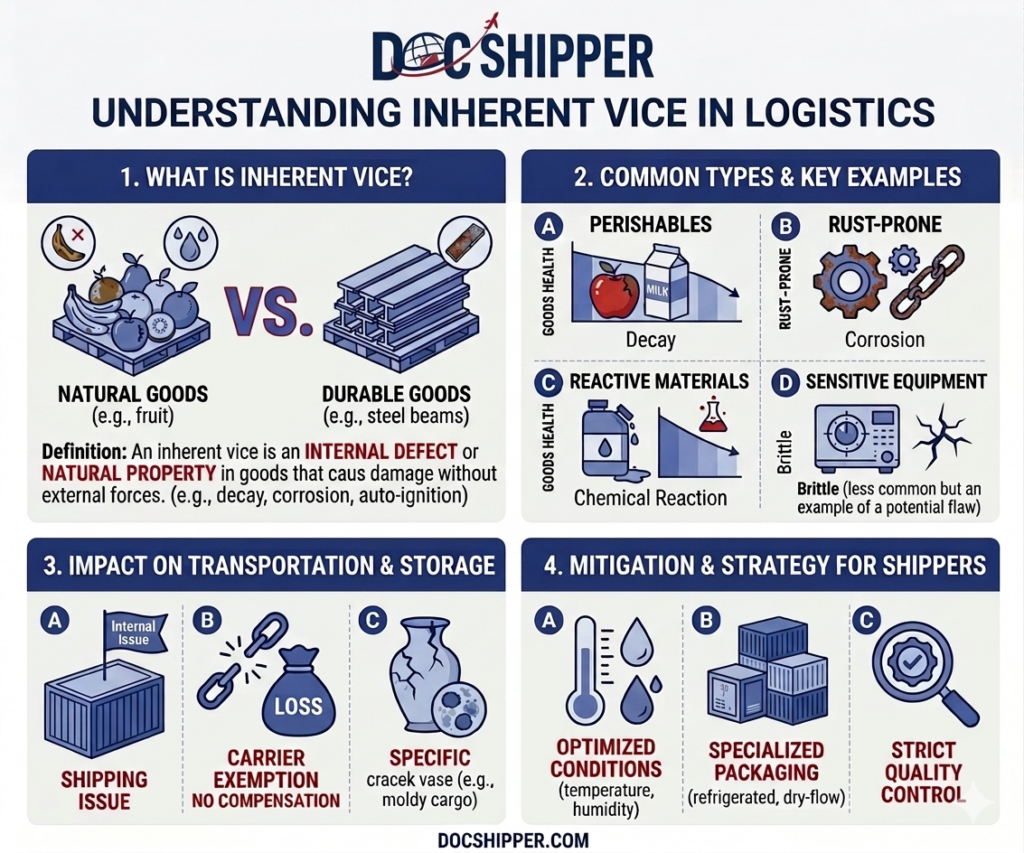
The concept of inherent vice originates from maritime law and has become a cornerstone principle in cargo insurance. Unlike external perils such as theft or collision, inherent vice stems from the goods’ natural composition and chemical or biological processes.
From a legal perspective, the Marine Insurance Act of 1906 specifically excludes inherent vice from insured perils. This exclusion reflects the principle that insurers cannot be held responsible for losses that are certain to occur due to the nature of the goods themselves.
Perishable goods represent the most common category affected by inherent vice. Fresh fruits, vegetables, meat, and dairy products naturally decompose through bacterial action and enzymatic processes. Even with refrigeration, these items have limited shelf life and will eventually deteriorate.
Hygroscopic materials like salt, sugar, and certain chemicals naturally absorb moisture from the atmosphere. This absorption can cause clumping, liquefaction, or chemical reactions that damage the cargo. The process occurs regardless of packaging quality if exposure time is sufficient.
Combustible substances such as coal, fertilizers, and certain organic materials can spontaneously ignite under specific conditions. The heat generated by oxidation processes within bulk cargoes can reach critical temperatures without any external ignition source.
At DocShipper, we systematically assess inherent vice risks during shipment planning, recommending appropriate packaging and transit solutions to minimize foreseeable deterioration before goods leave origin.
Temperature-sensitive pharmaceuticals and biologicals require strict cold chain management, as their chemical composition degrades outside specific temperature ranges. This degradation is inherent to the molecular structure of these products rather than caused by mishandling.
Practical Examples & Risk Assessment
Understanding inherent vice through concrete scenarios helps logistics professionals identify vulnerable shipments and implement preventive measures. The following examples illustrate how different product categories manifest inherent vice during international transport.
| Product Category | Inherent Vice Type | Typical Loss Rate | Mitigation Strategy |
|---|---|---|---|
| Fresh Bananas | Ripening & decay | 5-15% | Reefer containers at 13-14°C |
| Raw Leather | Bacterial putrefaction | 10-20% | Salt curing + rapid transit |
| Coal (Bulk) | Spontaneous combustion | 0.1-2% | Moisture control + ventilation |
| Rubber Products | Oxidation hardening | 3-8% | UV-blocking packaging |
| Vaccines | Protein denaturation | 20-40% (if temp breaks) | Cold chain + data loggers |
Use Case: Electronics Manufacturing
A European electronics manufacturer ships lithium batteries to North America. These batteries contain chemicals that can react exothermically under certain conditions. Despite proper packaging, internal short circuits occurred in 0.5% of units during a 30-day sea voyage, causing localized heating and damage to adjacent units.
Analysis revealed that the thermal runaway was caused by inherent electrochemical instability in the battery cells themselves, not by external shock or moisture. Standard cargo insurance denied the claim, as the loss resulted from the product’s inherent characteristics. The manufacturer subsequently obtained specialized coverage and implemented enhanced quality control at origin.
Key Risk Factors:
- Transit duration: Longer voyages increase exposure time for deterioration processes
- Temperature fluctuations: Accelerate chemical and biological degradation reactions
- Humidity levels: Critical for hygroscopic materials and organic products
- Packaging quality: Can slow but not eliminate inherent vice processes
- Product age: Older goods closer to natural expiration face higher inherent vice risks
According to Through Transport Mutual Insurance, inherent vice claims account for 12-18% of disputed cargo insurance cases annually, highlighting the importance of proper risk assessment before shipment.
Conclusion
Inherent vice represents a fundamental risk category in international logistics that requires specialized knowledge and proactive management. Unlike preventable external damages, inherent vice stems from the goods’ natural properties and demands tailored insurance coverage and handling protocols.
Need guidance on managing inherent vice risks in your supply chain? Contact DocShipper for expert consultation on cargo protection strategies and specialized insurance solutions.
📚 Quiz
Test Your Knowledge: Inherent Vice
1. What is the fundamental definition of inherent vice in logistics?
2. How does standard cargo insurance typically handle inherent vice losses?
3. A pharmaceutical company ships temperature-sensitive vaccines that degrade outside 2-8°C. The reefer container maintains proper temperature throughout transit, but 25% of vaccines lose potency. What caused this loss?
🎯 Your Result
📞 Free Personalized QuoteFAQ | Inherent Vice: Definition, Calculation & Concrete Examples
Inherent vice refers to natural deterioration processes within goods due to their composition, while latent defects are hidden manufacturing flaws not apparent during inspection. Inherent vice is predictable and inevitable given sufficient time, whereas latent defects result from production errors. Insurance treats these categories differently, with inherent vice typically excluded and latent defects potentially covered depending on policy terms.
Standard Institute Cargo Clauses (ICC A, B, C) exclude inherent vice from coverage. However, specialized endorsements and all-risk policies can be extended to cover certain inherent vice losses with additional premiums. Shippers of perishable or chemically unstable goods should specifically negotiate inherent vice coverage with insurers, understanding that premiums will reflect the elevated risk level.
Establishing inherent vice requires scientific evidence demonstrating that deterioration resulted from internal product characteristics rather than external factors. This typically involves expert surveys, laboratory analysis, and documentation of proper handling throughout the supply chain. Temperature logs, humidity records, and transit times help demonstrate that external conditions were adequate, pointing to inherent causes for the damage.
International conventions including the Hague-Visby Rules and Hamburg Rules generally exempt carriers from liability for inherent vice losses. Carriers must still provide reasonable care and proper conditions for the goods carried, but cannot be held responsible for deterioration inherent to the cargo's nature. Proving carrier negligence requires demonstrating that inadequate conditions accelerated deterioration beyond normal inherent vice expectations.
Comprehensive pre-shipment surveys documenting cargo condition, packaging integrity, and known shelf-life parameters establish baseline expectations. Temperature and humidity data loggers provide objective evidence of transit conditions. Certificates of analysis from independent laboratories verify product quality at origin. These documents collectively help determine whether losses resulted from inherent vice or external factors, facilitating faster claim resolution.
Packaging can slow deterioration processes but cannot eliminate inherent vice entirely. Modified atmosphere packaging, desiccants, and thermal insulation extend product viability but only delay inevitable decay. The goal is to extend product life beyond the transit duration, not to permanently prevent inherent deterioration. Understanding these limitations helps set realistic expectations for perishable and unstable cargo shipments.
Incoterms define when risk transfers between parties but do not alter inherent vice principles. Regardless of whether terms are FOB, CIF, or DAP, inherent vice losses typically remain with the cargo owner unless specifically insured. The party bearing risk at the time deterioration becomes apparent faces the financial consequences, making inherent vice insurance crucial regardless of chosen Incoterms.
Agriculture, pharmaceuticals, chemicals, and food processing industries experience the greatest inherent vice challenges. Fresh produce exports confront rapid deterioration, pharmaceutical cold chains demand precise temperature maintenance, bulk chemicals risk spontaneous reactions, and processed foods face microbial contamination risks. Each sector requires specialized logistics expertise and tailored insurance solutions to manage inherent vice exposure effectively.
Temperature variations accelerate inherent deterioration processes but do not cause them. A refrigerated shipment experiencing temporary temperature spikes may trigger claims disputes over whether damage resulted from inadequate cooling (carrier responsibility) or accelerated inherent decay (owner responsibility). Time-temperature integrators help establish whether conditions remained within acceptable parameters or contributed to premature deterioration beyond normal inherent vice.
Sellers have a duty to disclose known inherent vice characteristics that may affect transit and storage. Failure to communicate special handling requirements, limited shelf life, or chemical instability can constitute misrepresentation or breach of warranty. Buyers receiving goods with undisclosed inherent vice vulnerabilities may pursue remedies for non-conforming delivery, particularly when deterioration occurs within reasonable transit timeframes.
Independent cargo surveyors provide expert analysis determining whether damage stems from inherent vice or external causes. These professionals examine product condition, packaging integrity, storage conditions, and transit documentation to establish causation. Surveyor findings carry significant weight in insurance disputes, often determining whether claims are paid or denied. Engaging qualified surveyors promptly when damage is discovered protects parties' interests.
Inherent vice deterioration occurring before customs clearance can impact declared values and duty calculations. Customs authorities may accept reduced valuations for demonstrably deteriorated goods, potentially lowering duty assessments. However, importers must document the deterioration thoroughly and distinguish between pre-shipment condition and transit-related inherent vice. Proper valuation declarations considering inherent vice risks help avoid penalties while ensuring fair duty payments.
Need Help with
Logistics or Sourcing ?
First, we secure the right products from the right suppliers at the right price by managing the sourcing process from start to finish. Then, we simplify your shipping experience - from pickup to final delivery - ensuring any product, anywhere, is delivered at highly competitive prices.


Fill the Form
Prefer email? Send us your inquiry, and we’ll get back to you as soon as possible.
Contact us




