


In short ⚡
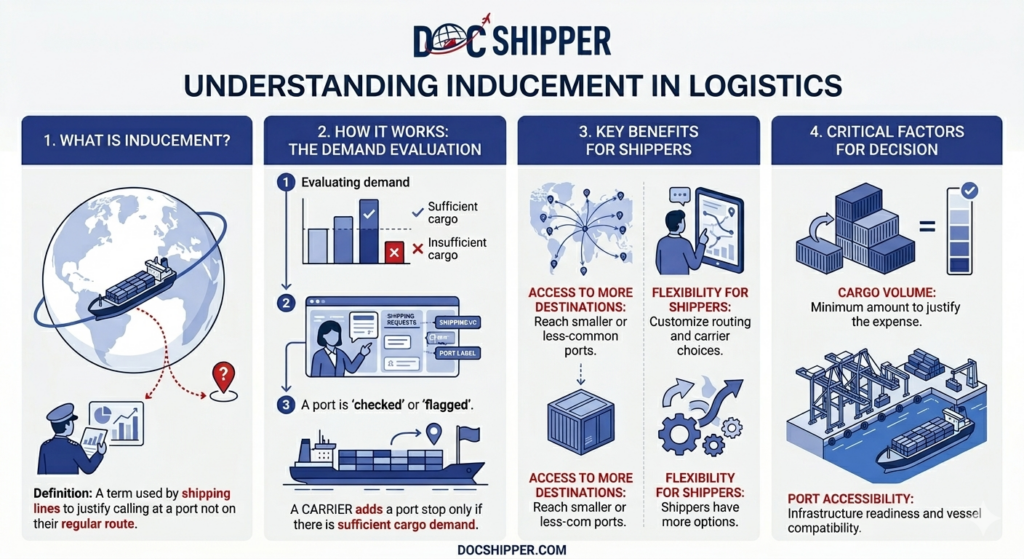
Inducement is a commercial incentive offered by a seller, carrier, or service provider to encourage the purchase or use of their services. In international logistics, it refers to benefits such as discounts, rebates, or preferential treatment intended to secure business relationships or influence buyer decisions.
Introduction
Many importers and exporters face confusion when distinguishing legitimate business incentives from prohibited commercial practices. Inducement sits at the intersection of competitive pricing and regulatory compliance, making it essential to understand its boundaries in international trade.
In global supply chains, inducement practices can significantly impact carrier selection, procurement decisions, and overall logistics costs. However, improper use may violate antitrust laws or maritime regulations.
Key characteristics of inducement in logistics include:
- Volume-based rebates offered by freight forwarders or carriers
- Service credits or future discounts for exclusive partnerships
- Preferential treatment such as priority booking or faster processing
- Marketing allowances or promotional support from service providers
- Financial incentives tied to performance metrics or contract commitments
Legal Framework & Regulatory Implications
The legality of inducement varies significantly across jurisdictions. In maritime shipping, the Federal Maritime Commission (FMC) in the United States strictly regulates rebates and service contracts under the Shipping Act.
European Union competition law addresses inducements through Article 101 of the Treaty on the Functioning of the European Union (TFEU), which prohibits agreements that distort competition. Loyalty rebates or exclusivity arrangements may trigger antitrust scrutiny if they foreclose market access to competitors.
The Robinson-Patman Act in the U.S. prohibits price discrimination that harms competition, affecting how logistics providers structure discounts. In practice, inducements must be justified by cost savings or made available to all buyers on proportionally equal terms.
International trade agreements such as the WTO Agreement on Subsidies also impact how governments can support domestic carriers. Export subsidies disguised as inducements may face countervailing duties. You can review detailed regulations on the WTO official website.
Service contract provisions in ocean freight often include inducement clauses specifying minimum volume commitments. These must comply with FMC filing requirements and transparency rules to avoid misdeclared rates.
At DocShipper, we systematically review service agreements to ensure inducement clauses align with regulatory frameworks and protect our clients from compliance risks.
Practical Examples & Industry Data
Understanding inducement through real-world scenarios clarifies its practical application. Below are structured examples illustrating how inducements operate across different logistics contexts.
Case Study: Volume Rebate Program
A European manufacturer imports 500 TEU annually from China. Their freight forwarder offers a tiered rebate structure:
- Tier 1 (0-200 TEU): Base rate of $1,800/TEU
- Tier 2 (201-400 TEU): 5% rebate ($1,710/TEU)
- Tier 3 (401+ TEU): 8% rebate ($1,656/TEU)
By committing to the full volume, the manufacturer saves $72,000 annually ($144 × 500 TEU). This inducement encourages loyalty while remaining legally compliant as it reflects genuine economies of scale.
Comparative Analysis: Carrier Inducement Strategies
| Inducement Type | Ocean Freight | Air Freight | Trucking |
|---|---|---|---|
| Volume Discounts | 5-15% for contracted volumes | 3-8% for frequent shipments | 10-20% for dedicated lanes |
| Service Credits | Future freight credits for delays | Priority boarding incentives | Fuel surcharge waivers |
| Performance Bonuses | Rebates for reaching annual targets | Loyalty points programs | Rate locks for consistent volume |
| Market Positioning | Loss-leader rates on key routes | Promotional pricing in off-peak | Contract buyouts from competitors |
Industry Data: Inducement Impact on Procurement
According to 2023 supply chain benchmarking studies, companies leveraging structured inducement programs reduce logistics costs by an average of 12-18% compared to spot market purchasing.
Key findings include:
- Contract compliance rates increase to 94% when inducements align with measurable KPIs
- Carrier retention improves by 35% with transparent rebate structures
- Procurement cycle times decrease by 22% through pre-negotiated inducement frameworks
- Cost predictability rises significantly when inducements are built into multi-year agreements
- Dispute resolution becomes faster when inducement terms are contractually explicit
DocShipper negotiates inducement-based contracts that balance competitive pricing with regulatory compliance, ensuring our clients maximize savings without legal exposure.
Conclusion
Inducement remains a powerful tool in logistics procurement, provided it operates within legal boundaries and transparent commercial frameworks. Understanding the regulatory landscape and structuring compliant incentive programs can significantly enhance cost efficiency and carrier relationships.
Need expert guidance on structuring inducement strategies for your supply chain? Contact DocShipper for customized logistics solutions.
📚 Quiz
Test Your Knowledge: Inducement
What best defines "inducement" in international logistics?
Under EU competition law, what makes a loyalty rebate potentially problematic?
A freight forwarder offers your company priority space allocation during peak season in exchange for a minimum annual volume commitment. Is this inducement practice legally acceptable?
🎯 Your Result
📞 Free Quote in 24hFAQ | Inducement: Definition, Legal Framework & Concrete Examples
Legal inducements are transparent, non-discriminatory incentives filed with regulatory authorities like the FMC. Illegal rebates involve secret payments, preferential treatment without justification, or arrangements that violate competition law. The key difference lies in transparency and equal availability to similarly situated buyers.
SMEs typically lack the shipment volumes to qualify for top-tier inducements. However, freight consolidation services, buying groups, or multi-client contracts can aggregate volumes to access better rates. Some forwarders offer scaled inducements specifically designed for smaller shippers to remain competitive.
Not inherently, but they face scrutiny if they create barriers to market entry or foreclose competition. The European Court of Justice examines whether rebates are based on objective cost justifications and whether they allow buyers freedom to choose alternative suppliers without penalty.
Essential documents include signed service contracts with clear inducement terms, FMC tariff filings (for ocean freight), correspondence showing equal offer availability, and audit trails demonstrating non-discriminatory application. Maintaining transparent records protects against regulatory challenges.
Yes, retroactive rebates are common when annual volume thresholds are reached. However, the terms must be pre-agreed in the service contract. Surprise retroactive inducements may raise red flags with auditors or suggest undisclosed preferential treatment.
Leading platforms embed inducement structures directly into their pricing algorithms, providing real-time visibility into volume discounts and tier qualifications. Blockchain-based solutions are emerging to create immutable records of inducement transactions, enhancing compliance and trust.
Carriers often prioritize space allocation for shippers with inducement-based contracts during peak seasons. This preferential treatment is legally permissible if it reflects genuine commercial value and doesn't constitute predatory exclusion of competitors.
Government subsidies to exporters can function as inducements but are regulated under WTO rules on state aid. Export credit agencies, tax rebates, or preferential financing must comply with subsidy disciplines to avoid countervailing measures from trading partners.
Contract rates incorporate inducements as negotiated discounts or volume commitments, while spot rates reflect immediate market conditions without loyalty incentives. Spot market inducements are rare and typically appear only during periods of overcapacity.
Inducements may be treated as revenue reductions or discounts, affecting gross income calculations. Some jurisdictions classify rebates as taxable income if received as separate payments rather than price adjustments. Consult tax advisors to ensure proper classification and reporting.
Yes, some service contracts allow earned inducements to be applied against accessorial charges like demurrage. However, this must be explicitly stated in the agreement. Ad-hoc offsets without contractual basis may violate carrier tariff rules.
Annual reviews align with budget cycles and market condition changes. However, significant volume shifts, regulatory updates, or competitive rate movements may warrant mid-term renegotiations. Proactive reviews ensure inducements remain commercially relevant and compliant.
Need Help with
Logistics or Sourcing ?
First, we secure the right products from the right suppliers at the right price by managing the sourcing process from start to finish. Then, we simplify your shipping experience - from pickup to final delivery - ensuring any product, anywhere, is delivered at highly competitive prices.


Fill the Form
Prefer email? Send us your inquiry, and we’ll get back to you as soon as possible.
Contact us




