


In short ⚡
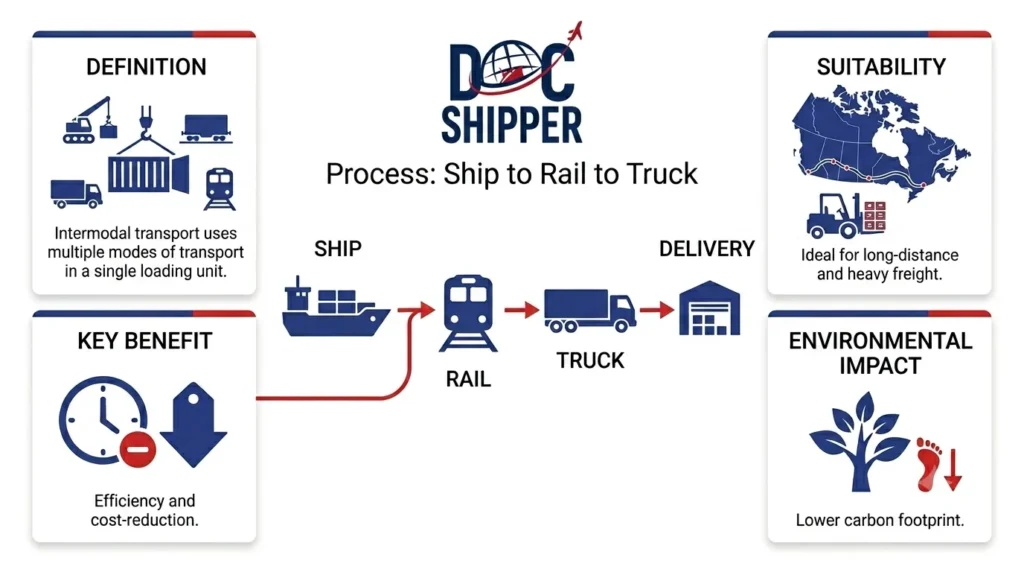
Intermodal transport is a logistics method where goods move in a single loading unit (container, swap body, or semi-trailer) across two or more transportation modes (sea, rail, road, air) without handling the cargo itself during mode changes. This approach reduces transit time, costs, and damage risks while maintaining cargo security throughout the supply chain.
Introduction
Many importers confuse intermodal with multimodal transport. The distinction is critical. In intermodal operations, multiple carriers handle different legs under separate contracts. In multimodal, one carrier manages everything under a single contract.
This distinction affects liability, documentation, and cost structures. Understanding intermodal transport is essential for optimizing international supply chains, especially when balancing speed, cost, and environmental impact.
Key characteristics of intermodal transport include:
- Standardized loading units (primarily ISO containers: 20ft, 40ft, 45ft)
- Minimal cargo handling during modal transitions
- Multiple carriers with separate contracts per transport leg
- Specialized infrastructure (intermodal terminals, rail ramps, container ports)
- Environmental benefits through optimized rail and sea transport utilization
In-Depth Analysis & Technical Expertise
Intermodal transport relies on containerization as its foundation. The ISO container, standardized globally since 1968, enables seamless transfers between ships, trains, and trucks. This standardization revolutionized international trade.
The process involves intermodal terminals equipped with specialized handling equipment. These facilities serve as transition points where containers transfer between modes. Rail terminals use gantry cranes or reach stackers. Port facilities deploy ship-to-shore cranes.
Legal frameworks governing intermodal transport differ by mode. Maritime legs follow the Hamburg Rules or Rotterdam Rules. Road transport adheres to CMR Convention. Rail follows CIM Convention. Each carrier maintains separate liability.
The Incoterms® rules interact with intermodal transport. FCA (Free Carrier) works well when goods transfer at an intermodal terminal. CIP (Carriage and Insurance Paid) covers the entire journey but requires clear modal breakdown for insurance purposes.
From an operational perspective, drayage represents the critical first and last mile. This short-distance trucking connects intermodal terminals to origin and destination points. Drayage costs often represent 30-40% of total intermodal expenses despite covering minimal distance.
At DocShipper, we coordinate all intermodal legs seamlessly, ensuring container availability, terminal bookings, and documentation compliance across every mode. Our expertise eliminates common pitfalls like missed rail connections or incorrect customs filing.
Concrete Examples & Data
Consider a typical Asia-Europe intermodal route. Cargo originates in Shenzhen, China, destined for Munich, Germany. Transit time: 35-40 days versus 28-32 days for all-sea to Hamburg with road delivery.
| Transport Mode Combination | Transit Time | Cost (40ft Container) | CO₂ Emissions |
|---|---|---|---|
| Sea (Shenzhen) → Rail (Duisburg) → Truck (Munich) | 35-40 days | $4,800-$5,500 | -40% vs all-road |
| Sea (Shenzhen → Hamburg) → Truck (Munich) | 28-32 days | $4,200-$4,800 | -25% vs all-road |
| Air (Guangzhou → Munich) | 3-5 days | $12,000-$18,000 | +800% baseline |
Use Case: Electronics Manufacturer
A European electronics company imports components from Taiwan. Volume: 150 TEU monthly. Previous all-sea routing via Rotterdam took 35 days. Switching to intermodal (sea to Piraeus, Greece + rail to Poland) reduced transit to 28 days while cutting costs by 12%.
The company gained inventory optimization benefits. Faster transit allowed reduced safety stock levels. Warehouse holding costs decreased by $180,000 annually. The environmental benefit: 35% reduction in carbon footprint compared to equivalent all-road from Hamburg.
Key factors driving intermodal adoption include:
- Cost efficiency – Rail averages 30-40% cheaper than road for distances exceeding 500km
- Capacity constraints – European road freight faces driver shortages; rail provides alternatives
- Regulatory pressure – EU carbon reduction targets favor rail over trucking
- Reliability – Rail schedules often prove more predictable than congested road networks
- Security – Sealed containers minimize theft and damage risks during transit
North American intermodal markets show similar patterns. The Los Angeles-Chicago corridor handles over 1.5 million containers annually via rail. Transit time: 7 days versus 3-4 days by truck. Cost savings: 20-25%. Most shippers accept the trade-off for non-urgent cargo.
Conclusion
Intermodal transport represents the optimal balance between cost, speed, and sustainability for many international shipments. Proper planning and carrier coordination unlock significant savings while reducing environmental impact.
Need assistance structuring your intermodal supply chain? Contact DocShipper for expert guidance on routing, documentation, and carrier selection.
📚 Quiz
Test Your Knowledge: Intermodal Transport
What is the primary defining characteristic of intermodal transport?
A shipper believes intermodal transport always provides faster delivery than all-road transport. Is this correct?
An importer needs to choose between intermodal sea-rail and express air freight for electronics components from Asia to Europe. Which factor should primarily drive this decision?
🎯 Your Results
📞 Free Quote in 24hFAQ | Intermodal Transport: Definition, Calculation & Concrete Examples
Intermodal involves multiple carriers with separate contracts for each transport leg. You contract directly with the ocean carrier, rail operator, and trucking company. Multimodal uses one carrier issuing a through bill of lading covering all modes. That single carrier assumes liability for the entire journey. Intermodal offers flexibility but requires more coordination. Multimodal simplifies documentation but may cost more.
FCA (Free Carrier) proves ideal for intermodal transport. The seller delivers goods to the first carrier at a named terminal. Risk transfers at that point. CIP (Carriage and Insurance Paid) also works when the seller arranges the entire intermodal journey. Avoid FOB (Free On Board) for intermodal—it's designed for maritime transport only. Using inappropriate Incoterms creates liability gaps during modal transitions.
Cost savings range from 15% to 40% depending on distance and route. The break-even point typically occurs at 500-800 kilometers. Longer distances yield greater savings. However, factor in drayage costs at both ends. A 1,500km journey from Rotterdam to Milan might save €600-800 per 40ft container using rail versus truck. Savings increase with volume through container slot commitments with rail operators.
Key risks include missed connections between modes, documentation errors causing customs delays, and damage during container handling at terminals. Weather can disrupt rail schedules. Port congestion affects container availability. Each carrier's liability is limited to their transport segment. Insurance gaps may exist between modal transitions. Proper cargo insurance covering the entire journey is essential. Working with experienced freight forwarders mitigates these risks significantly.
Yes, but tracking quality varies. Ocean carriers provide vessel tracking and estimated arrival times. Rail operators offer train position updates. Trucking companies use GPS for real-time location data. The challenge is consolidating information across carriers. Advanced freight forwarders use integration platforms providing unified tracking. Container tracking standards like DCSA's Track & Trace API improve visibility. Expect some information gaps during modal transfers at terminals.
Transit times depend on route and modal combination. Asia-Europe sea-rail routes via Russia averaged 28-32 days before geopolitical disruptions. Southern corridors through Turkey take 35-40 days. North America coast-to-coast intermodal requires 7-10 days versus 4-5 days by truck. Add 2-3 days for drayage at origin and destination. Schedule reliability varies—rail often experiences fewer delays than road, though less flexible when disruptions occur.
Standard ISO containers (20ft and 40ft) dominate intermodal transport. High-cube 40ft containers (9'6" tall) accommodate more cargo. Specialized types include refrigerated containers (reefers), open-top containers for oversized cargo, and tank containers for liquids. European swap bodies work well for intra-Europe intermodal but aren't suitable for international ocean legs. Container selection depends on cargo type, dimensions, and the specific modal combinations in your routing.
Customs clearance occurs at the first entry point into a customs territory. For sea-rail combinations entering the EU, clearance happens at the port of discharge (e.g., Hamburg, Rotterdam). The container then moves under customs transit procedures to inland destinations. Rail operators handle T1 transit documentation. Final customs release occurs at the destination country. Proper advance filing and harmonized system (HS) code classification are crucial. Errors cause container holds at terminals, incurring demurrage charges.
Demurrage charges apply when containers remain at terminals beyond free time (typically 3-7 days). Rates range from $50-150 per container per day. Detention covers containers held outside the terminal beyond allowed time. Free time varies by carrier and route. In intermodal transport, coordination delays between modes often trigger these charges. For example, if rail capacity isn't available when your container arrives at port, demurrage accrues. Advance booking and buffer time prevent costly penalties.
Yes, significantly. Rail produces 70-80% less CO₂ per ton-kilometer than road transport. Combining sea and rail for long-distance routes reduces emissions by 40-50% compared to all-road alternatives. A 40ft container traveling 1,500km by rail generates approximately 500kg CO₂ versus 1,800kg by truck. Many companies choose intermodal routes specifically to meet sustainability targets and ESG reporting requirements. The environmental advantage increases with distance and cargo volume.
The decision hinges on urgency, budget, and cargo characteristics. Intermodal suits non-urgent, high-volume, cost-sensitive shipments. Express air freight serves time-critical, high-value, or low-volume cargo. Calculate the cost of capital tied up in inventory during longer intermodal transit. If your product's value depreciates quickly or stockout costs are high, faster options may prove more economical. For stable-demand products with predictable lead times, intermodal optimizes logistics spend. Most companies use a mix based on product segmentation.
Core documents include the commercial invoice, packing list, and bill of lading for each transport leg. Ocean carriers issue a sea waybill or B/L. Rail operators provide a CIM consignment note or equivalent. Trucking companies issue a CMR document. Customs requires a Single Administrative Document (SAD) in the EU or equivalent entry forms elsewhere. Certificates of origin may be necessary for preferential tariffs. Dangerous goods require MSDS sheets and placarding. Working with freight forwarders ensures complete documentation across all modes.
Need Help with
Logistics or Sourcing ?
First, we secure the right products from the right suppliers at the right price by managing the sourcing process from start to finish. Then, we simplify your shipping experience - from pickup to final delivery - ensuring any product, anywhere, is delivered at highly competitive prices.


Fill the Form
Prefer email? Send us your inquiry, and we’ll get back to you as soon as possible.
Contact us




