


In short ⚡
An Intermediate Point is a strategic location in a transportation route where goods are temporarily stored, consolidated, or transferred between carriers. This hub optimizes transit times, reduces costs, and ensures regulatory compliance in complex international supply chains.Introduction
Many importers struggle with delayed shipments due to poor route planning. They overlook the strategic value of intermediate points—critical nodes that can transform logistics efficiency. In international trade, direct routes aren’t always feasible or economical. Goods often traverse multiple jurisdictions, requiring consolidation facilities or customs clearance hubs.
Understanding intermediate points is essential for:
- Cost optimization: Reducing per-unit transportation expenses through consolidation
- Transit time management: Leveraging strategic hubs for faster connections
- Regulatory compliance: Meeting customs requirements at designated checkpoints
- Risk mitigation: Diversifying routes to avoid geopolitical disruptions
- Inventory control: Buffering supply chain variability with strategic storage
This concept applies to air freight, maritime shipping, and multimodal transport. Whether consolidating LCL shipments in Rotterdam or transferring air cargo through Dubai, intermediate points dictate logistics success. For businesses navigating complex international freight operations, mastering this mechanism is non-negotiable.
Strategic Functions & Operational Framework
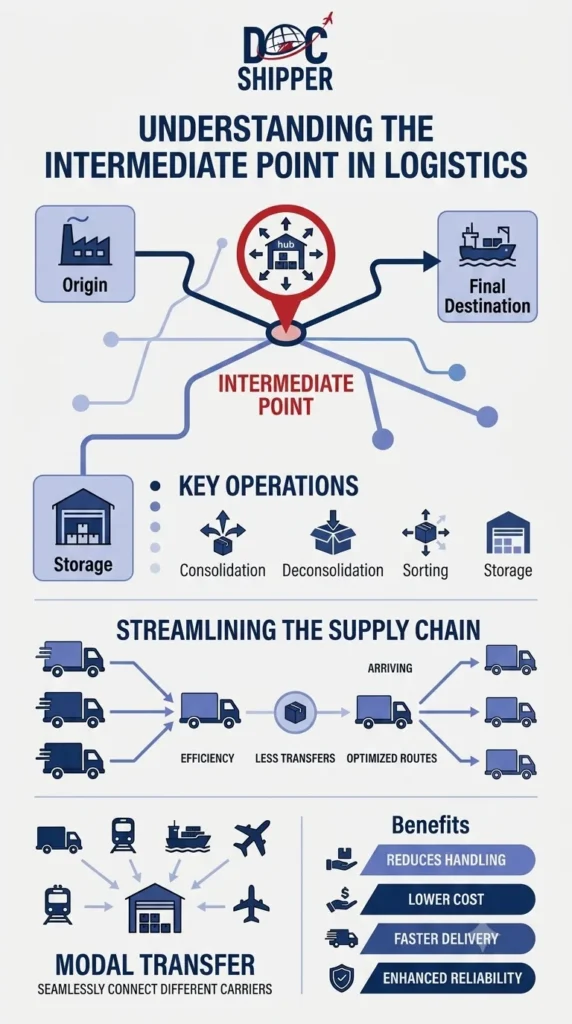
An intermediate point serves multiple critical functions beyond simple geographic positioning. Its selection impacts overall supply chain resilience and profitability.
Consolidation Centers: These facilities aggregate smaller shipments into full container loads (FCL) or pallet positions. By combining cargo from various suppliers, companies achieve economies of scale. A manufacturer sourcing from five Asian suppliers might use Singapore as a consolidation hub before shipping to Europe.
Customs Clearance Hubs: Certain intermediate points offer streamlined customs procedures. Free Trade Zones (FTZ) like Jebel Ali in Dubai allow goods to enter, store, and re-export without full customs duties. This mechanism accelerates processing and provides duty deferral benefits until goods reach final destinations.
Transshipment Ports: Major maritime hubs like Rotterdam, Singapore, and Los Angeles serve as transfer nodes between feeder and mainline vessels. According to UNCTAD’s 2023 Maritime Review, approximately 28% of global container traffic involves transshipment operations. These points optimize vessel utilization and route efficiency.
Break-Bulk Facilities: For project cargo or oversized shipments, intermediate points provide specialized handling. Heavy machinery moving from Germany to Australia might undergo partial assembly or repackaging at an intermediate facility in Singapore before final delivery.
Regulatory Compliance Zones: Some countries mandate inspections at designated entry points. Agricultural products entering the EU, for instance, must pass phytosanitary checks at approved border inspection posts (BIP). At DocShipper, we coordinate documentation to ensure compliance at every intermediate checkpoint, preventing costly delays.
The selection criteria for intermediate points include infrastructure quality, connectivity to major trade routes, political stability, labor costs, and regulatory environment. A poorly chosen hub can negate potential savings through demurrage fees or administrative bottlenecks.
Real-World Applications & Data Comparisons
Understanding intermediate points becomes tangible through concrete scenarios and comparative analysis.
Use Case 1: Electronics Import from China to the United States
A U.S. retailer imports consumer electronics from three suppliers in Shenzhen, Guangzhou, and Shanghai. Direct shipping from each origin generates high per-unit costs due to partial container utilization.
Solution: Consolidate shipments at Hong Kong (intermediate point) before ocean freight to Los Angeles. This approach reduces transportation costs by 34% and simplifies customs documentation to a single entry instead of three separate declarations.
Transit time impact: Added 3 days for consolidation, but reduced overall lead time by 5 days due to direct mainline vessel access from Hong Kong versus feeder services from smaller Chinese ports.
Comparative Analysis: Intermediate Points for Europe-Asia Trade
| Intermediate Point | Average Dwell Time | Handling Cost/TEU | Customs Processing | Best For |
|---|---|---|---|---|
| Singapore | 2.1 days | $185 | 24-48 hours | Southeast Asia consolidation |
| Dubai (Jebel Ali) | 1.8 days | $165 | 12-24 hours | Middle East distribution |
| Rotterdam | 2.5 days | $210 | 48-72 hours | European final distribution |
| Hong Kong | 1.5 days | $175 | 12-36 hours | China-origin cargo |
Use Case 2: Pharmaceutical Cold Chain Management
A pharmaceutical company ships temperature-sensitive vaccines from Belgium to Kenya. Direct flights exist but lack cold storage capacity during transit.
Strategy: Route through Dubai as an intermediate point with specialized pharma-grade facilities. The hub provides GDP-certified storage (Good Distribution Practice), ensuring temperature compliance throughout handling.
Outcome: Product integrity maintained, regulatory compliance achieved, and total landed cost reduced by 18% compared to direct chartered cargo flights.
Key Performance Indicators for Intermediate Point Selection
- Connectivity Index: Number of direct shipping lines or flight connections
- Average Dwell Time: Duration cargo remains at the facility (target: <2.5 days)
- Customs Clearance Efficiency: Processing time for standard commercial shipments
- Infrastructure Reliability: Equipment availability, power backup, security measures
- Total Landed Cost Impact: Comprehensive analysis including handling, storage, and potential duty savings
Companies working with experienced freight forwarders can leverage existing hub relationships to negotiate better rates and prioritize cargo handling at intermediate points.
Conclusion
Intermediate points represent strategic leverage in international logistics, transforming complex routes into optimized pathways. Their intelligent selection directly impacts cost structures, transit reliability, and regulatory compliance. Need expert guidance on optimizing your supply chain routes? Contact DocShipper for tailored logistics solutions.
📚 Quiz
Test Your Knowledge: Intermediate Point
What is the primary defining characteristic of an intermediate point in international logistics?
A company wants to use an intermediate point in a Free Trade Zone to completely avoid customs duties and bypass sanctions on restricted goods. Is this a legitimate application?
An electronics importer consolidates shipments from three Chinese suppliers at Hong Kong before shipping to Los Angeles. This strategy reduced transportation costs by 34%. What explains this cost reduction?
🎯 Your Result
📞 Free Personalized QuoteFAQ | Intermediate Point: Definition, Role & Practical Examples in International Logistics
An intermediate point involves active cargo handling—consolidation, deconsolidation, customs clearance, or mode transfer. A stopover is merely a refueling or crew change without cargo manipulation. Intermediate points add value through operational services, whereas stopovers are passive transit events with minimal handling.
Impact varies based on handling efficiency and connectivity. Well-managed hubs add 1-3 days but can reduce overall time by providing access to faster trunk routes. Poor hubs may add 5-7 days through congestion. The key metric is whether improved vessel/flight connections offset the additional handling time.
Yes, including handling fees ($150-$250 per TEU), storage charges (if exceeding free time), documentation fees, and potential customs duties depending on jurisdiction. However, these costs often offset against savings from consolidated shipping rates and reduced per-unit transportation expenses.
Intermediate points in Free Trade Zones may defer duties until final destination, but cannot legally circumvent sanctions. Using hubs to falsely certify origin (country of manufacture) constitutes customs fraud. Legitimate tariff optimization involves rules-of-origin compliance and proper documentation, not evasion tactics.
Liability depends on the transport contract and Incoterm used. Under multimodal transport, the intermediate handler may be responsible. Proper cargo insurance covering the entire journey, including intermediate handling, is essential. Documentation with detailed condition reports at each transfer point establishes accountability.
Analyze connectivity to origin and destination, handling infrastructure for your cargo type, customs efficiency, total cost including fees, and risk factors like political stability. Use freight forwarders' network knowledge to compare actual performance data rather than theoretical route maps.
No. Direct routes exist for major trade lanes with sufficient cargo volume. However, approximately 65% of global container traffic involves at least one intermediate handling point due to vessel routing economics and last-mile delivery requirements.
Required documents include the original bill of lading or air waybill, commercial invoice, packing list, certificate of origin (if claiming preferential tariffs), and any specific permits for restricted goods. Transshipment hubs may require additional local manifests or temporary import declarations.
Yes, but advanced notice is required. Most hubs charge inspection fees ($100-$300) and require coordination with warehouse operators. For high-value or sensitive cargo, pre-arranged inspection protocols should be specified in the freight contract before shipment begins.
Additional handling and potential longer routes may increase emissions. However, consolidated shipping via hubs often reduces overall carbon footprint compared to multiple direct low-volume shipments. Modern hubs with electric handling equipment and renewable energy can minimize environmental impact.
IoT sensors provide real-time location and condition monitoring, blockchain platforms offer immutable custody records, and EDI systems enable automated documentation exchange. Advanced hubs integrate these technologies into unified visibility platforms accessible to all supply chain participants.
Yes—cargo theft, tampering, and counterfeiting risks increase with multiple handling touchpoints. Choose hubs with certified security programs (TAPA, C-TPAT, AEO), implement tamper-evident seals, and utilize technology like smart containers with intrusion alerts for high-value shipments.
Need Help with
Logistics or Sourcing ?
First, we secure the right products from the right suppliers at the right price by managing the sourcing process from start to finish. Then, we simplify your shipping experience - from pickup to final delivery - ensuring any product, anywhere, is delivered at highly competitive prices.


Fill the Form
Prefer email? Send us your inquiry, and we’ll get back to you as soon as possible.
Contact us




