


In short ⚡
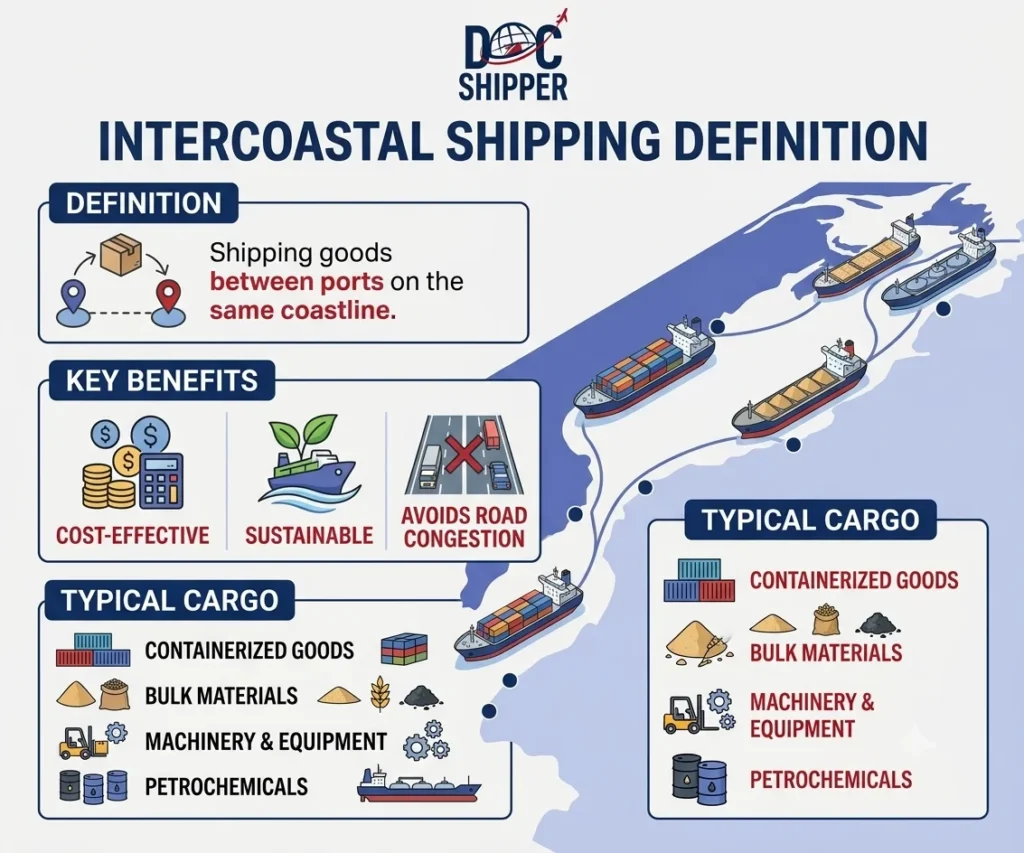
Intercoastal shipping refers to the maritime transport of goods between ports located on different coasts of the same country, typically connecting Atlantic and Pacific seaboards. This domestic maritime route provides an alternative to land-based logistics, offering cost-efficiency for heavy or bulk cargo while reducing highway congestion and carbon emissions.
Introduction
Many logistics managers face a recurring dilemma: how to transport heavy cargo between opposite coasts without incurring excessive trucking costs or rail capacity constraints. Intercoastal shipping addresses this challenge by leveraging maritime infrastructure already connecting a nation’s coastal regions.
In international trade contexts, understanding intercoastal routes becomes critical when planning domestic distribution after goods clear customs. This maritime option bridges the gap between import arrival and final inland delivery, particularly for containerized freight moving from East Coast ports to West Coast destinations or vice versa.
Key characteristics of intercoastal shipping include:
- Cabotage regulations: Domestic maritime transport typically restricted to national-flagged vessels
- Cost advantage: Lower per-unit costs for bulk and heavy cargo compared to overland transport
- Transit time: Longer delivery schedules requiring careful supply chain planning
- Environmental benefits: Reduced carbon footprint versus trucking equivalent loads
- Infrastructure dependency: Requires adequate port facilities on both coasts
Mechanisms & Regulatory Framework
Intercoastal shipping operates under specific cabotage laws that protect domestic maritime industries. In the United States, the Jones Act (Merchant Marine Act of 1920) mandates that all goods transported between U.S. ports must be carried on vessels built domestically, owned by U.S. citizens, and crewed by American sailors. Similar regulations exist in other countries to safeguard national shipping industries.
The routing mechanism typically involves container vessels or bulk carriers that follow established coastal routes. These ships often transit through strategic waterways—in the U.S., this may include passage through the Panama Canal or around Cape Horn for the longest routes. Transit times range from 7 to 21 days depending on distance and port stops.
From a documentation perspective, intercoastal shipments require bills of lading specifying domestic transport, though customs clearance has already occurred at the initial port of entry. Shippers must coordinate with domestic carriers that comply with national maritime regulations, ensuring proper vessel certification and crew qualifications.
The cost structure differs significantly from international ocean freight. While base rates may appear competitive, limited vessel availability under cabotage restrictions can drive prices higher than expected. Fuel surcharges, port handling fees, and potential transshipment costs must be factored into total landed costs.
At DocShipper, we systematically evaluate whether intercoastal shipping offers genuine savings versus intermodal rail or dedicated trucking. Our analysis includes transit time requirements, cargo characteristics, and total cost of ownership to recommend the optimal domestic distribution strategy after international cargo arrives.
Regulatory compliance extends beyond vessel requirements. The Federal Maritime Commission oversees intercoastal operations in the U.S., enforcing tariff regulations and ensuring fair practices. Shippers must verify that carriers maintain proper licensing and insurance coverage for domestic maritime transport.
Practical Examples & Data Analysis
Consider a real-world scenario: A manufacturing company imports 40-foot containers of machinery parts at the Port of Savannah (East Coast) but requires delivery to distribution centers in Los Angeles. The logistics options break down as follows:
| Transport Mode | Transit Time | Cost per Container | CO₂ Emissions |
|---|---|---|---|
| Intercoastal Shipping | 14-18 days | $2,800-$3,500 | Lowest (42g/ton-km) |
| Intermodal Rail | 7-10 days | $3,200-$4,000 | Medium (62g/ton-km) |
| Dedicated Trucking | 4-6 days | $5,500-$7,200 | Highest (104g/ton-km) |
This comparison reveals that intercoastal shipping delivers cost savings of 20-40% compared to trucking while offering the smallest environmental footprint. However, the extended transit time requires robust inventory management and demand forecasting.
Another practical application involves bulk commodities. A petroleum company routinely ships refined products from Gulf Coast refineries to Pacific Northwest markets. Using Jones Act-compliant tankers, they achieve economies of scale impossible with pipeline or rail transport. The per-barrel cost drops to $4-6 versus $8-12 for rail alternatives.
Industry data from the Maritime Administration shows that intercoastal shipping handles approximately 37 million tons of cargo annually in the United States, with petroleum products, chemicals, and containerized goods comprising the majority. This volume represents roughly 2% of total domestic freight but accounts for disproportionately heavy and valuable cargo.
Critical considerations for shippers include:
- Vessel schedules: Limited frequency compared to rail or trucking—typically weekly or biweekly sailings
- Port congestion: Major terminals may experience delays affecting intercoastal connections
- Weather dependencies: Seasonal storms or canal closures can disrupt schedules
- Equipment compatibility: Container specifications must match vessel and port handling capabilities
- Insurance requirements: Marine cargo policies with domestic transit endorsements
DocShipper clients shipping temperature-sensitive pharmaceuticals from New Jersey to California have successfully utilized refrigerated intercoastal containers (reefers) when transit time flexibility allows. The controlled maritime environment often proves more reliable than cross-country trucking through extreme climate zones, with cost savings funding enhanced cold chain monitoring systems.
Conclusion
Intercoastal shipping represents a strategic logistics option for heavy, bulk, or non-urgent cargo moving between domestic coasts. While cabotage regulations and extended transit times present constraints, the cost efficiency and environmental advantages make it indispensable for specific supply chain scenarios.
Need expert guidance on incorporating intercoastal routing into your distribution strategy? Contact DocShipper for a customized logistics analysis comparing all domestic transport options based on your cargo characteristics and delivery requirements.
📚 Quiz
Test Your Knowledge: Intercoastal Shipping
What is the primary defining characteristic of intercoastal shipping?
Under the Jones Act, which vessels can legally transport cargo between U.S. ports?
A company needs to move 40-foot containers of machinery from Savannah to Los Angeles with a 3-week delivery window. Which statement is most accurate?
🎯 Your Results
📞 Free Quote in 24hFAQ | Intercoastal Shipping: Definition, Routes & Practical Examples
Intercoastal shipping connects ports on different coasts of the same country (e.g., Atlantic to Pacific), while intracoastal refers to transport along a single coastline using protected waterways like the Intracoastal Waterway system in the United States. Intercoastal routes typically cover greater distances and may require ocean passage.
Yes, the Jones Act mandates that all cargo transported between U.S. ports must use American-built, -owned, and -crewed vessels. This cabotage law applies to all domestic maritime transport including intercoastal routes. Foreign-flagged vessels cannot legally carry cargo between two U.S. ports, though exceptions exist for specific commodities under temporary waivers during national emergencies.
Intercoastal shipping occurs after customs clearance at the initial port of entry. Once imported goods have been cleared by customs at the arrival port (e.g., New York), they become domestic cargo. Subsequent intercoastal transport to another U.S. port (e.g., Seattle) requires only domestic bills of lading, not international customs documentation.
Ideal cargo includes bulk commodities (petroleum, chemicals, grains), heavy machinery, construction materials, and containerized goods with flexible delivery windows. Non-perishable items that can tolerate 1-3 week transit times benefit most from the cost advantages. Time-sensitive or high-value goods typically require faster alternatives like rail or trucking.
Yes, most intercoastal carriers provide container tracking systems similar to international ocean freight. Shippers receive vessel departure notifications, estimated arrival times, and real-time location updates. Advanced tracking may include IoT sensors for temperature-controlled cargo, though coverage can be limited in open ocean segments compared to land-based GPS tracking.
Intercoastal rates are often proportionally higher per mile than international routes due to Jones Act compliance costs, limited vessel competition, and smaller cargo volumes. However, they remain cheaper than long-haul trucking for heavy loads. A 3,000-mile intercoastal shipment may cost $3,000-4,000 per container versus $1,500-2,000 for a similar distance internationally, but still beats $6,000+ for dedicated trucking.
Delays trigger standard maritime law provisions. Carriers typically include force majeure clauses for weather or mechanical issues. Shippers should review service contracts for delay compensation terms and maintain buffer inventory for critical supply chains. Marine cargo insurance can cover consequential losses from extended delays, though policies vary significantly.
Intercoastal vessels must comply with EPA emission standards, ballast water regulations, and coastal zone management rules. The International Maritime Organization's MARPOL conventions apply, along with stricter U.S. requirements for sulfur content in marine fuels when operating in Emission Control Areas along American coasts. These regulations often make intercoastal shipping cleaner than equivalent trucking.
Yes, many U.S. intercoastal routes transit the Panama Canal to connect Atlantic and Pacific ports. This reduces voyage time compared to circumnavigating South America. However, canal tolls add $50,000-150,000 per vessel depending on size, which gets distributed across cargo units. Shippers should verify that service contracts specify canal routing versus longer alternatives.
Intercoastal shipments require domestic marine cargo insurance rather than international policies. Coverage typically includes protection against vessel casualty, jettison, and general average. Limits may differ from ocean cargo policies, and some international policies exclude domestic legs. Shippers should specifically request "warehouse-to-warehouse" coverage spanning both import and subsequent intercoastal transport.
Limited vessel availability prompts consideration of intermodal rail as the primary alternative, offering 50-60% of intercoastal cost savings with faster transit. Dedicated trucking provides speed but at premium costs. Some shippers combine modes—using intercoastal for base inventory replenishment while reserving faster options for demand surges. Rail-truck combinations (drayage) offer middle-ground solutions.
Yes, labor disputes at either origin or destination ports can severely disrupt intercoastal schedules. Unlike international shipments that might divert to alternate ports, intercoastal cargo bound for specific domestic destinations has limited rerouting options. Shippers should monitor labor negotiations and consider accelerating shipments or using alternative modes during periods of high strike risk.
Need Help with
Logistics or Sourcing ?
First, we secure the right products from the right suppliers at the right price by managing the sourcing process from start to finish. Then, we simplify your shipping experience - from pickup to final delivery - ensuring any product, anywhere, is delivered at highly competitive prices.


Fill the Form
Prefer email? Send us your inquiry, and we’ll get back to you as soon as possible.
Contact us




