


In short ⚡
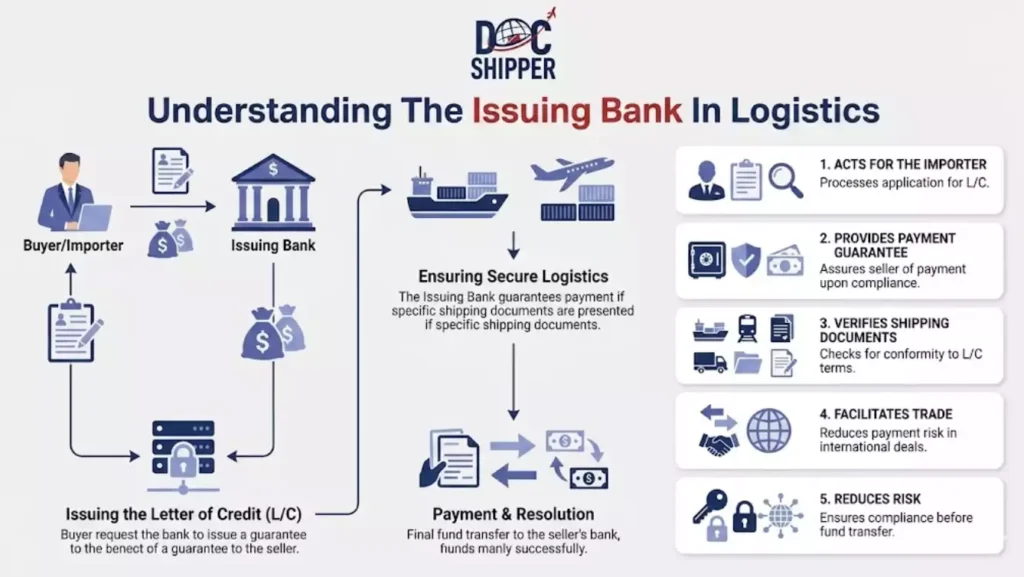
The Issuing Bank is the financial institution that opens a Letter of Credit (LC) on behalf of the buyer (importer) in international trade transactions. It guarantees payment to the seller (exporter) upon presentation of compliant documents, thereby mitigating payment risk and facilitating secure cross-border commerce.
Introduction
In international trade, the question “Who ensures the seller gets paid?” haunts every cross-border transaction. The Issuing Bank provides the answer by acting as a trusted intermediary between buyer and seller.
This financial institution transforms buyer creditworthiness into a bankable guarantee. Without it, exporters face substantial payment risk from unknown foreign buyers, while importers struggle to prove their solvency to distant suppliers.
Key characteristics of the Issuing Bank:
- Credit substitution: Replaces buyer’s credit risk with bank’s creditworthiness
- Document examination: Verifies shipping and commercial documents match LC terms
- Payment obligation: Must honor compliant presentations regardless of buyer disputes
- UCP 600 compliance: Operates under International Chamber of Commerce rules
- Communication hub: Coordinates with advising banks, confirming banks, and beneficiaries
Role & Technical Mechanisms
The Issuing Bank’s function extends far beyond simply opening a Letter of Credit. It performs credit assessment of the applicant (buyer), evaluating their financial capacity to honor the LC amount plus associated fees.
Upon approval, the bank issues the LC according to UCP 600 guidelines (Uniform Customs and Practice for Documentary Credits), the global standard governing 11-15 million annual LC transactions worldwide. The bank must specify all conditions precisely: goods description, shipment terms, document requirements, and expiry date.
The payment mechanism follows strict documentary compliance. When the exporter ships goods and presents documents to the nominated bank, these documents flow to the Issuing Bank for examination. The bank has five banking days to determine if documents comply “on their face” with LC terms.
A critical aspect is the independence principle: the LC is separate from the underlying sales contract. The Issuing Bank’s payment obligation depends solely on document compliance, not on physical goods quality or contract disputes. This protects the payment flow from commercial arguments.
The bank also manages amendments when transaction terms change. Any modification requires agreement from all parties—applicant, beneficiary, and the Issuing Bank itself. At DocShipper, we assist clients in coordinating LC amendments to avoid shipment delays caused by document discrepancies.
For regulatory context, consult the ICC UCP 600 official publication which standardizes Issuing Bank responsibilities globally.
Practical Examples & Data
Understanding the Issuing Bank’s role becomes clearer through concrete scenarios and quantified data from real-world trade operations.
Use Case: Electronics Import from China to Germany
A German retailer orders €500,000 worth of smartphones from a Shenzhen manufacturer. The Chinese exporter, unfamiliar with the buyer, demands secure payment.
Process breakdown:
- Day 0: German buyer applies to Deutsche Bank (Issuing Bank) for an irrevocable LC
- Day 2: Deutsche Bank issues LC after securing €500,000 + €3,500 issuance fee (0.7% rate)
- Day 3: LC transmitted via SWIFT to Bank of China (Advising Bank) in Shenzhen
- Day 25: Exporter ships goods, presents documents to Bank of China
- Day 28: Documents forwarded to Deutsche Bank for examination
- Day 32: Deutsche Bank confirms compliance, debits buyer’s account, credits exporter
Total transaction cost: €3,500 + €200 SWIFT fees = 0.74% of shipment value, significantly lower than the 15-30% payment default risk in unsecured transactions.
Comparative Analysis: Issuing Bank Costs by Region
| Region | Average LC Fee | Processing Time | Discrepancy Rate |
|---|---|---|---|
| North America | 0.5-0.75% | 3-5 days | 68% |
| European Union | 0.6-1.0% | 4-6 days | 72% |
| Asia-Pacific | 0.4-0.8% | 3-5 days | 65% |
| Middle East | 0.8-1.5% | 5-8 days | 78% |
| Africa | 1.0-2.0% | 7-12 days | 82% |
Key insight: Despite higher discrepancy rates (documents rejected on first presentation), African and Middle Eastern markets depend heavily on LCs due to limited alternative payment security mechanisms.
At DocShipper, we reduce document discrepancies through pre-shipment verification. Our team reviews commercial invoices, packing lists, and certificates of origin against LC requirements before the exporter presents them to their bank, increasing first-time acceptance rates by 34%.
Conclusion
The Issuing Bank remains the cornerstone of secure international trade, transforming buyer promises into bankable guarantees. Understanding its mechanisms allows importers to negotiate better LC terms and exporters to assess payment security accurately.
Need guidance on Letter of Credit processes or document preparation? Contact DocShipper for expert assistance in managing your international trade documentation.
📚 Quiz
Test Your Knowledge: Issuing Bank
What is the primary role of the Issuing Bank in international trade transactions?
Under the independence principle of UCP 600, can an Issuing Bank refuse payment if the buyer claims the shipped goods are defective?
A German electronics retailer receives documents from their Chinese supplier through the Issuing Bank. The commercial invoice shows €500,000 but the packing list references only 90% of the ordered smartphones. What should the Issuing Bank do?
🎯 Your Result
📞 Free Quote in 24hFAQ | Issuing Bank: Definition, Role & Practical Examples in International Trade
The Issuing Bank opens the Letter of Credit on behalf of the buyer and guarantees payment. The Advising Bank, located in the seller's country, notifies the beneficiary (exporter) that an LC has been opened in their favor. The Advising Bank does not assume payment obligation unless it also acts as a Confirming Bank.
No. Under the independence principle of UCP 600, the Issuing Bank's obligation depends solely on document compliance, not physical goods quality. If documents match LC terms exactly, the bank must pay regardless of product defects. Quality disputes are resolved between buyer and seller outside the LC framework.
According to UCP 600 Article 14, the Issuing Bank has a maximum of five banking days following the day of presentation to examine documents and determine compliance. This period begins when the nominated bank forwards documents, not when the exporter initially presents them.
Typical fees include: LC issuance fee (0.5-2.0% of LC value), amendment fee (flat rate €50-150 per change), examination fee (€75-200), SWIFT transmission fee (€25-50), and discrepancy handling fee (€50-150 if documents contain errors). Total costs usually range from 0.75% to 3% of transaction value.
Only if the LC is explicitly marked as "transferable." The Issuing Bank must include this designation at issuance. A transferable LC allows the first beneficiary (typically a middleman) to transfer all or part of the LC to a second beneficiary (actual supplier), though the Issuing Bank remains obligated only to the original LC amount.
The LC obligation remains valid. Bank resolution authorities or liquidators must honor compliant presentations from existing LCs as priority claims. However, this scenario underscores why exporters often request a Confirming Bank from a more stable jurisdiction to add a second payment guarantee.
The bank examines whether documents appear genuine "on their face" but does not conduct forensic authentication. Under UCP 600 Article 34, banks assume no liability for document authenticity, form, or legal validity. They verify only surface-level compliance with LC terms, checking signatures, stamps, and data consistency.
This depends on LC terms. If the LC states "partial shipments allowed," the bank accepts documents covering part of the total quantity and pays proportionally. If "partial shipments prohibited," any presentation for less than 100% of goods triggers automatic refusal. The LC must explicitly address this condition.
Not unilaterally for irrevocable LCs (the standard type under UCP 600). Cancellation or amendment requires written consent from all parties: applicant, beneficiary, and the Issuing Bank itself. Revocable LCs, which can be cancelled anytime without notice, are extremely rare and generally avoided in modern trade.
In standby LCs (used as payment guarantees rather than primary payment methods), the Issuing Bank pays only if the applicant defaults. The beneficiary presents a statement of default plus any required documents. Unlike commercial LCs where payment is expected, standby LCs function as backup insurance, hoping payment never occurs.
Primarily through SWIFT (Society for Worldwide Interbank Financial Telecommunication), a secure messaging network connecting over 11,000 financial institutions. LC issuance uses message type MT700, amendments use MT707, and document presentations trigger MT750 messages. This standardization ensures rapid, secure global transmission of LC instructions.
The buyer can dispute the bank's decision through legal action, claiming the bank failed its duty to examine documents with reasonable care. However, UCP 600 limits bank liability. If discrepancies were not obvious upon surface examination, courts often side with the bank. Prevention through detailed LC drafting remains more effective than post-payment disputes.
Need Help with
Logistics or Sourcing ?
First, we secure the right products from the right suppliers at the right price by managing the sourcing process from start to finish. Then, we simplify your shipping experience - from pickup to final delivery - ensuring any product, anywhere, is delivered at highly competitive prices.


Fill the Form
Prefer email? Send us your inquiry, and we’ll get back to you as soon as possible.
Contact us




