


In short ⚡
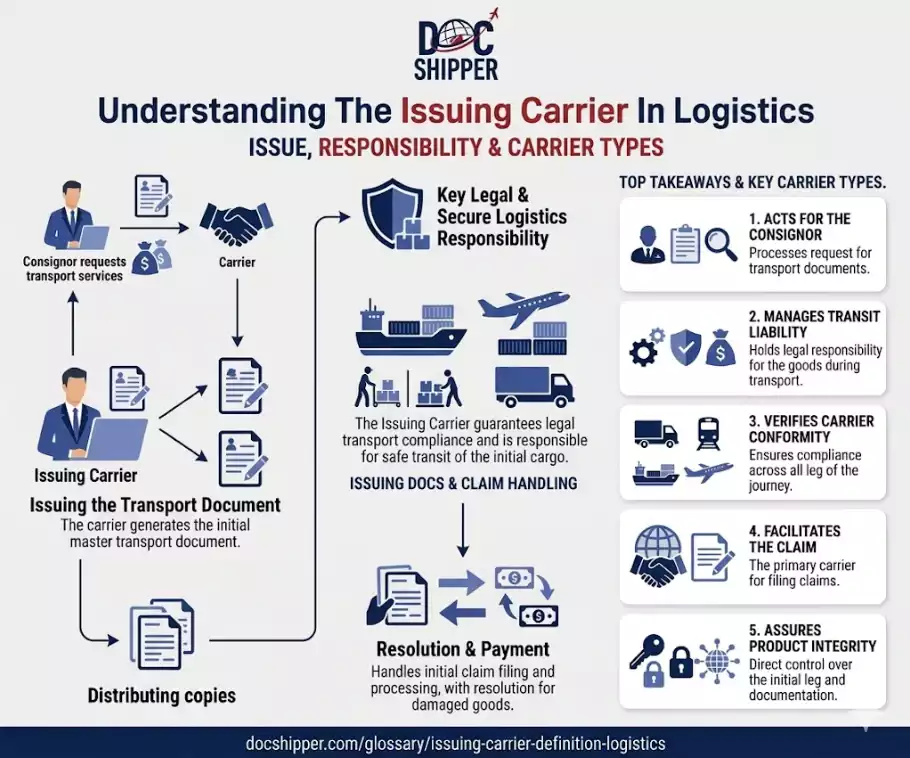
The Issuing Carrier is the transportation company that issues the bill of lading (B/L) or air waybill (AWB) and assumes legal responsibility for the shipment. This entity oversees cargo movement from origin to destination, whether performing the transport directly or subcontracting portions to other carriers while retaining contractual liability.
Introduction
In international shipping, confusion often arises between the issuing carrier, actual carrier, and freight forwarder. This distinction determines who bears responsibility for cargo damage, delays, or loss. Understanding the issuing carrier’s role prevents costly disputes and ensures proper insurance coverage.
The issuing carrier plays a pivotal role throughout the logistics chain. When goods move across borders, this entity serves as the primary contractual party, coordinating multimodal transport while managing documentation compliance.
Key characteristics include:
- Legal liability holder: Assumes responsibility under the transport contract regardless of subcontracting arrangements
- Document issuer: Generates official transport documents (B/L, AWB, CMR) bearing their name and credentials
- Rate negotiator: Establishes freight rates and terms directly with shippers or freight forwarders
- Cargo tracking authority: Provides shipment visibility through proprietary tracking systems
- Claims processor: Manages cargo claims under international conventions (Hague-Visby, Montreal, CMR)
In-Depth Analysis & Expertise
The issuing carrier concept originates from maritime law traditions where the shipowner issuing the bill of lading bore ultimate responsibility. Modern logistics evolved this principle across all transport modes. Under the EU Regulation 392/2009, the issuing carrier must be clearly identified on transport documents.
The contractual relationship distinguishes issuing carriers from actual carriers. While the actual carrier physically moves goods, the issuing carrier maintains legal obligations toward the shipper. This separation creates complex liability chains when multiple parties participate in multimodal transport.
Three scenarios define liability frameworks:
- Direct transport: The issuing carrier performs the entire journey using owned assets
- Subcontracted segments: The issuing carrier contracts third parties for portions while retaining full liability
- NVOCC operations: Non-Vessel Operating Common Carriers issue B/Ls without owning vessels, acting as contractual carriers
The documentation requirements vary by transport mode. Maritime B/Ls must display the carrier’s registered name and SCAC code. Air waybills require IATA airline codes. Road CMR documents mandate carrier identification per UN Convention standards.
Insurance implications depend on the issuing carrier’s financial standing. Shippers should verify carrier liability limits—typically $500 per package for ocean freight under COGSA. At DocShipper, we systematically verify carrier credentials and recommend appropriate cargo insurance to cover liability gaps.
The regulatory compliance burden falls primarily on issuing carriers. They must maintain licenses, bonds, and insurance certificates across jurisdictions. For instance, U.S.-bound ocean carriers must file ISF documentation with CBP, while EU carriers comply with AES export declarations.
Concrete Examples & Data
Consider a Germany-to-Thailand electronics shipment. The issuing carrier issues a through B/L covering ocean transport from Hamburg to Bangkok. Despite subcontracting feeder vessels and inland trucking, they remain liable for the entire journey.
| Transport Mode | Issuing Carrier Document | Liability Limit | Regulatory Framework |
|---|---|---|---|
| Ocean Freight | Master Bill of Lading (MBL) | $500/package or $500/customary freight unit | Hague-Visby Rules / COGSA |
| Air Freight | Master Air Waybill (MAWB) | 22 SDR/kg (~$30/kg) | Montreal Convention |
| Road Transport | CMR Consignment Note | 8.33 SDR/kg (~$11.50/kg) | CMR Convention |
| Rail Freight | CIM Consignment Note | 17 SDR/kg (~$23/kg) | COTIF Convention |
Use Case: A French manufacturer ships 5,000 kg of machinery to Brazil valued at €200,000. The ocean issuing carrier’s liability caps at approximately €6,500 (based on package count). Without supplemental insurance, the shipper risks €193,500 in uncovered losses if cargo is destroyed.
Key considerations when selecting issuing carriers:
- Financial stability: Verify carrier solvency through credit ratings (Moody’s, S&P) to ensure claims payment capacity
- Network coverage: Direct services reduce handoffs and liability transfers between carriers
- Technology integration: Real-time tracking capabilities indicate operational maturity and transparency
- Claims history: Research dispute resolution patterns through industry databases like TT Club
- Insurance certificates: Confirm P&I Club membership for maritime carriers or cargo liability coverage for others
In 2023, maritime issuing carriers processed 842 million TEUs globally, with container lines like Maersk, MSC, and COSCO dominating market share. Air freight issuing carriers handled 61.2 million tonnes, representing approximately 35% of global trade value despite minimal volume.
Conclusion
The issuing carrier serves as the contractual cornerstone of international logistics, balancing operational coordination with legal accountability. Proper carrier selection and documentation verification prevent financial exposure from inadequate liability coverage.
Need assistance navigating carrier selection or transport documentation? Contact DocShipper for expert guidance on securing your supply chain.
📚 Quiz
Test Your Knowledge: Issuing Carrier
What defines an issuing carrier's primary role in international shipping?
A French manufacturer ships 5,000 kg of machinery valued at €200,000 by ocean freight. The issuing carrier's standard liability limit is approximately €6,500. What does this scenario illustrate?
Your shipment involves an NVOCC (Non-Vessel Operating Common Carrier) issuing the bill of lading. Who bears contractual liability if cargo is damaged during ocean transit?
🎯 Your Result
📞 Free Quote in 24hFAQ | Issuing Carrier: Definition, Calculation & Concrete Examples
The issuing carrier assumes legal responsibility as the contractual transporter, issuing master transport documents. Freight forwarders arrange logistics but typically issue house bills (HBL/HAWB) as intermediaries, not principal carriers. Forwarders consolidate shipments under the issuing carrier's master document, creating a two-tier liability structure where the carrier holds ultimate responsibility.
Yes, in multimodal transport. Each transport leg may have a separate issuing carrier—one for ocean, another for inland trucking. However, through bills of lading consolidate liability under a single issuing carrier coordinating the entire journey. Shippers should clarify liability transitions at modal interchange points to avoid coverage gaps.
Non-Vessel Operating Common Carriers issue bills of lading without owning ships, purchasing space from vessel operators. They act as issuing carriers legally but subcontract actual transport. NVOCCs provide flexible consolidation services but add an intermediary layer. Vessel operators control physical assets and often offer lower rates for direct contracts.
Cargo may be stranded at ports or terminals as receivers cannot obtain delivery without valid documentation. Shippers should file claims with the carrier's insurer (P&I Club for maritime) or pursue salvage through bankruptcy proceedings. This scenario underscores the importance of carrier financial vetting and comprehensive cargo insurance covering carrier default.
Rarely for standard contracts. International conventions (Hague-Visby, Montreal) set minimum liability floors carriers cannot reduce. However, shippers can negotiate higher declared value limits by paying surcharges, typically 1-2% of declared cargo value. Alternatively, purchasing all-risk cargo insurance provides broader coverage than carrier liability.
In co-load arrangements, one carrier issues the master document while sharing space with partners. The issuing carrier retains full liability despite operational sharing. Shippers interact solely with the issuing carrier for claims and documentation. Behind the scenes, co-loading carriers may have internal cost-sharing agreements irrelevant to shipper liability.
The master transport document (MBL, MAWB, CMR) lists the issuing carrier prominently, including registered name, address, and identification codes (SCAC for ocean, IATA code for air). Supporting documents like carrier licenses, insurance certificates, and operating authorities validate legitimacy. Verify credentials through regulatory databases like FMC's SERVQUAL or IATA registry.
Generally no. Most jurisdictions follow the "Himalaya Clause" principle, limiting claims to the issuing carrier unless the actual carrier commits willful misconduct. However, maritime law allows shippers to sue the actual carrier directly under certain conventions if identifying the issuing carrier proves impossible. Legal counsel should evaluate jurisdiction-specific rules.
Carriers transport goods to destination ports but typically don't perform customs clearance unless contracted separately. They must present cargo manifests to customs authorities and notify consignees. Shippers or their agents handle duty payment and regulatory compliance. However, carriers may face penalties for manifest inaccuracies or carrying contraband.
Shippers can escalate through arbitration clauses specified in the transport contract, typically following ICC rules or maritime arbitration bodies like London Maritime Arbitrators Association. Legal action in the carrier's jurisdiction may be necessary for disputed claims. Many jurisdictions require exhausting contractual dispute resolution before court proceedings.
No, liability limits remain consistent regardless of cargo type under international conventions. However, carriers may refuse hazmat shipments without proper IMDG/IATA certifications or charge surcharges reflecting higher handling risks. Misdeclaring dangerous goods can void insurance and trigger criminal penalties for shippers beyond civil liability claims.
Electronic bills of lading (eBLs) streamline processes while maintaining legal equivalence to paper documents under frameworks like UNCITRAL Model Law. Blockchain platforms enable secure, tamper-proof transfer of title. However, adoption remains incomplete—only 1.2% of global B/Ls were electronic in 2023. Shippers should confirm carrier compatibility and jurisdiction acceptance before choosing digital formats.
Need Help with
Logistics or Sourcing ?
First, we secure the right products from the right suppliers at the right price by managing the sourcing process from start to finish. Then, we simplify your shipping experience - from pickup to final delivery - ensuring any product, anywhere, is delivered at highly competitive prices.


Fill the Form
Prefer email? Send us your inquiry, and we’ll get back to you as soon as possible.
Contact us




