


In short ⚡
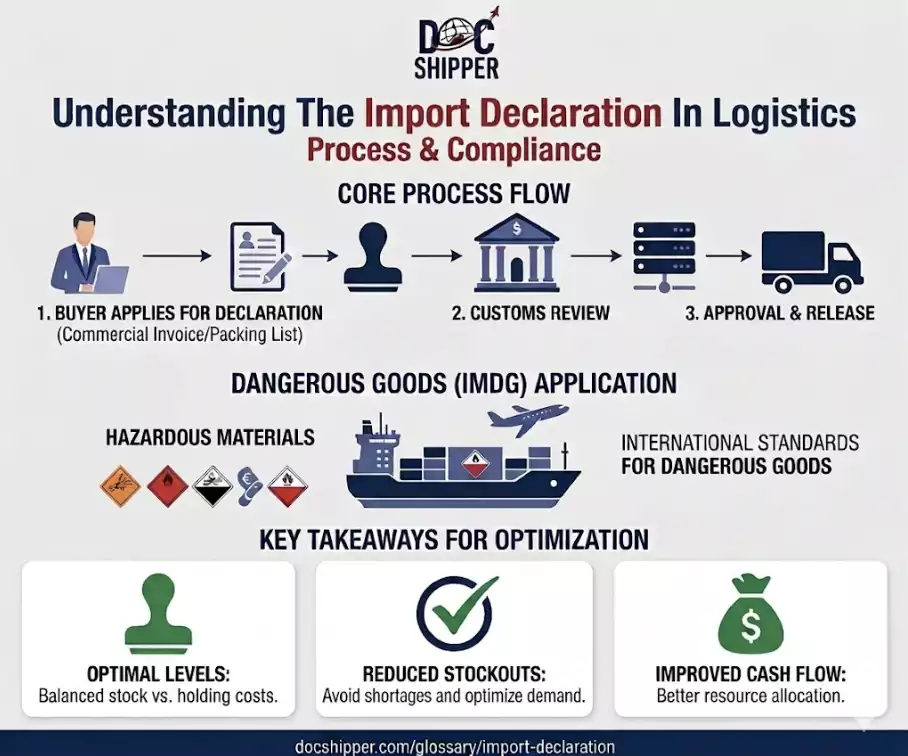
An Import Declaration is a mandatory customs document submitted by importers or their representatives to declare goods entering a country's territory. It contains detailed information about the merchandise, its value, origin, and classification, enabling customs authorities to assess duties, verify compliance, and authorize release into domestic commerce.
Introduction
Every year, millions of shipments cross international borders, yet countless importers struggle with customs clearance delays due to incomplete or inaccurate import declarations. This document serves as the legal gateway between international transit and domestic market entry.
Understanding the import declaration process is critical for any business engaged in cross-border trade. It determines not only the speed of customs clearance but also the total landed cost of goods, compliance risk exposure, and potential penalties.
Key characteristics of an import declaration include:
- Legal obligation: Required by all WTO member countries under national customs legislation
- Information density: Contains 30-50 data elements depending on jurisdiction
- Fiscal instrument: Basis for calculating import duties, VAT, and excise taxes
- Statistical tool: Feeds national trade statistics and economic monitoring systems
- Risk assessment trigger: Used by customs for security and compliance screening
Regulatory Framework & Legal Implications
The import declaration operates within a complex regulatory environment governed by international conventions and national legislation. The Revised Kyoto Convention establishes standardized procedures that most countries follow, while the WTO Customs Valuation Agreement sets rules for determining transaction values.
Modern customs systems increasingly rely on electronic declarations submitted through platforms like the EU’s Import Control System (ICS2) or the U.S. Automated Commercial Environment (ACE). These systems require structured data transmission hours or days before physical arrival, enabling pre-clearance risk analysis.
The declaration process involves several critical elements:
HS Code classification represents perhaps the most technically challenging aspect. This six-to-ten-digit code determines applicable duty rates, trade restrictions, and licensing requirements. Misclassification—whether intentional or accidental—constitutes a customs offense in most jurisdictions.
Customs valuation must reflect the transaction value according to GATT Article VII principles. Authorities can challenge declared values that appear inconsistent with market prices, potentially triggering audits and penalties. The European Commission reports that valuation disputes account for 32% of all customs litigation cases.
Origin determination establishes whether goods qualify for preferential tariff treatment under free trade agreements. Rules of origin vary significantly between agreements, requiring detailed production and sourcing documentation. A single declaration error can result in duty recovery demands extending back three to five years.
Documentary compliance extends beyond the declaration itself. Supporting documents—commercial invoices, certificates of origin, sanitary permits, conformity assessments—must align precisely with declared information. At DocShipper, we systematically verify document consistency across all submissions to prevent discrepancies that trigger customs holds.
The legal consequences of incorrect declarations range from monetary penalties to criminal prosecution. According to EU customs regulations, financial penalties can reach 300% of unpaid duties, with additional criminal liability for fraudulent declarations.
Practical Examples & Data
Understanding import declarations through concrete scenarios illuminates the practical implications for different business models and commodity types.
Case Study: Electronics Importer (Germany)
A German retailer imports smartphones from China with a declared CIF value of €200,000. The customs process involves:
- HS Code: 8517.12.00 (smartphones)
- Customs duty: 0% (suspended under ATQ—Autonomous Tariff Quota)
- Import VAT: 19% on adjusted value = €38,000
- Anti-dumping duty verification: None applicable for this origin-manufacturer combination
- Product compliance: CE marking verification required before release
Total declarable value after adjustments (including transport insurance not in CIF): €203,500. The declaration must be filed electronically through ATLAS system with Movement Reference Number (MRN) provided within 24 hours.
Comparative Declaration Requirements by Region
| Region | System | Pre-arrival Filing | Data Elements | Processing Time |
|---|---|---|---|---|
| European Union | ICS2 / PLDA | Required (4h air, 24h sea) | 46 mandatory fields | 2-4 hours standard |
| United States | ACE / ABI | ISF 10+2 mandatory | 52 data elements | 1-2 hours (C-TPAT members) |
| United Kingdom | CDS (Customs Declaration Service) | Not mandatory (optional pre-lodgement) | 44 mandatory fields | 3-6 hours |
| Australia | ICS (Integrated Cargo System) | Required (48h before arrival) | 38 mandatory fields | 4-8 hours |
| China | CSMS (China Single Window) | Required (24h before arrival) | 41 mandatory fields | 6-12 hours |
Cost Implications: Textile Import Scenario
Consider a U.S. fashion retailer importing cotton shirts from Bangladesh under GSP preferences:
- FOB Value: $50,000
- Freight: $3,200
- Insurance: $400
- CIF Value for customs: $53,600
- Standard duty rate: 16.5% (HS 6205.20)
- GSP preferential rate: 0% (with Form A certificate of origin)
- Potential duty savings: $8,844 per shipment
However, incorrect declaration or missing Form A results in full duty payment plus potential penalties. The World Customs Organization estimates that declaration errors cost businesses $8.4 billion annually in recovered duties and penalties.
Technology Impact on Declaration Accuracy
Recent studies show that automated declaration systems reduce error rates by 68% compared to manual filing. Machine learning algorithms now pre-validate HS codes with 94% accuracy, though human expertise remains essential for complex products and legal interpretation.
Conclusion
The import declaration represents far more than administrative paperwork—it functions as the legal and fiscal interface between international supply chains and domestic markets. Accuracy, timeliness, and regulatory compliance directly impact landed costs, clearance speed, and business risk exposure.
Need expert guidance on import declarations for your specific trade flows? Contact DocShipper for comprehensive customs compliance support across all major jurisdictions.
📚 Quiz
Test Your Knowledge: Import Declaration
1. What is the primary legal purpose of an import declaration?
2. Who bears ultimate legal responsibility for the accuracy of an import declaration?
3. A U.S. fashion retailer imports cotton shirts from Bangladesh with proper GSP documentation. What happens if they fail to claim preferential treatment on the import declaration?
🎯 Your Result
📞 Free Quote in 24hFAQ | Import Declaration: Definition, Process & Practical Examples
Customs authorities can issue penalty notices, demand duty recovery for up to five years retrospectively, and in serious cases, pursue criminal prosecution for fraud. The severity depends on whether the error appears accidental or deliberate. Most jurisdictions offer voluntary disclosure programs that reduce penalties if mistakes are self-reported before detection.
Yes, but procedures vary by country. EU customs allows post-clearance amendments within three years through Article 173 invalidation requests. The U.S. permits corrections via Post Entry Amendments (PEA) or Prior Disclosure if errors are discovered. Some corrections require duty adjustments and interest payments on underpaid amounts.
The importer of record holds ultimate legal responsibility, even when using customs brokers or freight forwarders. While agents file on behalf of importers, customs authorities hold the named importer liable for declaration accuracy, duty payment, and regulatory compliance. This liability cannot be contractually transferred.
Most jurisdictions require five to seven years retention. The EU mandates three years for standard declarations but up to ten years for certain preferential origin claims. The U.S. requires five years from entry date. Electronic records must remain accessible and readable for the entire retention period.
These terms are often used interchangeably, but technically a customs declaration covers both import and export filings, while an import declaration specifically refers to inbound shipments. The import declaration triggers duty calculation and import controls, whereas export declarations primarily serve statistical and strategic export control purposes.
No. Low-value shipments below de minimis thresholds (€150 in EU, $800 in U.S.) may use simplified procedures. Express courier shipments often use consolidated declarations. Temporary imports under ATA Carnets bypass standard procedures. However, restricted goods (weapons, pharmaceuticals, endangered species) always require full declarations regardless of value.
Used machinery and equipment pose valuation challenges since invoice prices may not reflect market value. Customs may apply depreciation tables, request independent appraisals, or reference comparable sales data. Detailed documentation of equipment age, condition, and specifications helps justify declared values and prevents arbitrary adjustments by customs.
Generally no. Each supplier requires a separate declaration because customs values, origins, and commercial terms differ. However, consolidated declarations are permitted for express shipments or when using customs warehousing procedures. Split shipment declarations allow one commercial transaction to be cleared across multiple customs entries with proper cross-referencing.
The Economic Operators Registration and Identification (EORI) number functions as a unique customs identifier in the EU and UK. Every business filing import declarations must have a valid EORI number. It links all customs transactions to a specific entity, enabling authorities to track compliance history, facilitate authorized economic operator (AEO) programs, and process declarations.
Customs use automated risk analysis comparing declared values against historical data, industry benchmarks, and transfer pricing databases. Significant deviations trigger manual review. Authorities may request purchase orders, payment evidence, royalty agreements, and related party transaction documentation. Persistent undervaluation can lead to customs audits covering multiple years of import activity.
Authorized traders with AEO status or simplified procedure authorization can release goods with minimal data (simplified declaration), then submit complete information later (supplementary declaration). This accelerates clearance while maintaining compliance. Eligibility requires proven compliance history, adequate record systems, and sometimes financial guarantees covering potential duty liabilities.
No. Preferential tariff treatment under FTAs requires active claiming on the import declaration plus proof of origin documentation. The importer must verify that goods meet origin criteria, obtain certificates (Form A, EUR.1) or supplier declarations, and explicitly reference the FTA provision on the customs declaration. Failure to claim at import typically means standard duties apply with limited retroactive correction options.
Need Help with
Logistics or Sourcing ?
First, we secure the right products from the right suppliers at the right price by managing the sourcing process from start to finish. Then, we simplify your shipping experience - from pickup to final delivery - ensuring any product, anywhere, is delivered at highly competitive prices.


Fill the Form
Prefer email? Send us your inquiry, and we’ll get back to you as soon as possible.
Contact us




