


In short ⚡
An import license is a government-issued authorization document that permits a business or individual to import specific goods into a country. It serves as a regulatory control mechanism to manage trade flows, protect domestic industries, ensure compliance with international agreements, and safeguard national security or public health.Introduction
Many importers mistakenly assume that all international shipments can cross borders without restriction. The reality is far more complex. Import licenses represent critical gatekeepers in global trade, controlling which products enter national markets and under what conditions.
In international logistics, understanding import licensing requirements prevents costly delays, compliance penalties, and shipment rejections. These documents are particularly crucial for regulated goods such as pharmaceuticals, agricultural products, dual-use items, and strategic materials.
- Regulatory compliance: Ensures adherence to national import policies and international trade agreements
- Market protection: Controls quantities and types of goods entering domestic markets
- Revenue collection: Facilitates proper customs duty assessment and quota management
- Safety standards: Verifies that imported goods meet health, environmental, and technical requirements
- Trade statistics: Provides governments with accurate data on import volumes and trade patterns
Regulatory Framework & Expert Insights
Import licenses operate within complex multilayered regulatory frameworks that vary significantly across jurisdictions. At the international level, the World Trade Organization (WTO) governs licensing procedures through the Agreement on Import Licensing Procedures, which mandates transparency and non-discrimination in application processes.
Two primary types exist: automatic import licenses and non-automatic import licenses. Automatic licenses are granted without conditions or delays, serving primarily statistical purposes. Non-automatic licenses involve substantive review and may be subject to quotas, restrictions, or specific conditions before approval.
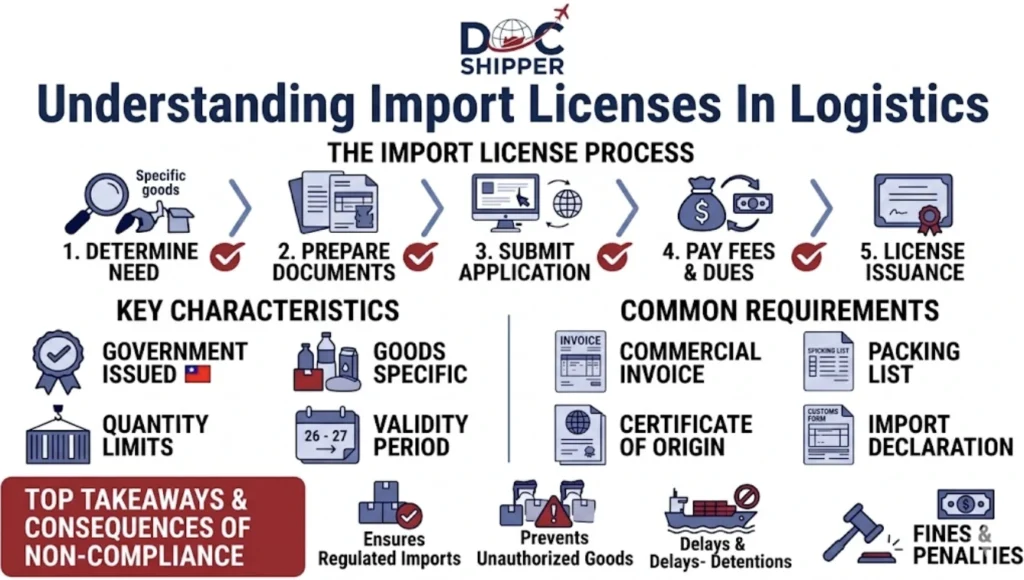
The application process typically requires detailed documentation including commercial invoices, certificates of origin, technical specifications, and evidence of financial capacity. Processing times range from a few days to several months depending on product sensitivity and administrative capacity.
Compliance obligations extend beyond initial approval. License holders must use permissions within specified timeframes, report actual import volumes, and often demonstrate that goods match declared specifications. Violations can result in license revocation, financial penalties, or criminal prosecution in severe cases.
According to the WTO Agreement on Import Licensing Procedures, member states must ensure that licensing processes are transparent, predictable, and do not create unnecessary barriers to trade. At DocShipper, we systematically verify licensing requirements across destination countries, ensuring our clients avoid regulatory pitfalls that could delay or block shipments.
The strategic importance of import licenses becomes evident in sectors like agriculture, where countries use them to protect food security, or in technology transfers, where dual-use goods require strict controls to prevent misuse. Understanding which Harmonized System (HS) codes trigger licensing requirements is essential for compliance planning.
Practical Examples & Data
Import licensing requirements vary dramatically by product category and destination country. Approximately 30-40% of global trade involves goods subject to some form of import licensing, though most developed economies have streamlined processes for non-sensitive items.
Comparative Licensing Requirements by Product Category
| Product Category | License Type | Typical Processing Time | Common Requirements |
|---|---|---|---|
| Pharmaceuticals | Non-automatic | 30-90 days | GMP certification, product registration |
| Agricultural Products | Non-automatic | 14-45 days | Phytosanitary certificate, quota allocation |
| Textiles (restricted) | Automatic/Non-automatic | 5-15 days | Certificate of origin, quota verification |
| Dual-use Goods | Non-automatic | 60-120 days | End-use certificate, security clearance |
| Consumer Electronics | Automatic | 1-3 days | Conformity assessment, statistical declaration |
Use Case: Pharmaceutical Import to European Union
A Brazilian pharmaceutical manufacturer seeks to export generic antibiotics to Germany. The process requires:
- Marketing authorization: Product registration with the European Medicines Agency (EMA) or national authority
- GMP certification: Proof that manufacturing facilities meet EU Good Manufacturing Practice standards
- Import license application: Submission to German customs authorities with batch documentation
- Processing timeline: Initial registration 12-18 months; subsequent shipments 30-45 days per license
- Compliance monitoring: Regular inspections and batch testing by destination authorities
Failure to obtain proper licensing resulted in over €2.3 billion in detained pharmaceutical shipments across EU borders in 2023, according to European Commission trade statistics. At DocShipper, we work with specialized regulatory consultants to navigate these complex approval processes, reducing time-to-market for our pharmaceutical clients.
Key Data Points on Global Import Licensing
- License coverage: WTO data shows member countries collectively maintain licensing requirements for approximately 8,500 HS code categories
- Processing efficiency: Digital licensing systems reduce processing times by 40-60% compared to paper-based procedures
- Compliance costs: Administrative expenses for license applications range from $200-$5,000 depending on product complexity and jurisdiction
- Rejection rates: Non-automatic licenses face refusal rates of 5-15% in heavily regulated sectors like defense and pharmaceuticals
- Regional variations: Developing countries tend to require licenses for 2-3 times more product categories than developed economies
Conclusion
Import licenses remain fundamental instruments in regulating international trade flows, balancing economic openness with legitimate policy objectives. Understanding licensing requirements, application procedures, and compliance obligations is non-negotiable for successful international operations.
Need expert guidance on import licensing for your specific products and markets? Contact DocShipper for comprehensive regulatory support and customs compliance management.
📚 Quiz
Test Your Knowledge: Import License
1. What is the primary purpose of an import license?
2. What is the key difference between automatic and non-automatic import licenses?
3. A pharmaceutical company plans to ship antibiotics to the EU. What is the correct approach?
🎯 Your Result
📞 Free Quote in 24hFAQ | Import License: Definition, Process & Practical Examples
Need Help with
Logistics or Sourcing ?
First, we secure the right products from the right suppliers at the right price by managing the sourcing process from start to finish. Then, we simplify your shipping experience - from pickup to final delivery - ensuring any product, anywhere, is delivered at highly competitive prices.


Fill the Form
Prefer email? Send us your inquiry, and we’ll get back to you as soon as possible.
Contact us




