



In short ⚡
Just In Time (JIT) is an inventory management strategy that synchronizes raw material orders with production schedules to minimize storage costs and waste. This lean manufacturing approach ensures goods arrive precisely when needed, eliminating excess inventory while maintaining continuous production flow and responding rapidly to market demand fluctuations.Introduction
Many companies struggle with balancing inventory costs against production continuity. Overstocking ties up capital and warehouse space, while understocking risks production halts and lost sales. This dilemma has plagued supply chain managers for decades.
Just In Time revolutionized global manufacturing by transforming inventory from a necessary burden into a competitive advantage. Originating in Toyota’s production system during the 1970s, JIT has become fundamental to modern international logistics, particularly for industries requiring rapid market response and minimal waste.
Understanding JIT is essential for import/export operations because it directly impacts:
- Supplier coordination: Requires precise delivery schedules across international borders
- Customs compliance: Demands streamlined clearance procedures to avoid production delays
- Transportation reliability: Zero tolerance for shipping delays or carrier inconsistencies
- Quality control: No buffer stock means defects immediately halt production
- Demand forecasting: Accurate predictions prevent both shortages and overproduction
JIT Mechanisms & Strategic Implications
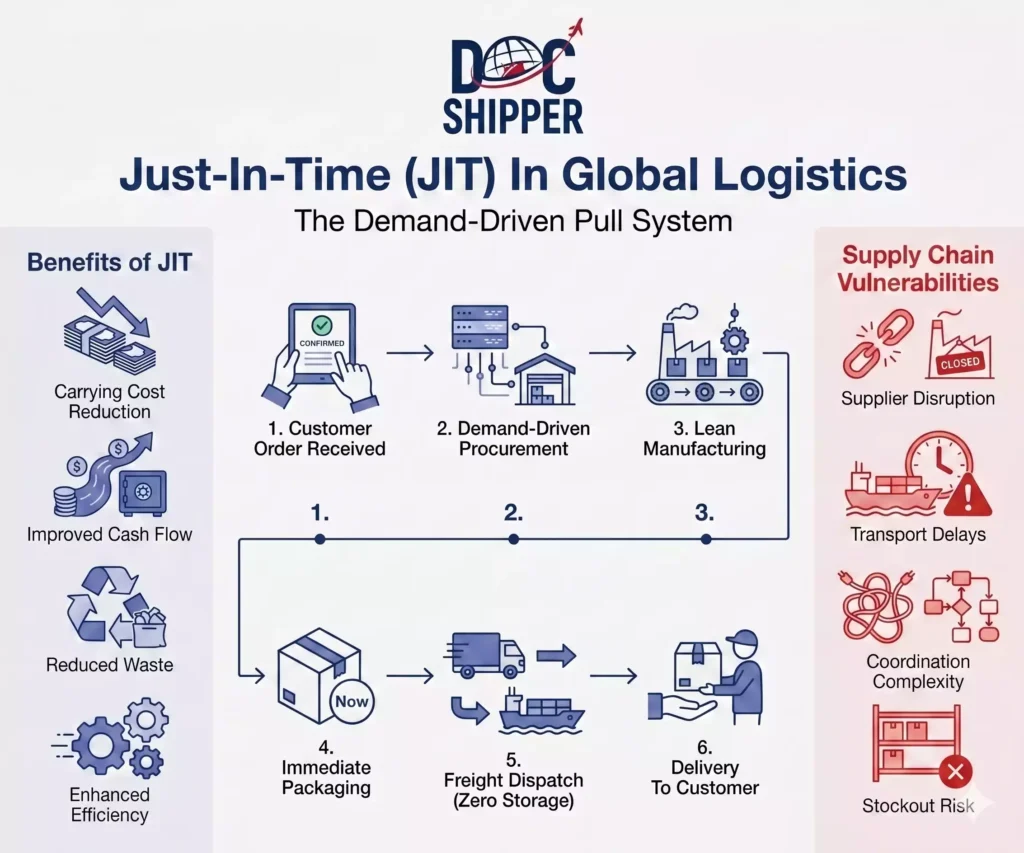
The Just In Time system operates on pull-based production, where manufacturing activities trigger material orders rather than forecasted demand pushing inventory accumulation. Each production stage signals the previous stage to deliver components exactly when needed, creating a synchronized chain from supplier to final assembly.
This approach requires takt time synchronization—aligning production pace with customer demand rate. If customers purchase 480 units daily during an 8-hour shift, the takt time equals 60 seconds per unit. Every process must complete within this interval to maintain continuous flow without inventory buildup.
Critical to JIT success is supplier partnership integration. Unlike traditional adversarial buyer-supplier relationships, JIT demands collaborative planning, transparent communication, and shared responsibility for quality. Suppliers often locate facilities near manufacturing plants or establish dedicated production lines for specific customers. At DocShipper, we facilitate these partnerships by coordinating international supplier networks and ensuring regulatory compliance across multiple jurisdictions.
The system’s vulnerability lies in supply chain disruption sensitivity. Natural disasters, port congestion, customs delays, or geopolitical events can immediately halt production. Companies mitigate this through supplier diversification, nearshoring strategies, and maintaining strategic safety stock for critical components. The World Trade Organization reports that supply chain resilience has become a priority following recent global disruptions.
JIT also demands zero-defect quality standards. Traditional manufacturing tolerates defective components because buffer inventory ensures production continuity during rework. JIT eliminates this safety net—a single defective batch stops the entire line. This necessitates rigorous supplier audits, statistical process control, and immediate corrective action protocols.
Practical Examples & Data Analysis
Consider a European automotive manufacturer importing electronic components from Asian suppliers. Under traditional inventory management, they maintained 90 days of safety stock, tying up €12 million in warehouse inventory. After implementing JIT with DocShipper’s logistics coordination, they reduced inventory to 7 days of working stock, freeing €11 million for R&D investment.
The transition required:
- Weekly shipment schedules: Replacing monthly bulk orders with smaller, frequent deliveries
- Bonded warehouse proximity: Establishing pre-cleared stock within 2-hour delivery radius
- Real-time tracking systems: GPS monitoring and automated customs declarations
- Quality pre-inspection: Verification at origin to prevent defective shipments
- Contingency suppliers: Secondary sources activated within 48 hours if primary fails
Data from manufacturing studies reveals significant JIT impacts:
| Metric | Traditional Inventory | JIT System | Improvement |
|---|---|---|---|
| Inventory Holding Costs | 15-25% of inventory value | 3-8% of inventory value | 60-80% reduction |
| Warehouse Space Requirements | 100,000 sq ft | 25,000 sq ft | 75% reduction |
| Lead Time to Market | 45-60 days | 10-15 days | 70% faster |
| Defect Rate | 2.5-4% | 0.3-0.8% | 85% reduction |
| Working Capital Tied Up | $50M | $8M | 84% reduction |
A practical electronics retailer case study demonstrates JIT’s flexibility advantage. When a competitor launched an unexpected product, the retailer adjusted production within 72 hours—shifting component orders and assembly schedules. Traditional manufacturers required 6-8 weeks to modify production plans due to committed inventory purchases.
However, JIT implementation costs include technology investments, supplier development programs, and initial logistics complexity. A mid-sized manufacturer should budget $500,000-$2 million for system integration, with ROI typically achieved within 18-24 months through inventory cost savings.
Conclusion
Just In Time transforms inventory from static cost into dynamic competitive advantage, demanding precision coordination across international supply networks. Success requires technological integration, supplier collaboration, and logistics expertise to balance efficiency gains against disruption vulnerability.
Need assistance implementing JIT strategies in your international operations? Contact DocShipper for customized supply chain solutions.
📚 Quiz
Test Your Knowledge: Just In Time (JIT)
What is the fundamental production principle that defines Just In Time inventory management?
A company maintains 90 days of safety stock under traditional inventory management. What is the primary risk they accept by transitioning to JIT with only 7 days of working stock?
An electronics manufacturer receives a shipment with 2% defective components. Under JIT principles, what is the correct immediate response?
🎯 Your Results
📞 Free Personalized QuoteFAQ | Just In Time (JIT): Definition, Implementation & Practical Examples
Traditional inventory management maintains large safety stocks based on forecasted demand, while JIT orders materials only when production signals actual need. JIT eliminates buffer inventory, reducing carrying costs by 60-80% but requiring precise supplier coordination and reliable logistics networks to prevent production disruptions.
JIT requires streamlined customs clearance and predictable transit times. Companies typically use bonded warehouses near production facilities, pre-cleared shipment procedures, and expedited customs brokerage services. Even 24-hour delays can halt production, making customs compliance and carrier reliability critical success factors for cross-border JIT operations.
Yes, but at scaled-down complexity. Small businesses can implement JIT principles through frequent supplier deliveries, minimal inventory holding, and demand-driven ordering without extensive technology investments. Success depends on strong supplier relationships, consistent demand patterns, and proximity to reliable suppliers or logistics partners who manage complexity.
Primary risks include supply chain disruptions (natural disasters, port strikes, geopolitical events), supplier quality failures, demand forecasting errors, and transportation delays. Companies mitigate these through supplier diversification, strategic safety stock for critical components, robust quality control systems, and comprehensive contingency planning with alternative logistics routes.
JIT dramatically improves quality because defects immediately stop production without buffer inventory to continue operations. This zero-tolerance environment forces rigorous supplier quality standards, statistical process control, and immediate corrective action. Defect rates typically decrease 80-90% under JIT systems compared to traditional manufacturing approaches.
Core technologies include Enterprise Resource Planning (ERP) systems for production scheduling, Transportation Management Systems (TMS) for logistics coordination, real-time inventory tracking using RFID or barcode scanning, Electronic Data Interchange (EDI) for supplier communication, and predictive analytics for demand forecasting. Cloud-based platforms enable real-time visibility across international supply networks.
Full JIT implementation requires 12-24 months for mid-sized manufacturers, including supplier selection and development, technology integration, process redesign, and staff training. Incremental implementation by product line or facility can show results within 6-9 months. Companies typically achieve ROI within 18-24 months through inventory reduction and efficiency gains.
Automotive, electronics, fashion, and food industries derive maximum JIT benefits due to high inventory costs, rapid product obsolescence, or perishability concerns. However, any industry with predictable demand patterns, reliable suppliers, and high inventory carrying costs can implement JIT successfully. Medical device and aerospace sectors increasingly adopt modified JIT approaches.
Resilient JIT strategies include maintaining 3-5 day strategic safety stock for critical components, qualifying multiple suppliers per component across different geographic regions, nearshoring production to reduce transit time, establishing regional distribution hubs, and implementing dynamic inventory allocation systems that adjust to real-time disruption data.
JIT is a core component of lean manufacturing philosophy, specifically addressing inventory waste elimination. Lean encompasses broader principles including continuous improvement (kaizen), waste reduction across all processes, value stream mapping, and respect for people. JIT operationalizes lean's inventory management principles through pull-based production and precise material timing.
JIT transforms supplier relationships from transactional to strategic partnerships. Companies share production schedules, quality data, and long-term forecasts with suppliers. Negotiations focus on delivery reliability, quality consistency, and continuous improvement rather than purely price-based competition. Suppliers often receive longer contract terms and collaborative problem-solving in exchange for JIT performance commitments.
Key performance indicators include inventory turnover ratio (target: 12-50x annually), on-time delivery percentage (target: >98%), production lead time, days of inventory on hand, supplier quality defect rates, stockout frequency, and working capital efficiency. Advanced metrics include supply chain cycle time and perfect order fulfillment rate measuring combined delivery, quality, and documentation accuracy.
Need Help with
Logistics or Sourcing ?
First, we secure the right products from the right suppliers at the right price by managing the sourcing process from start to finish. Then, we simplify your shipping experience - from pickup to final delivery - ensuring any product, anywhere, is delivered at highly competitive prices.


Fill the Form
Prefer email? Send us your inquiry, and we’ll get back to you as soon as possible.
Contact us




:%20Definition,%20Implementation%20&%20Practical%20Examples)