


In short ⚡
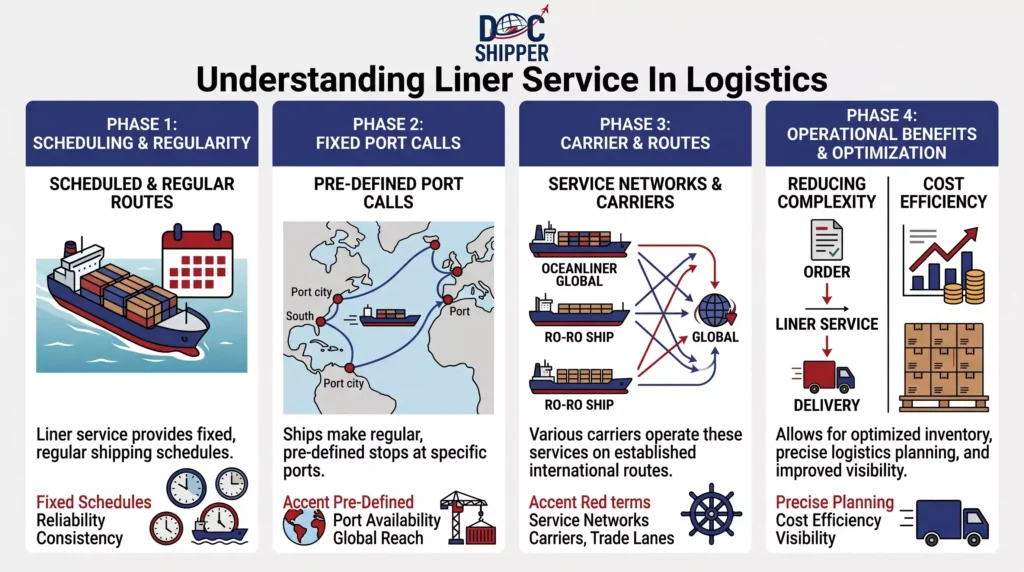
Liner Service is a regular maritime transport service operating on fixed routes with predetermined schedules and established ports of call. Unlike tramp shipping, liner services offer predictable departure and arrival times, making them essential for international trade and global supply chains.
Introduction
Many shippers struggle with unpredictable transit times and lack of transparency in ocean freight. Liner services solve this challenge by providing scheduled, regular maritime transport comparable to airline operations.
In international logistics, liner shipping represents the backbone of containerized trade. These services connect global ports through established routes, enabling businesses to plan inventory, manage production schedules, and optimize supply chain efficiency.
- Fixed schedules: Vessels depart and arrive according to published timetables, regardless of cargo volume
- Established routes: Predetermined port sequences connecting major trade lanes
- Standard freight rates: Published tariffs applying to all shippers equally
- Common carrier status: Legal obligation to accept cargo from any shipper within capacity limits
- Conference agreements: Cooperative arrangements among carriers to maintain service standards and rate stability
Operational Framework & Industry Standards
Liner services operate within a highly structured framework governed by international maritime conventions and commercial practices. Understanding these operational principles is crucial for importers and exporters.
Service strings represent the fundamental unit of liner operations. A string consists of multiple vessels rotating on a specific loop, ensuring weekly or bi-weekly port calls. Major carriers deploy 10 to 20 vessels on high-volume routes like Asia-Europe or Transpacific trades.
Vessel sharing agreements (VSAs) allow multiple carriers to share space on the same ships, optimizing capacity utilization. These alliances enable carriers to offer broader geographic coverage without deploying additional vessels. The three major alliances—2M, Ocean Alliance, and THE Alliance—control approximately 80% of global container capacity.
Port rotation patterns determine the sequence of calls. A typical Asia-Europe string might include: Shanghai → Ningbo → Hong Kong → Singapore → Colombo → Suez Canal → Rotterdam → Hamburg → Antwerp. Each rotation takes 8 to 12 weeks depending on vessel speed and port efficiency.
Schedule reliability remains a critical performance metric. According to BIMCO, global liner schedule reliability averaged 65% in recent years, meaning only two-thirds of vessels arrive within the scheduled day. At DocShipper, we monitor vessel movements in real-time to provide accurate arrival predictions and minimize supply chain disruptions.
Regulatory compliance shapes liner operations significantly. International Maritime Organization (IMO) regulations on sulfur emissions (IMO 2020) forced carriers to adopt low-sulfur fuel or install scrubbers. Environmental regulations increasingly influence routing decisions, vessel speed optimization, and operational costs.
Practical Examples & Market Data
Understanding liner services through concrete examples helps shippers make informed decisions about routing, carrier selection, and timing.
Comparative Analysis: Major Trade Routes
| Route | Transit Time | Frequency | Average Rate (40′ container) |
|---|---|---|---|
| Asia-North Europe | 28-35 days | Daily departures | $2,500-4,000 |
| Transpacific (Asia-US West Coast) | 14-18 days | Daily departures | $1,800-3,500 |
| Transatlantic (Europe-US East Coast) | 10-14 days | 3-4 times weekly | $1,200-2,000 |
| Asia-Middle East | 12-16 days | 5-7 times weekly | $800-1,500 |
Use Case: Electronics Manufacturer’s Shipping Strategy
A European electronics company imports components from Shenzhen to Hamburg. By selecting a liner service with weekly departures and 32-day transit time, they achieve:
- Predictable inventory planning: Components arrive every Tuesday, aligning with production schedules
- Reduced safety stock: Reliable schedules allow 25% reduction in buffer inventory
- Cost optimization: Consolidated weekly shipments at $3,200 per 40′ container vs. air freight at $8,500
- Documentation efficiency: Single booking process covering multiple shipments through annual contract
Key Market Indicators
- Global liner fleet capacity: Approximately 25 million TEU (Twenty-foot Equivalent Units)
- Top 10 carriers market share: 85% of global capacity
- Average vessel size on major routes: 15,000-24,000 TEU for Asia-Europe; 8,000-14,000 TEU for Transpacific
- Schedule reliability impact: Each day of delay costs shippers an average of $75-150 per container in inventory holding costs
- Digital adoption: 40% of liner bookings now processed through digital platforms, up from 15% pre-pandemic
At DocShipper, we leverage our relationships with major liner operators to secure competitive rates and priority space allocation during peak seasons. Our booking management system tracks vessel schedules across 200+ services globally, ensuring optimal routing for your shipments.
Conclusion
Liner services provide the predictability and reliability essential for modern supply chain management. Understanding route patterns, carrier alliances, and schedule dynamics enables strategic shipping decisions that balance cost, transit time, and service quality.
Need expert guidance on selecting the right liner service for your trade lane? Contact DocShipper for personalized freight solutions and rate negotiations.
📚 Quiz
Test Your Knowledge: Liner Service
What is the defining characteristic of liner service operations?
A shipper believes liner services guarantee exact arrival dates. Is this interpretation correct?
An electronics manufacturer needs predictable component deliveries from Asia to Europe. Which shipping option best suits their supply chain requirements?
🎯 Your Result
📞 Free Personalized QuoteFAQ | Liner Service: Definition, Operations & Practical Examples
Liner services operate on fixed schedules and routes with published rates, accepting cargo from multiple shippers. Tramp shipping operates on demand without fixed schedules, typically chartered by a single party for specific cargo movements. Liners function like buses with regular stops, while tramps operate like taxis going wherever chartered.
For standard shipments, booking 2-3 weeks before departure is typical. Peak seasons (August-October for Transpacific, pre-Chinese New Year for Asia exports) require 4-6 weeks advance booking. Time-sensitive or oversized cargo may need earlier reservation to secure appropriate space and equipment.
No, liner services provide estimated arrival dates based on scheduled transits. Weather conditions, port congestion, and operational factors can affect actual arrival times. Carriers typically specify "on-time" as arrival within one day of the scheduled date. Industry average schedule reliability hovers around 65-70% globally.
Liner conferences are agreements among carriers on specific routes to coordinate schedules and rates. While historically powerful in rate-setting, their influence has diminished due to deregulation and competition. Today, vessel sharing agreements and alliances serve similar coordination functions while maintaining competitive pricing structures.
BAF surcharges compensate carriers for fuel price fluctuations. These vary quarterly or monthly based on fuel costs and are applied as percentage additions to base freight rates. Since IMO 2020 sulfur regulations, BAF calculations have become more complex, often split between low-sulfur fuel surcharges and emission compliance costs.
Essential documents include commercial invoice, packing list, and shipping instructions containing consignee details, cargo description, and special handling requirements. Depending on the destination, you may need certificates of origin, phytosanitary certificates, or dangerous goods declarations. Electronic submission through carrier platforms has streamlined this process significantly.
Most major carriers offer container tracking through their websites and mobile apps using container numbers or bill of lading references. Tracking typically shows vessel position, port arrival/departure times, and customs clearance status. Third-party platforms aggregate data from multiple carriers for consolidated visibility across different shipments.
Carriers typically roll cargo to the next available vessel on the same service. Rolling policies vary by carrier and contract terms. Some carriers charge rollover fees, while service contract customers often receive automatic rebooking. During peak seasons, rolled cargo may face 1-2 week delays until space becomes available.
Carriers occasionally skip scheduled ports due to vessel delays, weather, or commercial decisions. Omitted cargo is either transshipped through alternative ports or rolled to the next sailing. Service contracts typically include clauses allowing such changes, though carriers may offer compensation for resulting delays exceeding specified thresholds.
Slow steaming reduces vessel speeds from 20-24 knots to 16-18 knots to save fuel and reduce emissions. This extends transit times by 10-20% but cuts fuel consumption by 30-50%. Carriers adjust service strings by adding vessels to maintain weekly frequency despite longer voyage times, affecting both costs and environmental footprints.
Peak shipping seasons (pre-holiday periods in Q3-Q4) see increased demand, higher rates, and reduced space availability. Carriers deploy extra vessels temporarily or increase frequencies. Low seasons (January-March, post-Chinese New Year) typically offer lower rates and abundant space, though carriers may reduce service frequencies or implement blank sailings.
Standard carrier liability is limited to approximately $500 per package or customary freight unit under maritime law. Shippers should purchase cargo insurance covering full value. All-risk marine cargo insurance typically costs 0.2-0.5% of cargo value and covers loss, damage, and general average contributions during the ocean voyage and inland transits.
Need Help with
Logistics or Sourcing ?
First, we secure the right products from the right suppliers at the right price by managing the sourcing process from start to finish. Then, we simplify your shipping experience - from pickup to final delivery - ensuring any product, anywhere, is delivered at highly competitive prices.


Fill the Form
Prefer email? Send us your inquiry, and we’ll get back to you as soon as possible.
Contact us




