


In short ⚡
The Load Line is a mandatory marking on a vessel's hull indicating the maximum safe draft level to which a ship can be loaded. Also known as the Plimsoll Line, it ensures maritime safety by preventing overloading and maintains vessel stability across different water densities and seasonal conditions, as regulated by the International Convention on Load Lines (ICLL).Introduction
Many shippers underestimate how vessel loading limits directly impact shipping costs, transit times, and cargo insurance validity. Exceeding the Load Line can result in port detention, fines up to $500,000, or even vessel seizure—yet countless importers remain unaware of how this marking affects their supply chain.
In international freight operations, the Load Line serves as the critical safety threshold between operational efficiency and maritime disaster. This internationally recognized marking system has reduced cargo-related vessel losses by 78% since its universal adoption in 1968, according to the International Maritime Organization (IMO).
Understanding Load Lines is essential for:
- Freight forwarders: Calculating accurate container weights and vessel suitability
- Marine insurers: Validating coverage eligibility based on loading compliance
- Port authorities: Enforcing safety regulations during cargo operations
- Importers/exporters: Preventing shipment delays due to overloading violations
- Logistics managers: Optimizing payload capacity across seasonal routes
The system accounts for variations in water density (saltwater vs. freshwater) and seasonal weather patterns, adjusting maximum draft levels accordingly. This ensures vessels maintain adequate freeboard—the distance between the waterline and deck—preventing wave ingress and structural stress.
Technical Framework & Regulatory Requirements
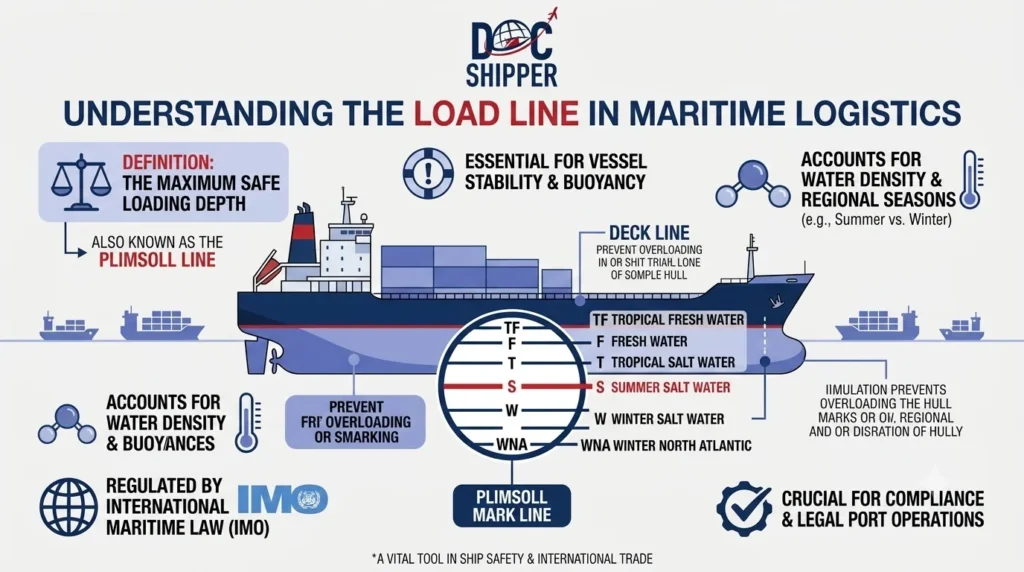
The Load Line marking consists of a horizontal line intersected by a circle, with additional marks indicating safe loading levels for different conditions. The deck line—a horizontal stripe 300mm long and 25mm wide—serves as the reference point for all measurements, positioned at the ship’s side amidships.
Below the deck line, the system displays six standard markings:
TF (Tropical Fresh Water): Maximum draft in tropical freshwater zones, typically 48mm above the Summer mark. Freshwater’s lower density (997 kg/m³ vs. seawater’s 1,025 kg/m³) requires reduced loading to maintain equivalent buoyancy. This applies to rivers like the Amazon or Yangtze during warm seasons.
F (Fresh Water): Standard freshwater loading limit, positioned above the Summer mark. The differential accounts for the 2.8% density difference between fresh and saltwater. Container vessels transiting the Great Lakes must adhere to this mark before entering freshwater channels.
T (Tropical): Permits maximum loading in warm seawater zones (between 30°N and 30°S latitudes), where calmer weather conditions prevail. This marking allows increased cargo capacity by approximately 1/48th of the Summer draft, translating to 20-30 additional TEUs on large container ships.
S (Summer): The baseline marking representing safe loading in temperate seawater during summer months. All other marks reference this level. The International Convention on Load Lines mandates this as the primary calculation point for vessel stability assessments.
W (Winter): Reduced draft level for harsh weather conditions, set 1/48th of the Summer draft below the S mark. North Atlantic routes between November and March typically require compliance with this lower limit due to increased wave heights and deck ice accumulation risks.
WNA (Winter North Atlantic): The most restrictive marking, applicable only to vessels under 100 meters traveling in designated North Atlantic zones during winter. This additional safety margin accounts for extreme weather patterns in this notoriously dangerous shipping corridor.
The International Maritime Organization (IMO) enforces compliance through the International Convention on Load Lines (ICLL), requiring all commercial vessels over 24 meters to display permanent Load Line markings. Classification societies like Lloyd’s Register and Det Norske Veritas conduct mandatory surveys every five years to verify marking accuracy and hull integrity.
At DocShipper, our maritime compliance specialists verify Load Line certificates and vessel suitability before finalizing charter agreements, preventing costly rejections at loading ports and ensuring your cargo travels on properly certified vessels.
The freeboard calculation incorporates vessel type, hull configuration, and superstructure design. Type A vessels (designed for liquid bulk cargo with high integrity standards) receive smaller freeboards than Type B vessels (general cargo ships). This distinction reflects different watertight integrity requirements and cargo shifting risks.
Practical Applications & Industry Data
Real-world Load Line management directly impacts cargo capacity planning and route optimization. Consider this comparative scenario for a 200-meter container vessel with a Summer draft of 12.5 meters:
| Loading Zone | Applicable Mark | Maximum Draft | TEU Capacity | Capacity Variation |
|---|---|---|---|---|
| Tropical Seawater | T | 12.76m | 8,520 TEU | +3.1% vs Summer |
| Summer Seawater | S | 12.50m | 8,260 TEU | Baseline |
| Winter Seawater | W | 12.24m | 8,050 TEU | -2.5% vs Summer |
| Winter North Atlantic | WNA | 11.98m | 7,840 TEU | -5.1% vs Summer |
| Freshwater | F | 12.85m | 8,450 TEU | +2.3% vs Summer |
This data reveals significant capacity fluctuations based on routing decisions. A Shanghai-Hamburg service routed via the Suez Canal during winter must comply with Winter markings for the North Atlantic leg, reducing potential revenue by approximately $210,000 per voyage at current freight rates ($50/TEU differential × 210 containers).
Case Study: Bulk Carrier Optimization
A 75,000 DWT bulk carrier loading iron ore in Brazil for delivery to Rotterdam demonstrates practical Load Line application. The vessel’s Summer deadweight capacity is 75,000 metric tons, but seasonal and route considerations modify actual loading limits:
- Departure scenario (January): Tropical zone allows maximum 77,344 MT (+3.1%)
- Mid-Atlantic crossing (February): Transition to Winter zone reduces effective capacity to 73,125 MT
- North Sea approach (February): Winter conditions mandate compliance with W mark
- Final unloading weight: 73,100 MT (allowing 25 MT safety margin)
- Revenue impact: Lost 4,244 MT at $85/MT = $360,740 opportunity cost
The shipper must calculate the optimal loading point balancing maximum departure capacity against arrival compliance. Overloading at departure risks port state control detention, while excessive conservative loading sacrifices revenue.
Industry statistics from the International Union of Marine Insurance indicate that Load Line violations contribute to 12% of cargo insurance claim denials, representing approximately $890 million in uncompensated losses annually. Most violations occur due to:
- Cargo density miscalculations (41% of cases)
- Ballast water management errors (28%)
- Fuel and provision weight underestimation (19%)
- Seasonal zone misinterpretation (12%)
Modern vessel management systems integrate Load Line data with weather routing software to optimize cargo intake. The Maersk Triple-E class vessels employ algorithms that calculate maximum loading based on forecast weather patterns along the entire route, adjusting ballast distribution to maintain optimal trim while respecting Load Line restrictions throughout the voyage.
At DocShipper, we provide pre-shipment weight verification services and Load Line compliance audits, ensuring your cargo specifications align with vessel capacity across all route segments—eliminating the risk of costly port rejections or insurance coverage gaps.
Conclusion
The Load Line system remains the fundamental safety mechanism preventing vessel overloading and ensuring maritime operational integrity across global supply chains. Understanding its technical requirements and seasonal variations enables shippers to optimize cargo capacity while maintaining full compliance and insurance coverage.
Need expert guidance on Load Line compliance for your upcoming shipments? Contact DocShipper’s maritime specialists for comprehensive vessel verification and cargo planning support.
📚 Quiz
Test Your Knowledge: Load Line
What is the primary purpose of the Load Line marking on a vessel's hull?
Why does the Load Line system include separate markings for freshwater and saltwater conditions?
A container vessel is transiting from tropical waters to the North Atlantic in February. Which Load Line mark compliance strategy is correct?
🎯 Your Result
📞 Free Quote in 24hFAQ | Load Line: Definition, Calculation & Practical Examples
Need Help with
Logistics or Sourcing ?
First, we secure the right products from the right suppliers at the right price by managing the sourcing process from start to finish. Then, we simplify your shipping experience - from pickup to final delivery - ensuring any product, anywhere, is delivered at highly competitive prices.


Fill the Form
Prefer email? Send us your inquiry, and we’ll get back to you as soon as possible.
Contact us




