


In short ⚡
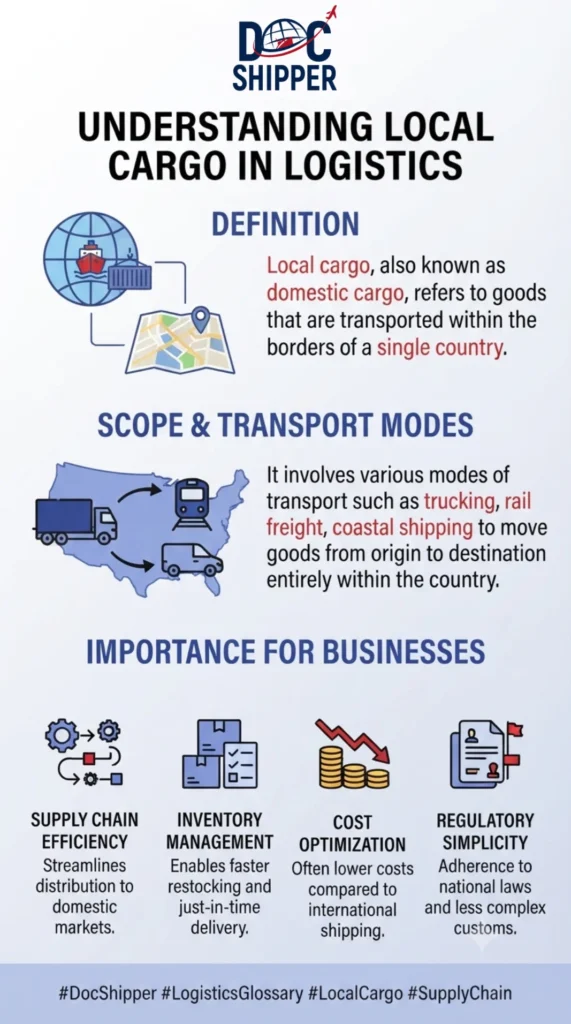
Local Cargo refers to freight transported within a specific geographic area, typically within the same city, region, or country. Unlike international shipments, local cargo involves shorter distances and simplified customs procedures, making it essential for domestic supply chains, last-mile delivery, and regional distribution networks.Introduction
Many businesses mistakenly believe that local cargo operations are simpler than international logistics. However, efficient domestic transport requires precise coordination, regulatory compliance, and strategic routing to maintain competitive advantage.
In modern supply chains, local cargo serves as the foundation for e-commerce fulfillment, retail distribution, and manufacturing continuity. Delays in local transport directly impact customer satisfaction and inventory management.
Key characteristics of local cargo operations include:
- Short transit times – typically 24-72 hours within the same region
- Reduced documentation – no international customs declarations required
- Flexible routing options – multiple carriers and transport modes available
- Cost efficiency – lower fuel surcharges and fewer handling points
- Real-time tracking – enhanced visibility through GPS and digital platforms
Understanding local cargo dynamics helps businesses optimize inventory placement, reduce delivery times, and control transportation costs. At DocShipper, we manage domestic logistics across all continents, ensuring seamless coordination between warehouses, distribution centers, and final delivery points.
Local Cargo Mechanisms & Operational Expertise
Local cargo operations differ fundamentally from international freight due to regulatory environments and infrastructure availability. Domestic transport typically involves fewer compliance checkpoints but demands precision in route planning and carrier selection.
The primary transport modes for local cargo include:
Road transport dominates local cargo due to flexibility and direct door-to-door delivery. Trucking companies offer various vehicle sizes, from vans for small parcels to full truckloads for bulk shipments. Temperature-controlled vehicles serve perishable goods markets.
Rail freight provides cost-effective solutions for heavy or bulk cargo over medium distances. Rail networks connect major industrial zones and ports, offering predictable schedules and lower carbon emissions compared to trucking.
Inland waterways serve specific regions with navigable rivers and canals. Barge transport handles large volumes at competitive rates, particularly for construction materials, agricultural products, and raw materials.
Local air freight addresses urgent shipments requiring same-day or next-day delivery within national boundaries. Express carriers utilize regional airports and dedicated cargo terminals for high-value or time-sensitive goods.
Regulatory compliance in local cargo focuses on weight restrictions, hazardous materials handling, and driver hour limitations. The U.S. Department of Transportation provides comprehensive guidelines for domestic freight operations, including safety standards and licensing requirements.
At DocShipper, we systematically verify carrier insurance coverage and licensing status before assigning local cargo shipments. Our network includes pre-qualified partners across North America, Europe, Asia, and emerging markets, ensuring reliable service regardless of origin or destination.
Technology integration transforms local cargo efficiency. Transportation Management Systems (TMS) optimize routing, consolidate shipments, and provide real-time visibility. Electronic Proof of Delivery (ePOD) systems eliminate paperwork and accelerate invoicing cycles.
Practical Examples & Industry Data
Understanding local cargo through concrete scenarios helps businesses anticipate challenges and optimize their domestic logistics strategies. The following examples demonstrate typical applications across different industries.
Case Study: E-commerce Last-Mile Delivery
An online retailer operates a distribution center in Chicago serving the Midwest region. Daily shipment volume reaches 8,500 packages destined for customers within a 300-mile radius.
The company implements zone-based routing with multiple carriers:
- Zone 1 (0-50 miles): In-house delivery fleet – 2-hour delivery windows
- Zone 2 (51-150 miles): Regional carrier – next-day delivery
- Zone 3 (151-300 miles): National carrier – 48-hour delivery
By optimizing carrier selection by zone, the retailer reduces per-package delivery costs by 23% while maintaining delivery commitments. Consolidation strategies combine orders going to the same zip codes, further reducing transportation expenses.
Comparative Cost Analysis: Local Cargo Transport Modes
| Transport Mode | Cost per Ton/Mile | Average Speed | Best Use Case |
|---|---|---|---|
| Full Truckload (FTL) | $1.50 – $2.50 | 45-55 mph | Large shipments, direct routes |
| Less Than Truckload (LTL) | $0.90 – $1.80 | 35-45 mph | Smaller shipments, shared capacity |
| Rail Freight | $0.30 – $0.70 | 20-30 mph | Bulk cargo, non-urgent delivery |
| Local Air Cargo | $8.00 – $15.00 | 400-500 mph | Urgent, high-value shipments |
| Inland Barge | $0.20 – $0.50 | 5-10 mph | Very heavy/bulk, waterway accessible |
These cost structures demonstrate why mode selection depends on shipment characteristics, urgency, and budget constraints. Combining multiple modes creates hybrid solutions that balance speed and cost efficiency.
Industry Performance Metrics
Recent logistics industry data reveals critical benchmarks for local cargo operations:
- Average on-time delivery rate for local cargo: 94.3% (compared to 89.7% for international shipments)
- Damage claim frequency: 0.8% of local shipments (versus 2.1% for international freight)
- Average dwell time at distribution centers: 18 hours for local cargo processing
- Fuel efficiency improvement through route optimization: 15-22% reduction in miles driven
- Cost savings from consolidation strategies: 12-18% for shippers with regular local routes
At DocShipper, we leverage these benchmarks to design customized local cargo solutions. Our clients achieve above-average performance through strategic carrier partnerships, technology integration, and continuous process optimization.
Conclusion
Local cargo operations form the backbone of domestic commerce, requiring strategic planning and operational precision. Mastering domestic logistics translates directly into competitive advantages through reduced costs and improved customer satisfaction.
Need expert guidance on optimizing your local cargo operations? Contact DocShipper for tailored logistics solutions across all continents.
📚 Quiz
Test Your Knowledge: Local Cargo
What is the primary defining characteristic of local cargo?
Which statement accurately reflects a common misconception about local cargo operations?
A retailer ships 500 packages daily within a 200-mile radius. Which transport strategy would optimize costs while maintaining delivery commitments?
🎯 Your Result
📞 Free Quote in 24hFAQ | Local Cargo: Definition, Operations & Practical Examples
Local cargo typically refers to shipments within a metropolitan area or single state, usually under 250 miles. Regional cargo covers multi-state areas within a specific geographic zone, while national cargo spans coast-to-coast distances. The distinction affects carrier selection, transit times, and pricing structures. Local cargo often uses smaller vehicles and more frequent deliveries, while national cargo requires long-haul trucking or intermodal solutions.
Local cargo insurance generally requires lower coverage limits since shipments stay within one country's legal jurisdiction. Standard carrier liability ranges from $0.60 to $2.00 per pound. International cargo demands comprehensive all-risk policies covering marine perils, customs issues, and political risks. Local shipments avoid complexities like foreign exchange fluctuations and international arbitration. However, high-value local cargo still requires additional declared value coverage beyond basic carrier liability.
Essential documents include a bill of lading, commercial invoice, and packing list. Unlike international cargo, local shipments do not require customs declarations, certificates of origin, or export licenses. Hazardous materials need Material Safety Data Sheets (MSDS) and proper placarding regardless of distance. Temperature-sensitive cargo requires cold chain documentation. Electronic documentation increasingly replaces paper bills of lading through platforms offering digital signatures and automated proof of delivery.
Cost reduction strategies include shipment consolidation, flexible delivery windows, and zone-based carrier selection. Negotiating volume discounts with preferred carriers yields 10-15% savings. Implementing Transportation Management Systems optimizes routing and eliminates empty miles. Backhauling opportunities reduce deadhead costs. Using regional carriers for specific zones often beats national carrier pricing. Analyzing shipping patterns identifies opportunities to shift non-urgent shipments to less expensive modes like rail or LTL trucking.
Technology enables real-time tracking through GPS devices and mobile applications. Transportation Management Systems automate carrier selection, rate shopping, and load optimization. Electronic Proof of Delivery eliminates paperwork delays and accelerates billing cycles. Predictive analytics forecast demand patterns and prevent capacity shortages. Integration with warehouse management systems coordinates inventory levels with transportation schedules. Blockchain technology emerges as a solution for transparent, tamper-proof documentation across supply chain partners.
Peak seasons like holiday retail periods create capacity constraints, driving rates up 20-40% above baseline pricing. Agricultural harvest seasons strain rural transport networks. Weather disruptions in winter months delay deliveries and increase fuel surcharges. Forward-thinking shippers secure capacity through annual contracts or quarterly commitments. Diversifying carrier relationships prevents over-reliance on single providers. Buffer inventory strategies reduce urgency during peak periods, allowing use of less expensive transport modes.
Local cargo generates significant carbon emissions through frequent short-haul trips. Electric delivery vehicles reduce emissions in urban areas but require charging infrastructure. Route optimization software decreases fuel consumption by 15-25%. Consolidation strategies reduce total vehicle miles traveled. Rail and barge transport offer lower emissions per ton-mile than trucking. Regulatory pressures increase as cities implement low-emission zones. Companies pursuing sustainability certifications must measure and report local cargo environmental impact through standardized frameworks.
Hazardous materials require proper classification under DOT regulations, specialized packaging, and trained handlers. Carriers need hazmat certifications and appropriate vehicle placarding. Material Safety Data Sheets must accompany shipments throughout transport. Routing restrictions avoid residential areas and sensitive infrastructure. Emergency response information must be immediately accessible. Penalties for non-compliance range from fines to criminal charges. Specialized carriers focus exclusively on hazmat transport, offering expertise that general freight carriers cannot match.
Critical metrics include on-time delivery rate (target: >95%), cost per shipment, damage frequency (<1%), and average transit time. Utilization rates measure vehicle capacity usage (optimal: 85-95%). Customer satisfaction scores track service quality. Fuel efficiency monitoring identifies improvement opportunities. Claims ratio reveals packaging and handling issues. Dwell time at distribution centers affects overall supply chain velocity. Carrier scorecard systems compare performance across multiple providers, enabling data-driven selection decisions.
Cross-docking eliminates storage time by transferring cargo directly from inbound to outbound vehicles. This approach reduces handling costs by 30-50% and accelerates delivery times. Distribution centers become flow-through facilities rather than storage warehouses. Synchronized arrival schedules maximize cross-dock efficiency. Requirements include advanced shipment notifications, barcode scanning, and precise timing coordination. Perishable goods particularly benefit from minimized handling and storage time. However, cross-docking demands reliable carrier performance and sophisticated coordination systems.
Effective contingency plans identify alternative carriers, backup routes, and emergency protocols. Maintaining relationships with multiple carriers prevents single-point failures. Safety stock buffers absorb short-term disruptions. Communication protocols ensure rapid notification of delays or issues. Insurance coverage protects against financial losses from major disruptions. Regular scenario planning exercises test response capabilities. Weather monitoring systems provide early warnings for storm-related delays. Diversified distribution networks reduce vulnerability to localized disruptions affecting single facilities.
Pricing varies significantly based on fuel costs, labor rates, competition density, and infrastructure quality. Urban areas typically see higher rates due to congestion and limited parking. Rural regions face capacity constraints and longer distances between stops. Coastal markets benefit from competitive carrier options, while inland areas may have limited choices. Fuel surcharges fluctuate with diesel prices, adding 10-20% to base rates. Seasonal demand spikes affect pricing predictability. Shippers in high-competition markets negotiate better rates through competitive bidding processes.
Need Help with
Logistics or Sourcing ?
First, we secure the right products from the right suppliers at the right price by managing the sourcing process from start to finish. Then, we simplify your shipping experience - from pickup to final delivery - ensuring any product, anywhere, is delivered at highly competitive prices.


Fill the Form
Prefer email? Send us your inquiry, and we’ll get back to you as soon as possible.
Contact us




