


In short ⚡
LAYCAN (Laydays and Canceling) is a contractual clause in maritime charter parties defining the earliest date a vessel must arrive at the loading port (laydays) and the latest date the charterer can cancel the contract if the vessel has not arrived (canceling date). This window protects both shipowner and charterer from scheduling uncertainties.Introduction
In international shipping, timing failures cost thousands of dollars daily in demurrage, storage, and lost sales opportunities. LAYCAN clauses exist precisely to manage these risks by establishing clear time boundaries for vessel availability.
Whether chartering bulk carriers for grain exports or container vessels for manufactured goods, understanding LAYCAN protects your cargo scheduling and budget. This contractual mechanism balances flexibility with accountability across the supply chain.
Key characteristics of LAYCAN include:
- Dual-date structure: Earliest laydays start and latest canceling deadline
- Mutual protection: Shipowner gets preparation time; charterer gets cancellation rights
- Charter party integration: Applies to voyage and time charters
- Commercial flexibility: Negotiable window duration based on route and cargo
- Legal enforceability: Governed by maritime law and contract terms
LAYCAN Mechanisms & Legal Framework
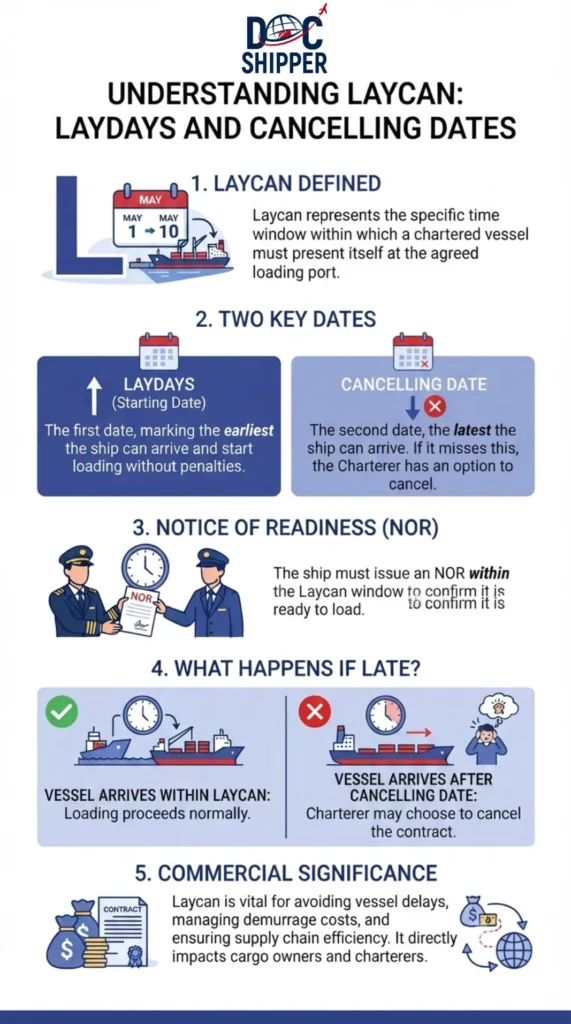
The LAYCAN window operates through two critical dates. The laydays date marks when the vessel becomes available for loading—arriving earlier grants no advantage, as the charterer isn’t obligated to load until this date. The canceling date represents the charterer’s deadline: if the vessel hasn’t arrived and given Notice of Readiness by this point, the charterer may cancel without penalty.
Between these dates lies the acceptable arrival window. Shipowners typically aim for mid-LAYCAN arrival to buffer against delays while avoiding excessive early positioning costs. Standard windows range from 3-7 days for short routes to 10-15 days for long-haul voyages, though parties negotiate based on cargo urgency and vessel availability.
Legal implications govern each scenario. Early arrival before laydays means the vessel waits at its own expense until the commencement date. Timely arrival within the window proceeds normally with loading operations. Late arrival past the canceling date triggers the charterer’s option to cancel, though some contracts include force majeure clauses protecting shipowners from penalties due to weather, port congestion, or mechanical failures beyond reasonable control.
The International Chamber of Shipping provides standardized charter party forms incorporating LAYCAN provisions. These templates, including GENCON and NYPE forms, establish industry-recognized dispute resolution procedures when timing conflicts arise.
At DocShipper, we monitor LAYCAN windows throughout the booking process, coordinating with carriers to ensure vessel schedules align with your cargo readiness dates. Our maritime team negotiates favorable LAYCAN terms that balance flexibility with protection against delays.
Practical Examples & Industry Data
Understanding LAYCAN through real scenarios clarifies its commercial impact. Consider a grain exporter shipping 50,000 metric tons of wheat from Houston to Rotterdam. The charter party specifies LAYCAN as September 10-17, 2024.
| Scenario | Vessel Arrival Date | Commercial Outcome | Financial Impact |
|---|---|---|---|
| Early Arrival | September 7 | Waits 3 days; loading starts Sept 10 | Shipowner absorbs ~$30,000 positioning cost |
| Optimal Arrival | September 13 | Loads immediately; smooth operation | No additional costs |
| Late Arrival | September 19 | Charterer cancels; finds alternative vessel | Charterer incurs ~$75,000 replacement cost; shipowner loses freight |
| Weather Delay | September 18 (hurricane delay) | Force majeure invoked; LAYCAN extended | Negotiated 3-day extension; contract maintained |
Industry data reveals LAYCAN’s commercial significance. According to Baltic Exchange 2023 reports, approximately 12% of charter parties experience LAYCAN disputes, with 68% resolved through negotiated extensions rather than cancellations. The average LAYCAN window has increased from 5 days in 2015 to 8 days in 2024, reflecting growing supply chain volatility.
Container shipping versus bulk cargo demonstrates different LAYCAN applications. Container vessels operate on fixed schedules with narrow LAYCAN windows (24-48 hours), while bulk carriers allow broader windows (7-14 days) due to cargo flexibility and port congestion variability. Tankers carrying time-sensitive chemicals often negotiate premium rates for tighter LAYCAN guarantees.
Cost implications vary by cargo value. High-value electronics shipments might include penalty clauses of $50,000-$100,000 for LAYCAN breaches, while commodity cargo contracts focus on replacement vessel costs. Smart charterers build contingency plans, identifying backup vessels within the LAYCAN period to minimize disruption risks.
Conclusion
LAYCAN clauses form the temporal foundation of maritime charter agreements, balancing operational flexibility with contractual certainty. Mastering these provisions protects your shipping investments and ensures cargo moves according to your business timeline.
Need expert guidance on charter party negotiations or LAYCAN management? Contact DocShipper for comprehensive maritime logistics support.
📚 Quiz
Test Your Knowledge: LAYCAN in Maritime Shipping
What is the primary purpose of the LAYCAN clause in maritime charter parties?
If a vessel arrives before the LAYCAN laydays date, who bears the waiting costs until loading can commence?
A grain shipment from Houston to Rotterdam has LAYCAN September 10-17, 2024. The vessel arrives September 19 due to documented hurricane delays. What is the most likely outcome?
🎯 Your Results
📞 Get Your Free Quote in 24hFAQ | LAYCAN: Definition, Calculation & Practical Examples in Maritime Shipping
The vessel must wait until the laydays commence before the charterer is obligated to begin loading operations. All waiting costs—including port fees, crew wages, and fuel—remain the shipowner's responsibility. The charterer cannot be forced to load earlier, though they may choose to do so by mutual agreement, sometimes negotiating reduced freight rates for the accommodation.
Yes, technically the charterer has the legal right to cancel if the vessel has not arrived and tendered Notice of Readiness by the exact canceling date and time specified in the charter party. However, in practice, many charterers negotiate short extensions (24-48 hours) if the delay is minimal and caused by documented force majeure events, as finding replacement tonnage often costs more than the delay itself.
Force majeure clauses—covering events like hurricanes, port strikes, or piracy—typically excuse late arrival penalties if the shipowner can prove the delay was unforeseeable and unavoidable. The shipowner must notify the charterer immediately and provide documentation. Many contracts automatically extend the LAYCAN by the duration of the force majeure event, though this must be explicitly stated in the charter party terms.
For standard transatlantic routes (e.g., US Gulf to Mediterranean), typical LAYCAN windows range from 7 to 10 days. Longer routes like transpacific voyages may extend to 12-15 days. The window depends on voyage distance, seasonal weather patterns, port congestion history, and cargo urgency. Charterers seeking tighter windows usually pay premium freight rates to compensate shipowners for reduced operational flexibility.
LAYCAN is less common in liner container shipping, which operates on published schedules rather than individual charter parties. However, for full container load (FCL) bookings with specific delivery requirements, shippers may negotiate "guaranteed space" contracts with LAYCAN-like provisions, ensuring their containers load on specific voyages. These typically involve premium booking fees and contractual penalties for missed sailings.
LAYCAN amendments require mutual agreement from both shipowner and charterer, typically formalized through written addendums to the original charter party. Common reasons for renegotiation include cargo readiness delays, port congestion, or changed buyer requirements. The party requesting the change usually compensates the other—charterers might pay additional fees for extensions, while shipowners might reduce freight rates for earlier laydays.
Key documents include the Notice of Readiness (NOR), stating the vessel has arrived at the load port and is ready to load cargo; port arrival logs with timestamped entries; and the charter party itself with LAYCAN terms. If disputes arise, Statement of Facts (prepared by port agents), deck logs, and AIS tracking data serve as evidence. Electronic Automatic Identification System records now provide definitive arrival timestamps accepted in arbitration.
LAYCAN defines when the vessel must arrive; laytime begins counting only after the vessel tenders NOR within the LAYCAN window and receives loading permission. If a vessel arrives early (before laydays), laytime doesn't start until the laydays date. If arrival is within LAYCAN but the charterer isn't ready to load, demurrage charges typically begin accruing after the contractual laytime expires, regardless of the LAYCAN window.
While LAYCAN duration and specific dates are fully negotiable, maritime organizations like BIMCO provide standardized charter party forms (GENCON, NYPE) with template LAYCAN clauses. These standards establish baseline terms—typically 5-10 day windows for most cargo types—but parties regularly customize based on specific voyage requirements, cargo characteristics, seasonal considerations, and relative bargaining power in the freight market.
If the vessel arrives within LAYCAN and tenders NOR, but the charterer wrongfully refuses to load, the shipowner can claim damages including deadfreight (compensation for unused cargo space) and demurrage for the delay period. In severe cases, the shipowner may terminate the charter party and sue for full freight payment. Most disputes resolve through arbitration as specified in the charter party's dispute resolution clause.
In voyage charters, LAYCAN applies to specific cargo loading dates for individual voyages. In time charters (where vessels are hired for extended periods), LAYCAN terms typically govern the initial delivery of the vessel to the charterer's control. Once delivered, the time charterer directs vessel operations within geographic limits, and subsequent cargo operations follow voyage-specific scheduling rather than additional LAYCAN windows, unless negotiated for particular high-value cargo movements.
Standard LAYCAN clauses don't automatically protect against port congestion unless specifically addressed. Many modern charter parties now include "port congestion clauses" stating that if the vessel cannot berth due to congestion, laytime may be suspended or LAYCAN extended. Charterers increasingly demand "always accessible" port warranties, making shipowners liable for congestion delays, while shipowners seek "reachable on arrival" terms limiting their congestion exposure.
Need Help with
Logistics or Sourcing ?
First, we secure the right products from the right suppliers at the right price by managing the sourcing process from start to finish. Then, we simplify your shipping experience - from pickup to final delivery - ensuring any product, anywhere, is delivered at highly competitive prices.


Fill the Form
Prefer email? Send us your inquiry, and we’ll get back to you as soon as possible.
Contact us




